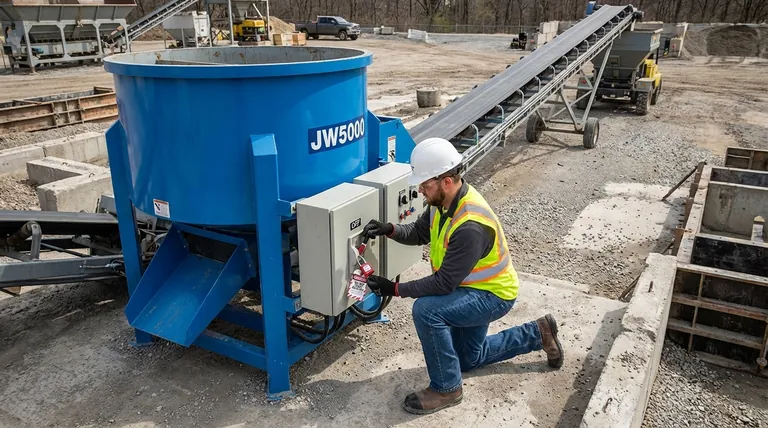
To safely maintain a concrete mixer or conveyor belt, you must implement a multi-step energy isolation process. This involves disconnecting the main power switch and the specific motor's circuit breaker, physically locking the electrical cabinet, placing a warning sign, pressing the emergency stop on the main console, and engaging any local emergency stops near the equipment.
The core principle of safe maintenance is not just turning the machine off, but creating a series of redundant, verifiable barriers that make an accidental startup impossible while work is being performed.
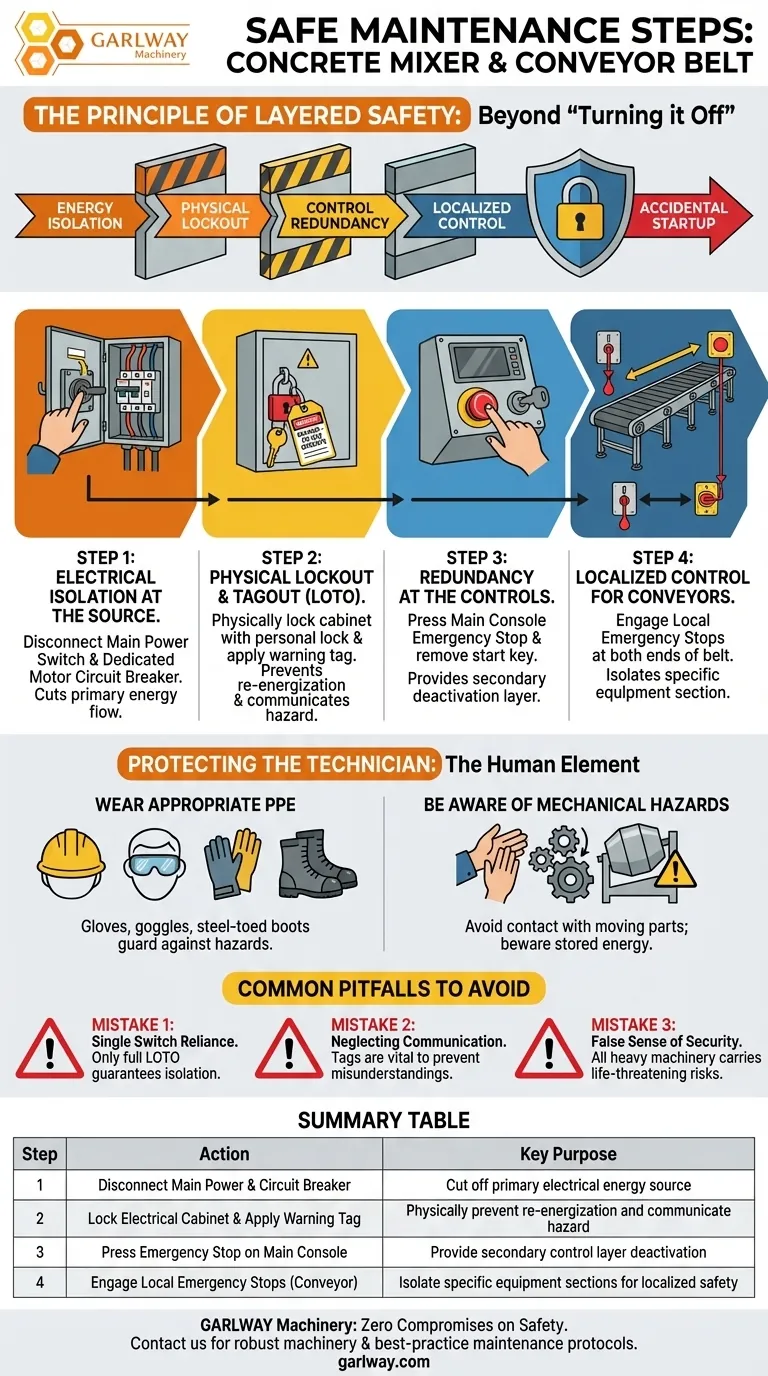
The Principle of Layered Safety: Beyond "Turning it Off"
Effective maintenance safety relies on a system of layered controls. Each step is designed to act as a backup for the others, ensuring that a single point of failure or human error does not lead to a catastrophic accident. This is a professional standard known as a Lockout/Tagout (LOTO) procedure.
Step 1: Electrical Isolation at the Source
The first and most critical step is to completely cut off the flow of electricity. This is done by turning off both the main power switch for the plant area and the dedicated circuit breaker for the motor you are servicing.
This action ensures the primary energy source is definitively severed from the equipment.
Step 2: Physical Lockout and Tagout (LOTO)
After cutting the power, the cabinet door for the switches and breakers must be physically locked. A personal lock, to which only the maintenance technician has the key, should be used.
A warning sign or "tag" must be hung on the lock. This communicates to all other personnel that the equipment is under maintenance and must not be operated. This prevents another worker from unknowingly re-energizing the machine.
Step 3: Redundancy at the Controls
Next, go to the operator's control console. Press the main emergency stop button and, if applicable, remove the start key.
This provides a secondary, visible layer of deactivation at the point of normal operation, reinforcing that the machine is in a safe state.
Step 4: Localized Control for Conveyor Systems
For long machinery like conveyor belts, you must also press the emergency stop switches located at both ends of the belt.
These local switches ensure that even if the main console were somehow activated, the specific piece of equipment remains inoperable. They provide an immediate shutdown point close to the work area.
Protecting the Technician: The Human Element
Isolating the machine's energy is only half of the equation. Protecting the individual performing the work is just as critical.
The Role of Personal Protective Equipment (PPE)
Always wear appropriate protective gear. This includes gloves, safety goggles, and steel-toed boots as a minimum requirement to guard against residual materials, sharp edges, and impact hazards.
Awareness of Mechanical Hazards
Even with the power off, you must remain vigilant. Avoid contact with any moving parts, such as the mixer drum or loading mechanisms, as they can still pose a risk from stored mechanical energy or unexpected movement.
Common Pitfalls to Avoid
A disciplined approach is non-negotiable. Complacency is the primary cause of accidents involving this type of heavy machinery.
Mistake 1: Assuming a Single Switch is Enough
Relying solely on the control console's off button or a single emergency stop is a critical error. Only a full Lockout/Tagout procedure at the main electrical source guarantees isolation.
Mistake 2: Neglecting Communication
The "Tagout" part of the LOTO process is vital. A lock prevents re-energization, but the tag is what communicates your presence and intent to the rest of the team, preventing dangerous misunderstandings.
Mistake 3: A False Sense of Security
Some equipment is described as requiring "minimum maintenance" or being "easy to handle." This never negates the need for strict safety protocols. The potential energy stored in heavy machinery is always a life-threatening hazard, regardless of its design.
Implementing a Robust Safety Protocol
Your approach to maintenance should be systematic and uncompromising. Use the following guidelines to structure your work.
- If your primary focus is preventing accidental startup: The Lockout/Tagout (LOTO) procedure is your most crucial process—disconnecting power at the breaker, applying a personal lock, and tagging it is non-negotiable.
- If your primary focus is ensuring personnel safety during maintenance: Wearing the correct PPE and maintaining constant situational awareness of mechanical pinch points and hazards is your essential duty.
Ultimately, safety is a deliberate system, not a matter of chance.
Summary Table:
| Step | Action | Key Purpose |
|---|---|---|
| 1 | Disconnect Main Power & Circuit Breaker | Cut off primary electrical energy source |
| 2 | Lock Electrical Cabinet & Apply Warning Tag | Physically prevent re-energization and communicate hazard |
| 3 | Press Emergency Stop on Main Console | Provide secondary control layer deactivation |
| 4 | Engage Local Emergency Stops (Conveyor) | Isolate specific equipment sections for localized safety |
Ensure your construction site operates with zero compromises on safety. Proper maintenance is critical for the longevity and reliability of your concrete mixing plant equipment. GARLWAY specializes in providing robust construction machinery, including durable concrete mixers and batching plants designed with safety in mind. Our experts can help you establish best-practice maintenance protocols.
Contact GARLWAY today to discuss how our equipment and support can enhance the safety and efficiency of your operations.
Visual Guide
Related Products
- Construction Products Concrete Plant Machine Mixing Concrete Mixer
- HZS90 Large Multiquip Concrete Mixers for Construction
- HZS120 Ready Mix Concrete Batching Plant Commercial Mud Cement Mixer
- HZS25 Best Cement Mixer for Quick Mix Concrete at Bunnings
- JW1000 Mobile Cement Mixer Concrete Mixer Truck and Batching Plant
People Also Ask
- What factors should be considered when choosing between volumetric and traditional mixers? Optimize Your Concrete Project Strategy
- What is the difference between pan and planetary mixers? Choose the Right Mixer for Your Concrete Project
- When was the first concrete mixer developed and by whom? Discover the 1900 Breakthrough
- What is the average lifespan of a concrete mixer? Maximize Your Equipment's Lifespan & ROI
- What are the two broad types of concrete mixers? Choose the Right Mixer for Your Project