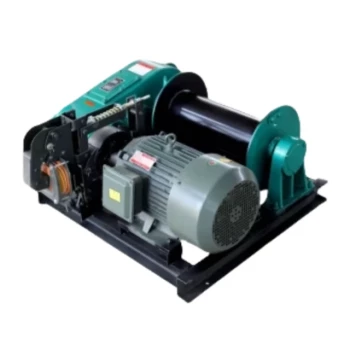
The fundamental safety advantage of an electric hoist is its ability to almost completely remove the physical strain and variability of manual labor from the lifting equation. By replacing human muscle with a controlled electric motor, it directly mitigates the primary causes of workplace lifting injuries, such as musculoskeletal disorders, and dramatically reduces accidents caused by fatigue or human error.
By automating the lifting process, an electric hoist shifts the safety focus from managing the unpredictable limits of human physical endurance to overseeing a reliable, engineered system with built-in safeguards.
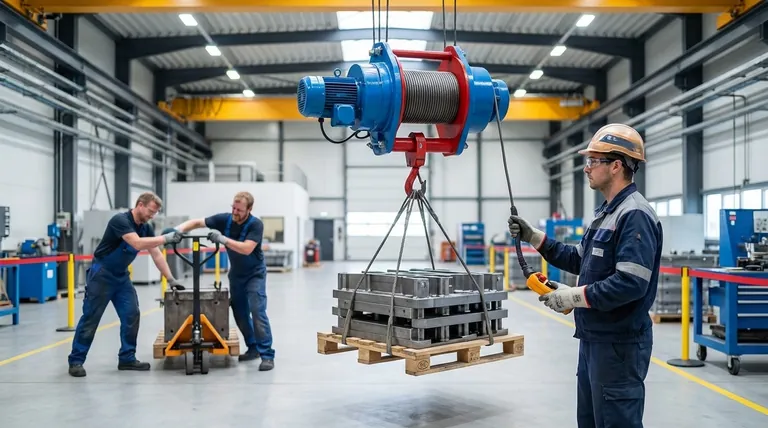
Eliminating the Root Cause of Lifting Injuries
The most immediate safety impact of using an electric hoist comes from preventing the physical toll that manual material handling takes on the human body.
Preventing Musculoskeletal Disorders (MSDs)
Manual lifting is a leading cause of workplace injuries like back sprains, muscle tears, and chronic joint damage. An electric hoist bears the entire load, eliminating the ergonomic risks that lead to these costly and debilitating injuries.
Reducing Cumulative Fatigue
A worker's ability to lift safely diminishes throughout a shift due to physical fatigue. This dramatically increases the likelihood of an accident. An electric hoist provides consistent, unwavering performance from the first lift of the day to the last.
Mitigating the Risk of Sudden Drops
A load can be dropped during a manual lift due to a loss of grip, a sudden muscle spasm, or miscommunication between team members. An electric hoist's mechanical chain or rope provides a secure and reliable hold, preventing such catastrophic failures.
Engineering Safety Through Precision and Control
Beyond simply providing power, electric hoists introduce a level of control and predictability that manual lifting can never match. This engineered precision is a core safety benefit.
Consistent and Predictable Performance
The automation of an electric hoist ensures every lift is smooth and controlled. This removes the inconsistencies of human strength and technique, making the entire operation more predictable and therefore safer.
Precise Load Positioning
Many hoists feature dual-speed configurations, allowing for slow, careful movements when positioning a heavy load. This precision reduces the risk of collisions, property damage, or crushing injuries that can occur during awkward manual placements.
Safe Operation in Constrained Spaces
An electric hoist often has a compact design, allowing it to operate safely in tight spaces. This avoids forcing workers into awkward and dangerous postures when trying to manually maneuver a heavy object in a confined area.
Understanding the Trade-offs and Built-in Safeguards
While electric hoists introduce new maintenance requirements, their inherent design includes critical safeguards that are absent in manual labor.
The Fail-Safe of Overload Protection
A common cause of equipment failure is attempting to lift a load beyond capacity. Most electric hoists have limit switches or overload sensors that prevent this. This is a critical safety check that relies purely on guesswork and estimation in a manual lift.
The Non-Negotiable Emergency Stop
The ability to instantly halt all movement with an emergency stop button provides an immediate and decisive way to prevent an accident. This level of instant control is impossible to coordinate within a team of people performing a manual lift.
The Shift from Physical to Technical Risk
Adopting an electric hoist replaces high-frequency physical risks (strains, sprains) with low-frequency technical risks (mechanical failure). These technical risks, however, are highly manageable through standardized training, regular inspection, and proper maintenance protocols.
Making the Right Choice for Workplace Safety
Choosing to integrate an electric hoist is a strategic decision to engineer a safer and more efficient work environment.
- If your primary focus is reducing worker injuries and compensation claims: An electric hoist directly targets the leading causes of lifting-related MSDs and accidents resulting from physical overexertion.
- If your primary focus is improving operational consistency and reducing errors: The automation of a hoist removes human fatigue from the equation, ensuring every lift is performed with the same controlled power and precision.
- If your primary focus is handling heavy or awkward loads: An electric hoist provides the necessary power combined with built-in safeguards like overload protection that are impossible to guarantee with manual lifting.
Ultimately, integrating electric hoists is a decisive shift from relying on human endurance to leveraging engineered safety.
Summary Table:
| Safety Advantage | Key Benefit |
|---|---|
| Eliminates Physical Strain | Prevents musculoskeletal disorders (MSDs) and fatigue-related accidents |
| Ensures Consistent Performance | Removes human error and variability for predictable lifts |
| Provides Precision Control | Dual-speed options for safe, accurate load positioning |
| Includes Built-in Safeguards | Overload protection and emergency stop features prevent failures |
Upgrade your worksite safety with GARLWAY electric hoists. As a specialist in construction machinery, we provide robust and reliable hoists designed to protect your team from lifting injuries and boost productivity. Whether you're a contractor or a large construction company, our solutions ensure consistent, safe operations. Contact GARLWAY today to explore our range of winches, concrete mixers, and batching plants tailored for your global projects.
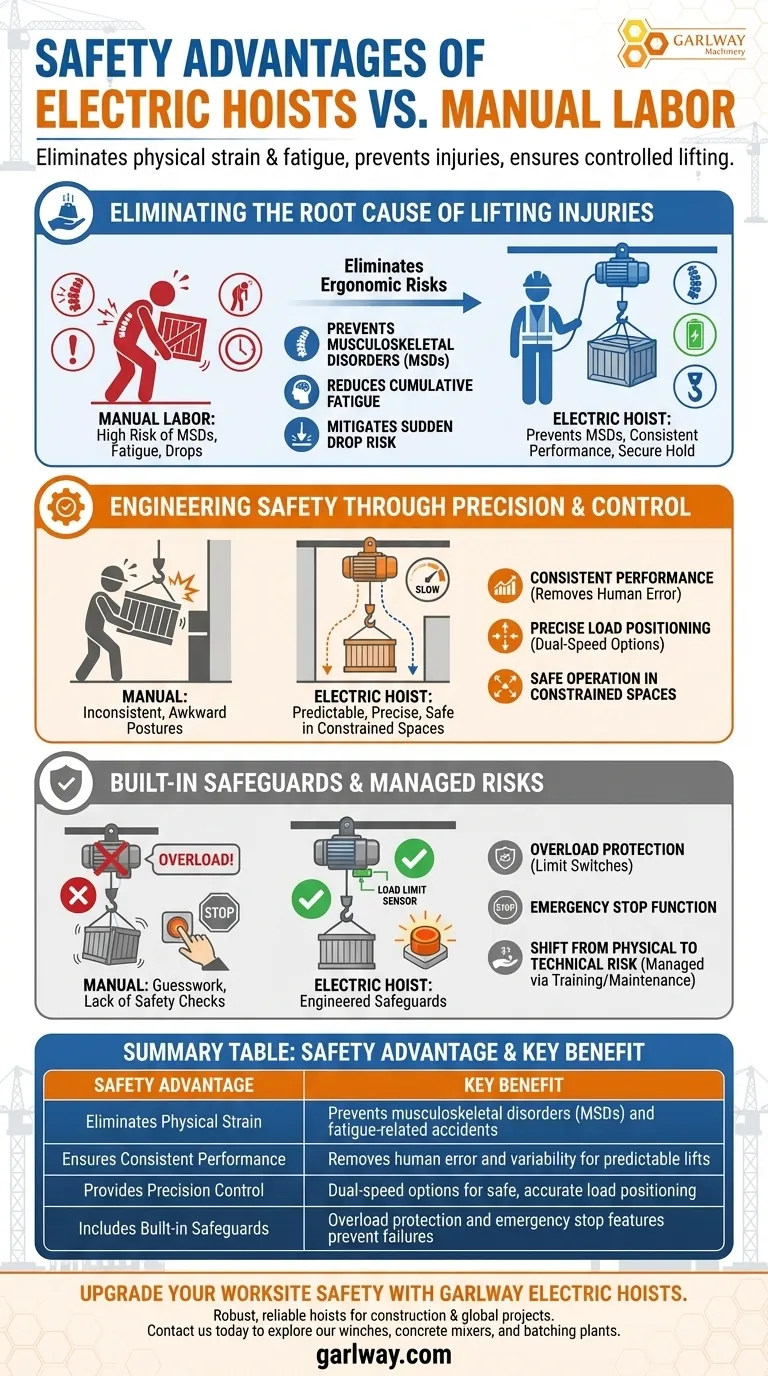
Visual Guide
Related Products
- Electric Hoist Winch Boat Anchor Windlass for Marine Applications
- Electric and Hydraulic Winch for Heavy Duty Applications
- Hydraulic Winding Engine Harbor Freight Winch
- Heavy Duty Electric Boat Winch Windlass Anchor
- 12000 lb Electric Boat Trailer Winch with Windlass Anchor Warn
People Also Ask
- How does an electric anchor winch work? Power, Safety, and Reliable Operation Explained
- What are the advantages of installing an electric anchor winch on a boat? Boost Safety & Ease for Boaters
- What are the operational differences between electric hoists and winches? A Guide to Safe Lifting vs. Pulling
- What are the main benefits of a boat anchor winch? Boost Safety & Efficiency for Your Vessel
- How does a boat anchor winch work? A Guide to Reliable Anchor Handling