
The defining feature of a planetary mixer is its unique mixing action, where one or more agitators spin on their own axis while simultaneously orbiting the center of the mixing vessel. This complex motion provides exceptionally thorough coverage and high shear, making it ideal for uniformly blending difficult or demanding materials.
A planetary mixer is engineered to solve one primary problem: eliminating "dead zones" in a mix. Its dual-rotation action ensures that every point within the vessel is contacted, delivering a highly consistent and homogenous product where simpler mixers would fail.
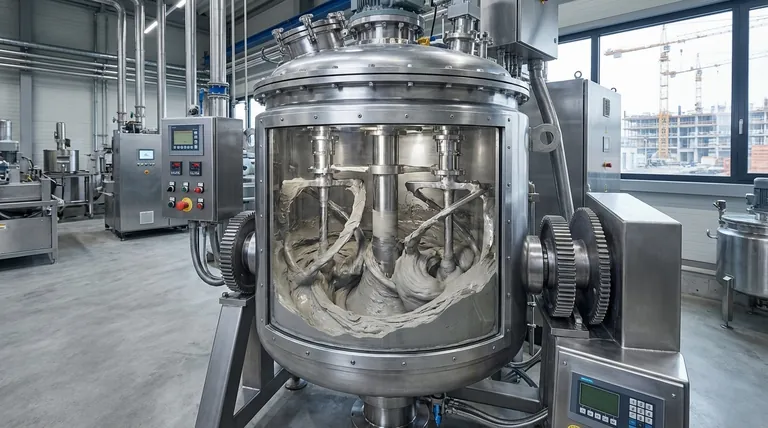
The Mechanics of Planetary Mixing
To understand why a planetary mixer is chosen for specific applications, we must first look at its fundamental design. Unlike simpler mixers that stir from a fixed central point, the planetary action is inherently more comprehensive.
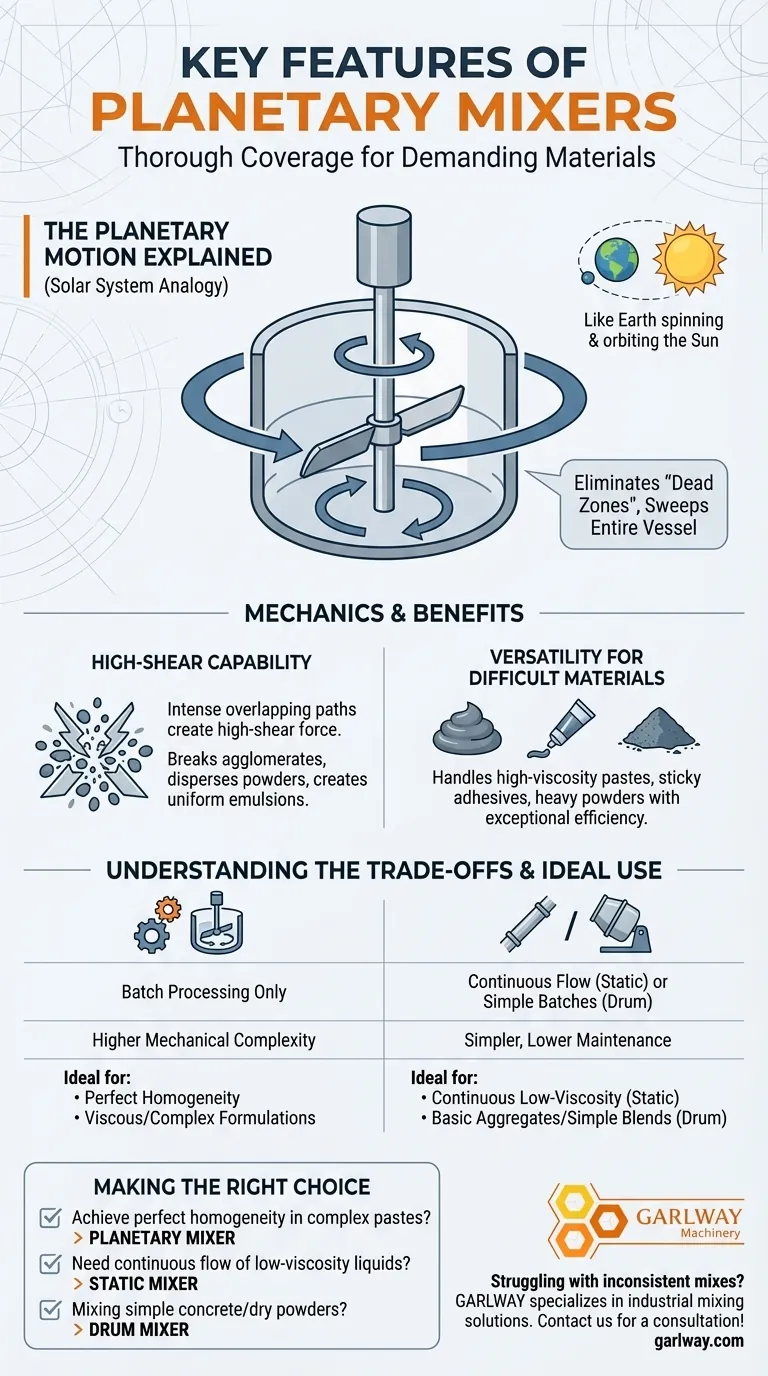
The "Planetary" Motion Explained
The name comes from its resemblance to our solar system. The mixing blade, or agitator, rotates on its own axis (like the Earth spinning) while also traveling in a circular path around the vessel's center (like the Earth orbiting the sun).
This dual-axis motion forces the agitator to sweep the entire circumference of the bowl, including the difficult-to-reach vessel walls, ensuring no material is left unmixed.
High-Shear Capability
The intense, overlapping paths created by the planetary motion generate significant high-shear force. This force is critical for breaking down agglomerates, dispersing fine powders into thick liquids, and creating uniform emulsions.
It effectively cuts, smears, and folds the material onto itself, achieving a level of homogeneity that is difficult to attain with other mixing methods.
Versatility for Difficult Materials
This combination of complete coverage and high shear makes planetary mixers uniquely suited for a wide range of challenging materials. They can handle high-viscosity pastes, sticky adhesives, heavy powders, and varying particle sizes with exceptional efficiency.
Understanding the Trade-offs
While powerful, the planetary mixer is a specialized tool, and its advantages come with specific considerations. It is not the optimal choice for every mixing task.
Mechanical Complexity vs. Simplicity
A planetary mixer has more moving parts and a more complex gearbox than a static mixer (which has no moving parts) or a basic drum mixer. This can translate to a higher initial investment and more involved maintenance.
Not for Continuous Flow
Planetary mixers are designed for batch processing, where a specific quantity of material is mixed at one time. For applications requiring a constant, uninterrupted flow of mixed material, a static mixer is the appropriate tool.
Overkill for Simple Blends
For low-viscosity liquids or simple blending of dry materials like concrete, the high-shear action of a planetary mixer is unnecessary. A more straightforward and cost-effective solution, such as a tilting drum mixer, is often a better fit for these tasks.
Making the Right Choice for Your Application
Selecting the correct mixer depends entirely on the material you are processing and your desired outcome.
- If your primary focus is achieving perfect homogeneity in viscous pastes, sealants, or complex formulations: The planetary mixer's high-shear action and complete vessel coverage are non-negotiable.
- If your primary focus is blending low-viscosity liquids in a continuous production line: A static mixer provides an efficient, low-maintenance solution without moving parts.
- If your primary focus is mixing basic aggregates like concrete or simple dry powders for small batches: A drum mixer offers a reliable and economical approach for straightforward tasks.
Ultimately, choosing the right mixer is about matching the tool's capabilities to the unique demands of your material.
Summary Table:
| Key Feature | Benefit | Ideal For |
|---|---|---|
| Planetary Motion (Dual-Axis Rotation) | Eliminates dead zones, ensures complete vessel coverage | Viscous pastes, adhesives, complex formulations |
| High-Shear Capability | Breaks down agglomerates, creates uniform emulsions | Dispersing powders, mixing heavy materials |
| Batch Processing Design | Precise control over each mix cycle | Small to medium batch production |
| Versatility | Handles a wide range of difficult materials | Sealants, chemicals, food products |
Struggling with inconsistent mixes or difficult materials? GARLWAY specializes in industrial mixing solutions for construction companies and contractors globally. Our expertise in machinery like planetary mixers, winches, and concrete batching plants ensures you get the right equipment for your specific material challenges. Let our engineers help you achieve perfect homogeneity and boost your production efficiency. Contact GARLWAY today for a personalized consultation and quote!
Visual Guide
Related Products
- JS1000 Volumetric Concrete Mortar Mixer for Sale Skid Steer Cement Mixer
- Portable Ready Mix Concrete Mixer Equipment
- Portable Cement Mixer with Lift Concrete Machine
- Portable Concrete Mixer Machine Equipment for Mixing Concrete
- Harbor Freight JS1500 On Site Concrete Mixing Volumetric Cement Mixer
People Also Ask
- What is the basic working principle of volumetric concrete mixers? On-Demand Mixing for Zero Waste
- What are the advantages of using volumetric mixers for small concrete jobs? Save Costs and Gain On-Site Control
- What are the advantages of volumetric concrete mixers compared to drum mixers? Achieve On-Demand Mixing & Zero Waste
- What are some innovations in volumetric concrete mixers? Boost Efficiency with On-Demand Production
- Why do volumetric mixers provide better ROI? Maximize Profit with On-Demand Concrete Production


