
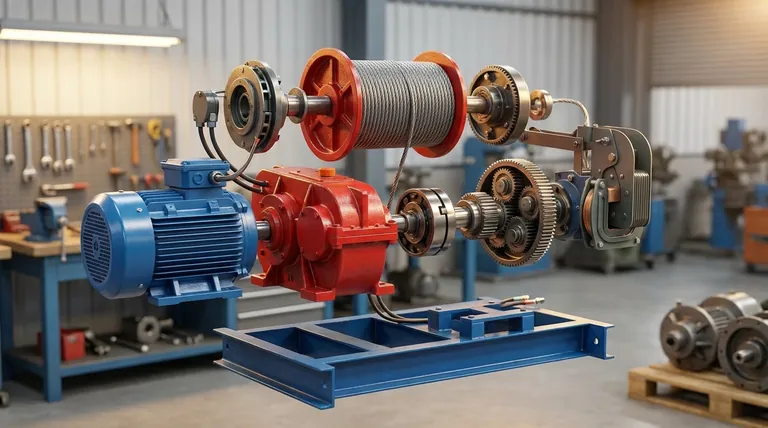
At its core, an electric winch is a system designed to convert electrical energy into immense pulling force. The key components that work together to achieve this are the electric motor, a gear train (or gearbox), a cable-wound drum, a braking system, and a clutch. These elements are all mounted on a sturdy frame to form a single, powerful unit.
A winch is best understood not as a collection of parts, but as a system of force multiplication. It strategically transforms the high-speed, low-power rotation from an electric motor into the low-speed, high-torque force necessary to pull or lift thousands of pounds.
The Powertrain: From Electricity to Torque
The primary function of a winch is to create torque. This process begins with the electric motor and is amplified significantly by the gear train.
The Electric Motor: The Heart of the System
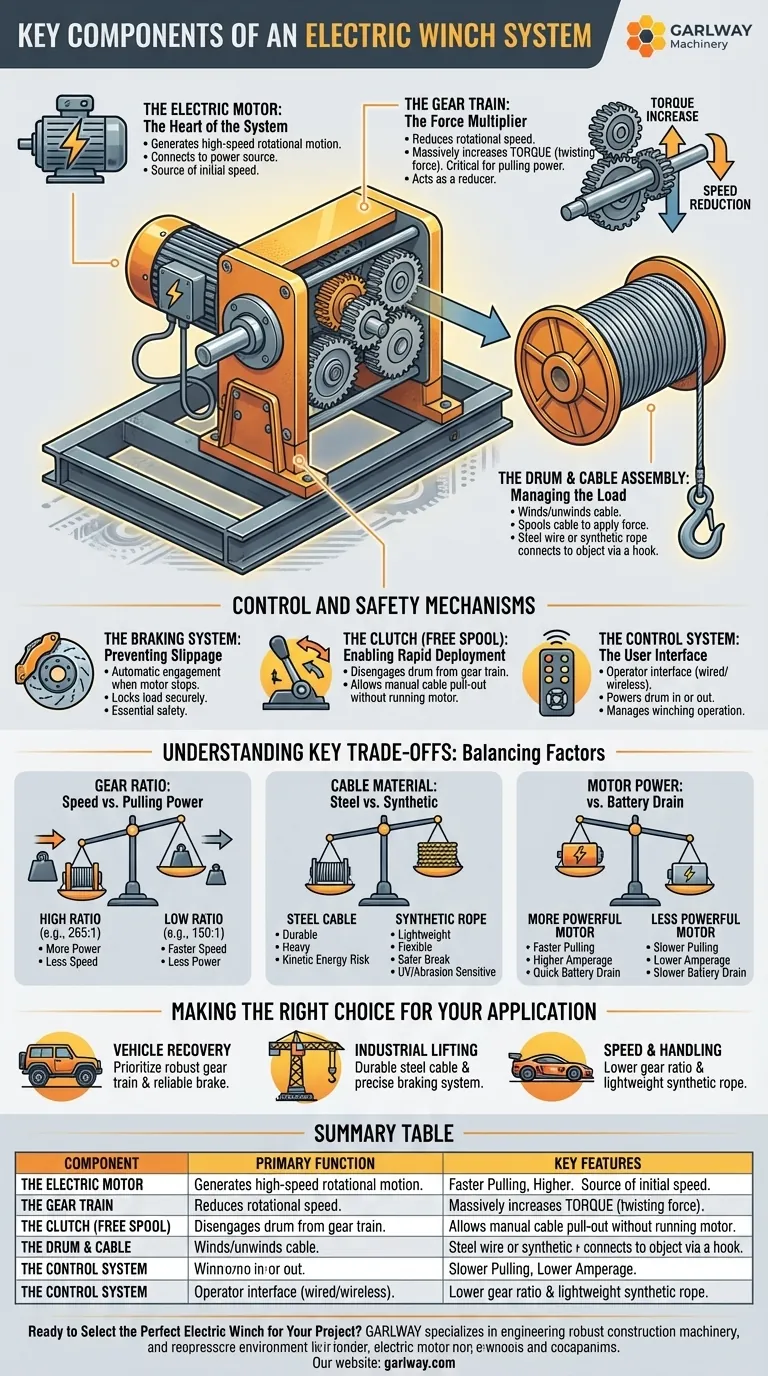
The electric motor is the source of power. It connects to a vehicle's battery or another power source and generates high-speed rotational motion when activated.
The motor's power is a key factor, but it does not produce the final pulling force on its own. Its job is to provide the initial speed that the rest of the system will convert into power.
The Gear Train: The Force Multiplier
This is arguably the most critical component for generating pulling power. The gear train, often a planetary gear system, sits between the motor and the drum.
Its purpose is to act as a reducer. It takes the high-speed output from the motor and, through a series of gears, reduces the rotational speed dramatically. This reduction in speed results in a massive increase in torque, which is the twisting force that gives the winch its strength.
The Spooling Assembly: Managing the Load
Once the torque is generated, it must be applied to a cable in a controlled manner to perform work. This is the role of the drum and cable assembly.
The Drum: Winding and Unwinding
The drum is the cylinder onto which the winch cable is wound. The gear train turns this drum, causing it to spool the cable in or out.
The size of the drum influences both the length of cable it can hold and the winch's line speed.
The Cable and Hook: The Point of Connection
The cable, made of either steel wire or lighter synthetic rope, is the component that attaches to the object being pulled. A heavy-duty hook is fastened to the end of the cable.
Control and Safety Mechanisms
Power is useless without control and safety. Several components ensure the winch operates predictably and securely, especially under heavy load.
The Braking System: Preventing Slippage
An automatic brake is a crucial safety feature. It engages the moment the motor stops, preventing the drum from unwinding and releasing the load.
This ensures that if power is cut or the operator stops pulling, the load remains securely held in place.
The Clutch (Free Spool): Enabling Rapid Deployment
The clutch allows the operator to disengage the drum from the gear train. This is known as "free spooling."
It enables the user to quickly and easily pull the cable out by hand to attach it to a load, without having to run the motor in reverse.
The Control System: The User Interface
This system, often a wired or wireless remote, is what the operator uses to activate the motor. It provides simple controls to power the drum in or out, managing the entire winching operation.
Understanding the Key Trade-offs
Selecting a winch involves balancing competing design factors. Understanding these trade-offs is essential for choosing the right tool for the job.
Gear Ratio: Speed vs. Pulling Power
A winch with a high gear ratio (e.g., 265:1) will pull very slowly but with enormous power. A winch with a low gear ratio (e.g., 150:1) will have a much faster line speed but less raw pulling force.
Steel Cable vs. Synthetic Rope
Steel cable is extremely durable and resistant to abrasion but is heavy, can develop sharp burrs, and stores dangerous amounts of kinetic energy if it snaps.
Synthetic rope is lightweight, flexible, and safer if it breaks. However, it is more susceptible to abrasion and degradation from UV light and chemicals.
Motor Power vs. Battery Drain
A more powerful motor can pull a load faster and with less strain, but it will also draw significantly more amperage from your vehicle's electrical system. This can drain a battery quickly during a long, difficult pull.
Making the Right Choice for Your Application
Your intended use should dictate which components you prioritize.
- If your primary focus is vehicle recovery: Prioritize a robust planetary gear train for maximum torque and a reliable automatic brake for safety on uneven terrain.
- If your primary focus is intermittent industrial lifting: A durable steel cable and a precise electromagnetic braking system are critical for control and longevity.
- If your primary focus is speed and ease of handling: A winch with a lower gear ratio and a lightweight synthetic rope offers the best combination for rapid deployment and retrieval.
Understanding how these components interact is the first step toward selecting and operating a winch with both confidence and safety.
Summary Table:
| Component | Primary Function | Key Feature |
|---|---|---|
| Electric Motor | Generates initial rotational power | Connects to vehicle battery/power source |
| Gear Train (Planetary) | Multiplies torque, reduces speed | Critical for generating pulling force |
| Drum & Cable | Spools cable to apply force | Holds steel wire or synthetic rope |
| Braking System | Locks load when motor stops | Automatic engagement for safety |
| Clutch | Disengages drum for free spooling | Enables rapid cable deployment |
| Control System | Operator interface for winch control | Wired or wireless remote |
Ready to Select the Perfect Electric Winch for Your Project?
Understanding the components is the first step. Choosing the right winch for your specific needs—whether for rugged vehicle recovery or precise industrial lifting—is what ensures success and safety.
GARLWAY specializes in engineering robust construction machinery, including a full range of electric winches, concrete mixers, and batching plants for construction companies and contractors worldwide. We can help you navigate the trade-offs between power, speed, and durability to find the ideal solution for your application.
Let our experts guide you to the right equipment. Contact GARLWAY today for a consultation and discover the reliability and power our winches can bring to your operations.
Visual Guide
Related Products
- Electric 120V Boat Winch by Badlands
- Electric and Hydraulic Winch for Heavy Duty Applications
- Small Electric Winch 120V and 240V for Compact Applications
- 12000 lb Electric Boat Trailer Winch with Windlass Anchor Warn
- Electric Hoist Winch Boat Anchor Windlass for Marine Applications
People Also Ask
- How do electric boat winches work? Unlock Effortless Launching & Retrieval
- How much current does an electric boat winch draw? Plan Your Electrical System for Peak Performance
- Can I run a winch straight from a battery? Essential Power Setup for Safe Operation
- What are the types of electric winches available? Choose the Right Winch for Your Job
- What are the uses of electric winches in mining and tunneling? Enhance Safety and Efficiency Underground





