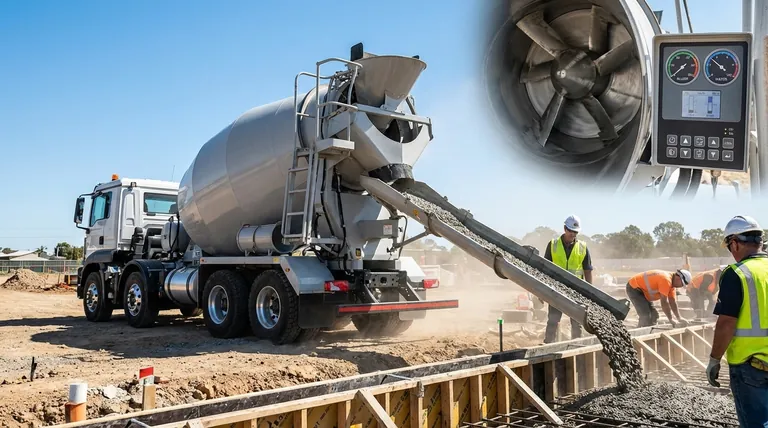
At its core, a truck mixer is a specialized transport vehicle designed to deliver Portland Cement Concrete (PCC) in a ready-to-use state. Its key components include a rotating, inclined drum fitted with internal helical blades, a discharge system with a long chute, and increasingly, onboard systems for monitoring mix consistency.
A truck mixer is not merely a container; it is an active processing machine. Its primary function is to maintain the concrete's workability and quality through agitation or mixing during transit, ensuring it arrives at the construction site within specification.
The Core Anatomy of a Truck Mixer
Understanding the physical components of a truck mixer reveals how it is engineered to handle a perishable and heavy material like concrete.
The Mixing Drum
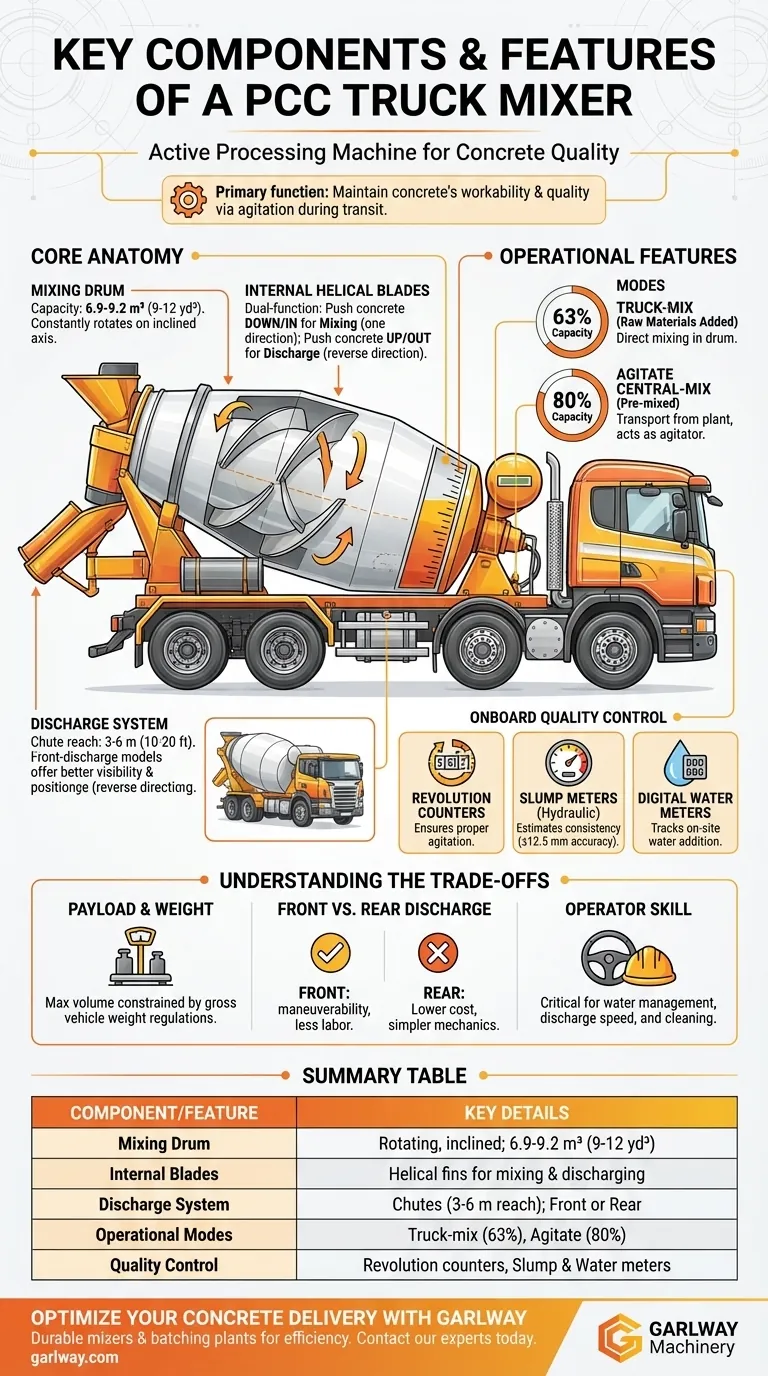
The most prominent feature is the truck-mounted drum, which constantly rotates on an inclined axis.
Typical drum volumes range from 6.9 to 9.2 cubic meters (approximately 9 to 12 cubic yards), with the maximum size being constrained by the vehicle's gross weight limits.
Internal Helical Blades
Inside the drum, a set of helical blades, or fins, is welded to the interior wall. These blades are the key to the mixer's dual-function design.
When the drum rotates in one direction, the blades push the concrete downward and inward, creating a continuous mixing or agitating action. Reversing the rotation causes the blades to push the concrete outward and up, facilitating a controlled discharge.
The Discharge System
The discharge system allows for the precise placement of concrete. It consists primarily of a set of chutes, which can typically extend 3 to 6 meters (10 to 20 feet) from the truck.
While most mixers discharge from the rear, front-discharging models are gaining popularity. They offer the driver better visibility and control, allowing for easier positioning of the chute without needing a separate spotter.
Operational Features and Constraints
Beyond its physical parts, a truck mixer's operational features are critical for ensuring the quality of the final product.
Mixing vs. Agitating
A truck mixer can be used in two distinct modes, which dictates its carrying capacity.
When used to truck-mix PCC (where materials are added directly into the drum for mixing), the drum can only be filled to 63 percent of its total volume to allow for proper mixing action.
For transporting central-mixed PCC (where concrete is fully mixed at a plant before loading), the truck acts as an agitator. In this mode, the drum can be filled up to 80 percent of its volume.
Onboard Quality Control
Modern mixers often include technology to monitor the concrete's properties during transit.
Many units are equipped with drum revolution counters to ensure the mix has been properly agitated. Some feature slump meters, which measure hydraulic pressure to estimate consistency with an accuracy of about 12.5 mm (0.5 inches), and digital water meters to precisely track any water added on-site.
Understanding the Trade-offs
While essential, truck mixers have inherent limitations that must be managed for successful concrete placement.
Payload and Weight Restrictions
The single biggest constraint is gross vehicle weight. The maximum volume of concrete a truck can carry is dictated not just by drum size, but by federal and local road weight regulations.
Front vs. Rear Discharge
Front-discharge mixers provide superior maneuverability and labor efficiency on-site. However, they often come with a higher initial purchase cost and potentially more complex mechanics compared to traditional rear-discharge models.
Reliance on Operator Skill
The quality of the delivered concrete still heavily depends on the driver's expertise. Knowing when to add water (if permitted), how to manage discharge speed, and how to properly clean the drum are all critical skills that technology can only assist, not replace.
Making the Right Choice for Your Goal
Selecting or specifying a truck mixer depends entirely on the priorities of the project.
- If your primary focus is efficiency on tight job sites: A front-discharge mixer is the superior choice for its enhanced maneuverability and reduced labor needs.
- If your primary focus is strict quality control: Specify trucks equipped with slump meters, water meters, and revolution counters to ensure the concrete arrives within specification.
- If your primary focus is maximizing delivery volume from a central plant: Use the truck as an agitator, allowing you to fill the drum to 80% capacity and deliver more concrete per trip.
Ultimately, understanding these components and features allows you to treat the truck mixer as a crucial piece of quality control equipment, not just a delivery vehicle.
Summary Table:
| Component/Feature | Key Details |
|---|---|
| Mixing Drum | Rotating, inclined drum; capacity 6.9-9.2 m³ (9-12 yd³). |
| Internal Blades | Helical fins for mixing (one direction) and discharging (reverse). |
| Discharge System | Chutes for placement; 3-6 m (10-20 ft) reach; front or rear discharge. |
| Operational Modes | Truck-mix (63% capacity) or Agitate central-mix (80% capacity). |
| Quality Control | Revolution counters, slump meters, and digital water meters. |
Optimize Your Concrete Delivery with GARLWAY
Are you a construction company or contractor looking to maximize efficiency and ensure the highest quality concrete on your projects? The right truck mixer is critical. GARLWAY specializes in construction machinery, offering durable and advanced equipment like concrete mixers and batching plants designed for reliability and performance.
Let us help you select the perfect mixer for your needs. Contact our experts today to discuss how our solutions can improve your concrete transport and placement, saving you time and money.
Visual Guide
Related Products
- Mini Cement Mortar Mixer Truck for Construction
- Ready Mixer Machine for Construction Ready Mix Machinery
- JW1000 Mobile Cement Mixer Concrete Mixer Truck and Batching Plant
- Harbor Freight JS1500 On Site Concrete Mixing Volumetric Cement Mixer
- Portable Concrete Mixer Machine Equipment for Mixing Concrete
People Also Ask
- Why might mixing mortar in a cement truck be problematic? Avoid Costly Mixing Mistakes
- What are the main types of construction cement mixers available? Choose the Right Mixer for Your Project
- What are the two primary methods for filling a cement mixer truck? Central vs. Transit Mix Explained
- What are the common uses of cement mixer trucks? Boosting Construction Efficiency and Quality
- What are the primary methods to fill a cement mixer truck? Central Mix vs. Transit Mix Explained