
At its core, a twin-shaft mixer is a high-capacity machine defined by its dual-shaft design engineered for rapid, compulsory mixing. This makes it the industry standard for large infrastructure projects like bridges and tunnels, where the quick and consistent production of high-volume, high-quality concrete is non-negotiable.
While twin-shaft mixers offer unmatched speed and consistency for demanding, high-volume concrete production, this performance is balanced by higher power consumption and more complex maintenance requirements compared to simpler designs.
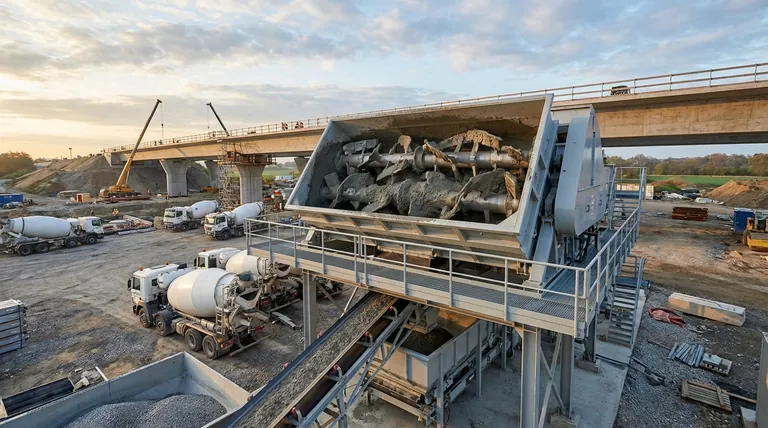
The Core Principle: How Twin-Shaft Mixers Work
A twin-shaft mixer's effectiveness comes from its fundamental design, which creates a highly energetic and efficient mixing environment. Understanding this principle is key to appreciating its applications.
The Dual-Shaft Advantage
The mixer contains two parallel, counter-rotating shafts fitted with paddles. This synchronized movement forces material from the ends of the mixer toward the center and circulates it aggressively.
This process creates a compulsory mixing action, ensuring that every particle of aggregate is thoroughly coated with cement paste in a very short amount of time.
Creating a High-Intensity Zone
The overlapping paths of the mixing paddles create a turbulent, three-dimensional flow within the mixing drum. This "high-intensity zone" eliminates dead spots and guarantees a homogenous, high-quality concrete batch after batch.
Key Features and System Variations
While the dual-shaft principle is constant, these mixers can be configured with different systems to match specific operational needs.
Feeding Methods: Hopper vs. Belt
A hopper-fed system is suited for batch-style operations where materials are loaded one complete set at a time.
A belt-fed system, by contrast, allows for a continuous flow of materials into the mixer, making it ideal for plants that require uninterrupted production.
Discharge Mechanisms
Discharging methods can be manual, pneumatic, or hydraulic. Hydraulic and pneumatic gates offer faster and more automated discharge cycles, which is critical in high-output environments.
Lubrication Systems
Lubrication can be manual or automatic. While manual systems are simpler, an automatic lubrication system significantly reduces daily maintenance efforts and helps prevent premature wear on critical components like shaft seals.
Primary Applications: Where Speed and Volume Matter
The unique capabilities of twin-shaft mixers make them indispensable in specific sectors of the construction and materials industry.
Major Infrastructure Projects
For projects like dams, airports, tunnels, and bridges, contractors require massive volumes of concrete poured continuously. The twin-shaft mixer's speed and reliability are essential to meet these demanding schedules.
Precast Concrete Production
The precast industry depends on absolute consistency to produce identical structural elements. The intense mixing action ensures uniform strength, color, and texture across every product, from beams to wall panels.
High-Performance and Specialized Concrete
Modern concrete often includes various admixtures that require perfect dispersion to be effective. The compulsory mixing of a twin-shaft design is superior for thoroughly blending these specialized, and often costly, ingredients.
Understanding the Trade-offs
The high performance of a twin-shaft mixer comes with specific operational considerations that must be factored into any decision.
Increased Power Consumption
Driving two heavily loaded shafts through dense material requires significant energy. Consequently, these mixers consume more power than single-shaft or drum mixers of a similar capacity.
Complex Mechanical Design
The dual-shaft system, with its synchronized gearboxes and multiple shaft seals, is inherently more complex than other mixer types. This complexity adds to the initial investment cost.
Higher Maintenance Demands
A more complex design translates directly to higher maintenance needs. Regular inspection and servicing of seals, bearings, and gearboxes are critical to prevent costly downtime and ensure a long operational life.
Making the Right Choice for Your Project
Selecting the right mixer is a strategic decision based on your project's core priorities.
- If your primary focus is maximum output and speed: A twin-shaft mixer with belt feeding and a hydraulic discharge gate is the definitive choice for continuous, high-volume production.
- If your primary focus is consistent quality for specialized mixes: The compulsory mixing action of a twin-shaft mixer provides the superior homogenization required for high-performance or architectural concrete.
- If your primary focus is minimizing operational costs: You must carefully weigh the mixer's higher power and maintenance demands against the undeniable benefits of its production speed and quality.
Ultimately, choosing a twin-shaft mixer is a decision to prioritize production volume and consistency, provided you are prepared to support its operational requirements.
Summary Table:
| Feature | Benefit | Ideal For |
|---|---|---|
| Dual-Shaft Design | Rapid, compulsory mixing for superior homogeneity | High-volume, consistent concrete production |
| High-Intensity Mixing Zone | Eliminates dead spots, ensures batch-to-batch uniformity | Precast concrete, high-performance mixes |
| Configurable Feeding/Discharge | Hopper or belt feeding; manual, pneumatic, or hydraulic discharge | Matching specific plant operational needs |
| Automatic Lubrication | Reduces daily maintenance, prevents premature wear | Operations prioritizing uptime and reliability |
Ready to boost your project's efficiency with a high-performance concrete mixer?
GARLWAY specializes in providing robust construction machinery, including advanced twin-shaft mixers, for construction companies and contractors globally. Our solutions are engineered to deliver the speed, consistency, and reliability required for your most demanding infrastructure and precast projects.
Contact our experts today to discuss how a GARLWAY twin-shaft mixer can meet your specific production goals and drive your success.
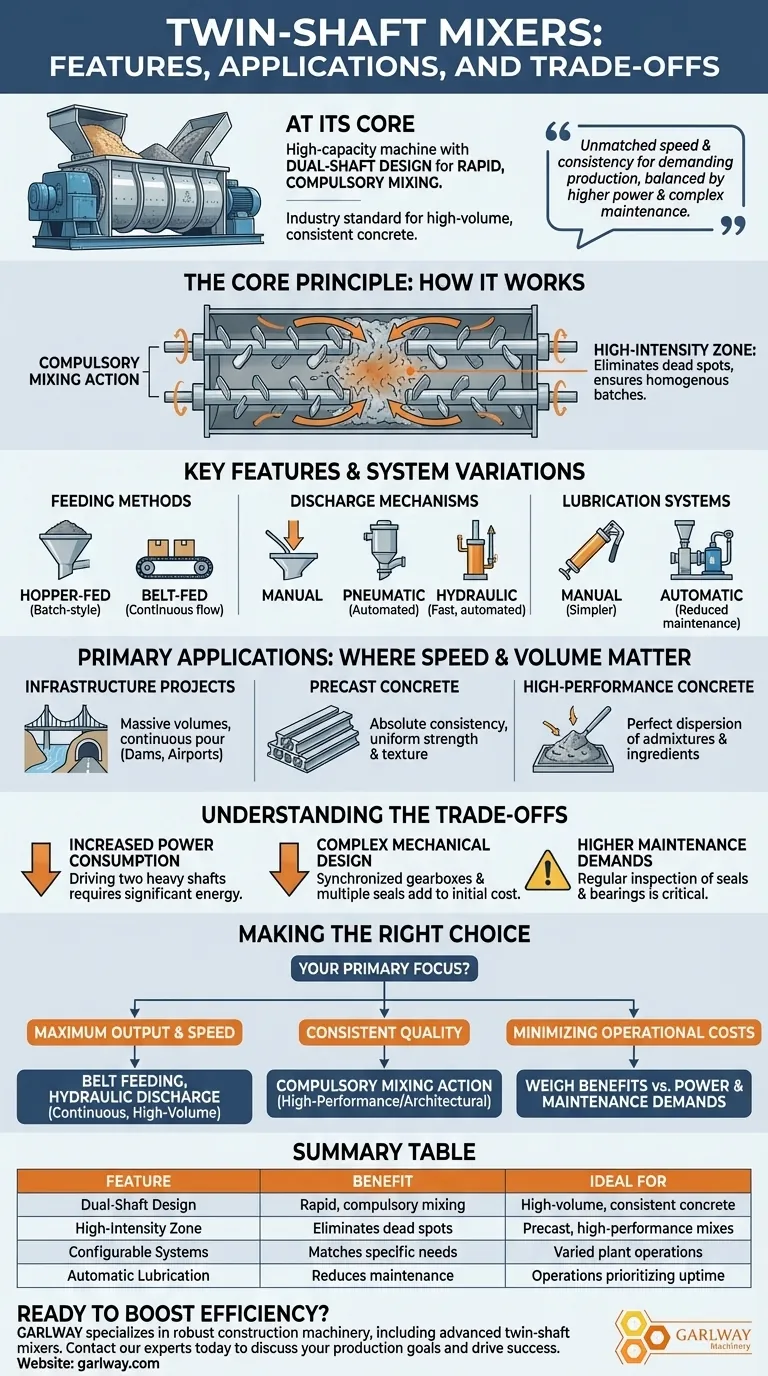
Visual Guide
Related Products
- JS500 Electric Cement Concrete Mixer for Sale
- Shaft Mixer Machine for Cement and Regular Concrete Mixing
- Portable Cement Mixer with Lift Concrete Machine
- HZS90 Large Multiquip Concrete Mixers for Construction
- HZS25 Best Cement Mixer for Quick Mix Concrete at Bunnings
People Also Ask
- What are the benefits of electric concrete mixers? Quiet, Clean, and Low-Maintenance Mixing
- What are the four factors to consider when selecting a concrete mixer? Optimize Your Construction Project
- What are the two main types of concrete mixers and their uses? Choose the Right Mixer for Your Project
- What is a concrete mixer used for? Achieve Consistent, High-Quality Concrete
- How can a concrete mixer be used to remove rust from metal parts? A Powerful, Large-Scale Cleaning Method





