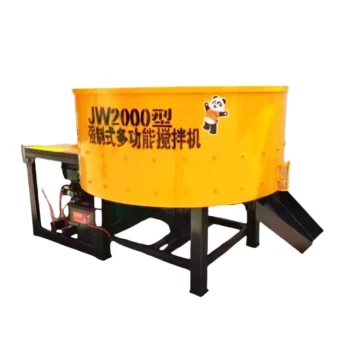
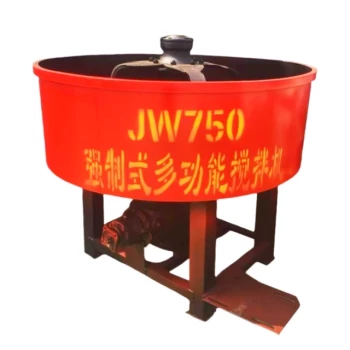
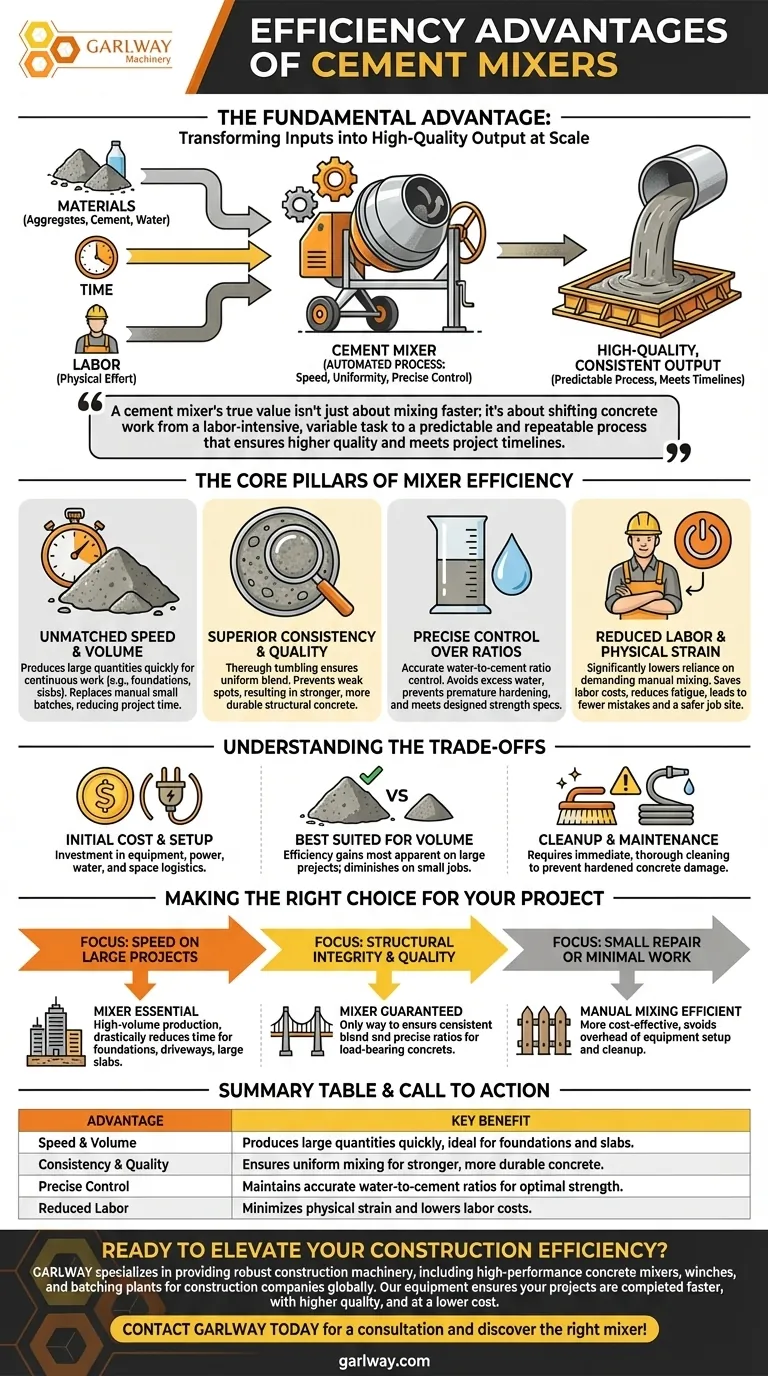
The fundamental efficiency advantage of a cement mixer is its ability to transform the key inputs of a project—materials, time, and labor—into a high-quality, consistent output at scale. A mixer automates the most physically demanding and critical step of concrete production, ensuring speed, uniformity, and precise control that manual methods cannot replicate.
A cement mixer's true value isn't just about mixing faster; it's about shifting concrete work from a labor-intensive, variable task to a predictable and repeatable process that ensures higher quality and meets project timelines.
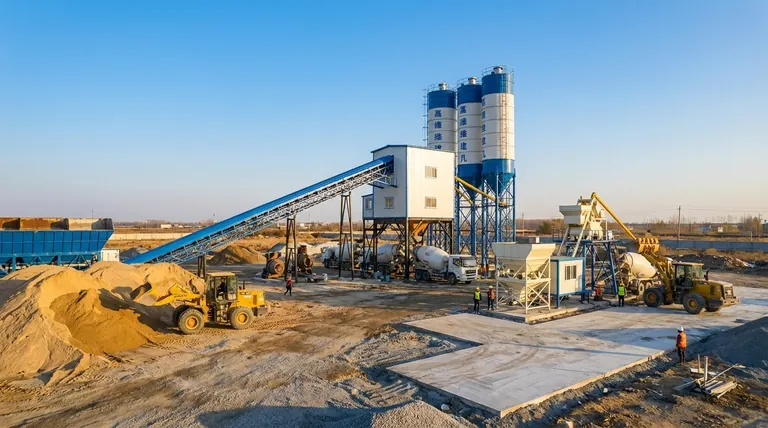
The Core Pillars of Mixer Efficiency
The advantages of a cement mixer extend beyond simple speed. They impact the project's quality, cost, and physical demands from start to finish.
Unmatched Speed and Volume
A primary benefit is the ability to produce a large volume of concrete quickly. This is crucial for projects like pouring foundations, slabs, or sidewalks where continuous work is necessary.
Instead of mixing small batches by hand, a mixer can produce a consistent supply, allowing for faster completion of the work and reducing overall project time.
Superior Consistency and Quality
Manual mixing often results in an uneven blend, creating weak spots with too much water or unmixed aggregate. A cement mixer's tumbling action ensures all components are thoroughly integrated.
This consistent mixing is directly linked to higher-quality concrete. The resulting product has uniform strength and durability, which is critical for any structural application.
Precise Control Over Ratios
The strength of concrete is highly dependent on the water-to-cement ratio. A mixer allows for much better control over the addition of materials, helping to avoid the common mistake of adding too much water.
This precision prevents issues like premature hardening and ensures the final concrete meets its designed strength specifications.
Reduced Labor and Physical Strain
Manually mixing concrete is one of the most physically demanding tasks in construction. A mixer significantly reduces this reliance on manual labor.
This not only saves on labor costs but also reduces worker fatigue, which can lead to fewer mistakes and a safer job site.
Understanding the Trade-offs
While highly efficient for many applications, a cement mixer is not always the best tool for every job. Understanding its limitations is key to making a sound decision.
Initial Cost and Setup
Mechanical mixers represent an initial investment in equipment. They also require a power source, a water supply, and space to operate, adding a layer of logistical planning.
Best Suited for Volume
The efficiency gains of a mixer are most apparent on projects requiring a significant amount of concrete. Its benefits diminish on very small jobs.
For a minor repair or setting a single fence post, the time spent on setup and cleanup can outweigh the time saved during mixing. Manual mixing in a wheelbarrow is often more practical for these tasks.
Cleanup and Maintenance
A cement mixer must be cleaned thoroughly and immediately after use. Hardened concrete can quickly ruin the machine, making proper maintenance a critical, non-negotiable step.
Making the Right Choice for Your Project
Selecting the right mixing method comes down to the specific demands and scale of your work.
- If your primary focus is speed on a large project: A mixer is essential for high-volume production, drastically reducing the time required for pouring foundations, driveways, or large slabs.
- If your primary focus is structural integrity and quality: A mixer is the only way to guarantee the consistent blend and precise ratios needed for strong, durable, load-bearing concrete.
- If your primary focus is a small repair or minimal concrete work: Manual mixing is often the more efficient and cost-effective solution, avoiding the overhead of equipment setup and cleanup.
Choosing the right tool for the job is the foundation of efficient and high-quality construction.
Summary Table:
| Advantage | Key Benefit |
|---|---|
| Speed & Volume | Produces large quantities quickly, ideal for foundations and slabs. |
| Consistency & Quality | Ensures uniform mixing for stronger, more durable concrete. |
| Precise Control | Maintains accurate water-to-cement ratios for optimal strength. |
| Reduced Labor | Minimizes physical strain and lowers labor costs. |
Ready to elevate your construction efficiency?
GARLWAY specializes in providing robust construction machinery, including high-performance concrete mixers, winches, and batching plants designed for construction companies and contractors globally. Our equipment ensures your projects are completed faster, with higher quality, and at a lower cost.
Contact GARLWAY today for a consultation and discover the right mixer to meet your project's specific demands!
Visual Guide
Related Products
- HZS25 Best Cement Mixer for Quick Mix Concrete at Bunnings
- JDC350 Small Cement Concrete Mortar Mixer
- JW1000 Mobile Cement Mixer Concrete Mixer Truck and Batching Plant
- JZC400 Mobile Small Concrete Mixer Cement Mixer Machine
- Concrete Cement Mixer Machine Drum Mixer for Construction
People Also Ask
- How do cement mixers enhance safety on construction sites? Reduce Strain, Hazards, and Accidents
- What are the main components of a cement mixer? A Guide to Core Parts & Functions
- What are some tips for using a cement mixer effectively? Maximize Your Mixer's Performance & Concrete Quality
- How does cleaning a cement mixer after use benefit its performance? Maximize Lifespan and Mix Quality
- Why is it important to clean the cement mixer after use? Prevent Costly Damage and Ensure Quality Concrete