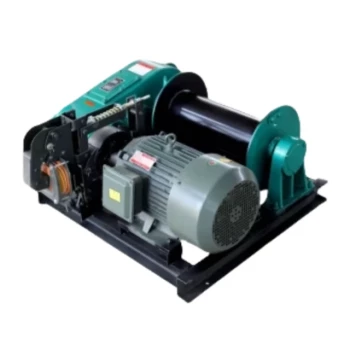
At its core, a winch is categorized by its power source. The three primary types are manual, electric, and hydraulic. Beyond this fundamental classification, winches are further specialized by their intended application, leading to more specific categories like utility, industrial, or hoist winches.
The most critical decision is not simply choosing a "type" of winch, but matching its power source and design to the demands of your task. This involves balancing power, speed, portability, and how long the winch can operate without interruption.
The Core Categories: Power Source
The engine of the winch—its power source—is the most fundamental distinction. It dictates the winch's performance, complexity, and ideal use case.
Manual Winches
Manual winches are the simplest form, operated by a hand crank. They require no external power source, relying entirely on physical effort.
They are ideal for light-duty, infrequent jobs where portability is key and access to power is limited. Their primary limitation is their low pulling capacity and slow speed.
Electric Winches
Electric winches are the most common and versatile type available today. They are typically powered by a vehicle's DC battery or, for stationary models, an AC electrical outlet.
These winches offer an excellent balance of power, speed, and user convenience, making them the standard for off-road vehicles, trailers, and general utility work. Their main constraint is the duty cycle—they generate significant heat and require cool-down periods to prevent motor damage.
Hydraulic Winches
Hydraulic winches tap into a vehicle's power steering pump or a dedicated hydraulic system for power. This design makes them exceptionally durable and powerful.
Their key advantage is the ability to pull for very long periods without overheating, making them the preferred choice for heavy industrial, commercial, and recovery applications where continuous operation is essential. However, they are generally slower than electric winches and require a more complex installation.
Classification by Application
While the power source is the core technical difference, winches are also categorized by the job they are built to do. These application-specific designs often use one of the power sources above.
Utility Winches
This is the most recognizable category, encompassing the electric winches commonly mounted on the front of trucks, Jeeps, and other off-road vehicles for self-recovery.
ATV/UTV & Trailer Winches
These are essentially scaled-down versions of utility winches. They are lighter-duty electric models designed for the smaller power systems and lower weight requirements of ATVs, UTVs, and car trailers.
Hoist Winches
A critical distinction: standard winches are designed for pulling a load horizontally, while hoists are specifically engineered and rated for lifting a load vertically. Hoists incorporate specialized braking systems for safety when suspending a load.
Industrial Winches
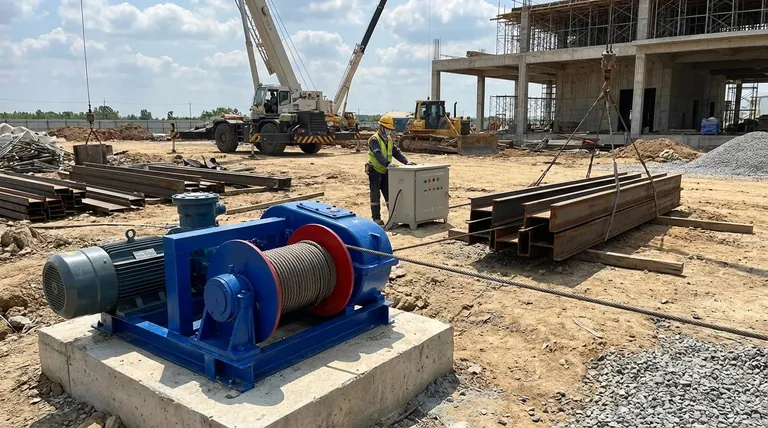
These are heavy-duty winches built for constant, demanding work in commercial settings. They are often hydraulic or powerful three-phase AC electric models and are designed for maximum durability and pulling capacity in fixed locations.
Portable Winches
Portable winches are lightweight, self-contained electric units. They are not permanently mounted, allowing for flexible use in various situations, such as light vehicle recovery or pulling logs, where a fixed winch is not practical.
Understanding the Trade-offs
Choosing a winch involves weighing its capabilities against your specific needs. No single type is universally superior.
Power vs. Duty Cycle
An electric winch may offer faster line speed, but it can only work in short bursts before needing to cool down. A hydraulic winch can pull a heavy load continuously, making it the clear choice for sustained industrial operations.
Simplicity vs. Complexity
A manual winch is the simplest tool, requiring no setup beyond anchoring it. Electric winches require proper wiring to a power source, while hydraulic winches demand tapping into the vehicle's hydraulic lines, representing the most complex installation.
Portability vs. Capacity
Generally, as pulling capacity increases, so does the winch's size, weight, and power requirement. A lightweight portable winch is excellent for small jobs, but it cannot match the immense pulling force of a permanently mounted industrial winch.
Selecting the Right Winch for Your Task
Your choice should be guided directly by the primary work you need to accomplish.
- If your primary focus is off-road vehicle recovery: An electric utility winch is the industry standard, offering the best balance of power, speed, and convenience for typical situations.
- If your primary focus is continuous, heavy-duty commercial work: A hydraulic winch is superior due to its unmatched duty cycle and durability under constant load.
- If your primary focus is light, infrequent tasks without a power source: A manual hand winch provides a simple, reliable, and completely portable solution.
- If your primary focus is maximum versatility for smaller jobs: A portable electric winch offers a convenient, non-permanent option for various light-duty pulling needs.
Understanding these core differences ensures you select a tool that is not just capable, but perfectly suited to your specific challenge.
Summary Table:
| Power Source | Best For | Key Characteristics |
|---|---|---|
| Manual | Light-duty, portable tasks | Hand-cranked, no power needed, simple |
| Electric | Off-road vehicles, general utility | Versatile, good power/speed, limited duty cycle |
| Hydraulic | Heavy industrial, continuous use | High power, excellent duty cycle, complex setup |
Ready to Find Your Perfect Winch?
Navigating the different types of winches is the first step. The next is choosing the right model for your specific needs. GARLWAY specializes in providing robust construction machinery solutions, including a full range of winches, concrete mixers, and batching plants for construction companies and contractors worldwide.
Let our experts help you:
- Match the right winch to your vehicle and application.
- Ensure optimal performance with durable, reliable equipment.
- Get the support you need for installation and operation.
Don't leave your projects to chance. Contact GARLWAY today for a personalized consultation and quote!
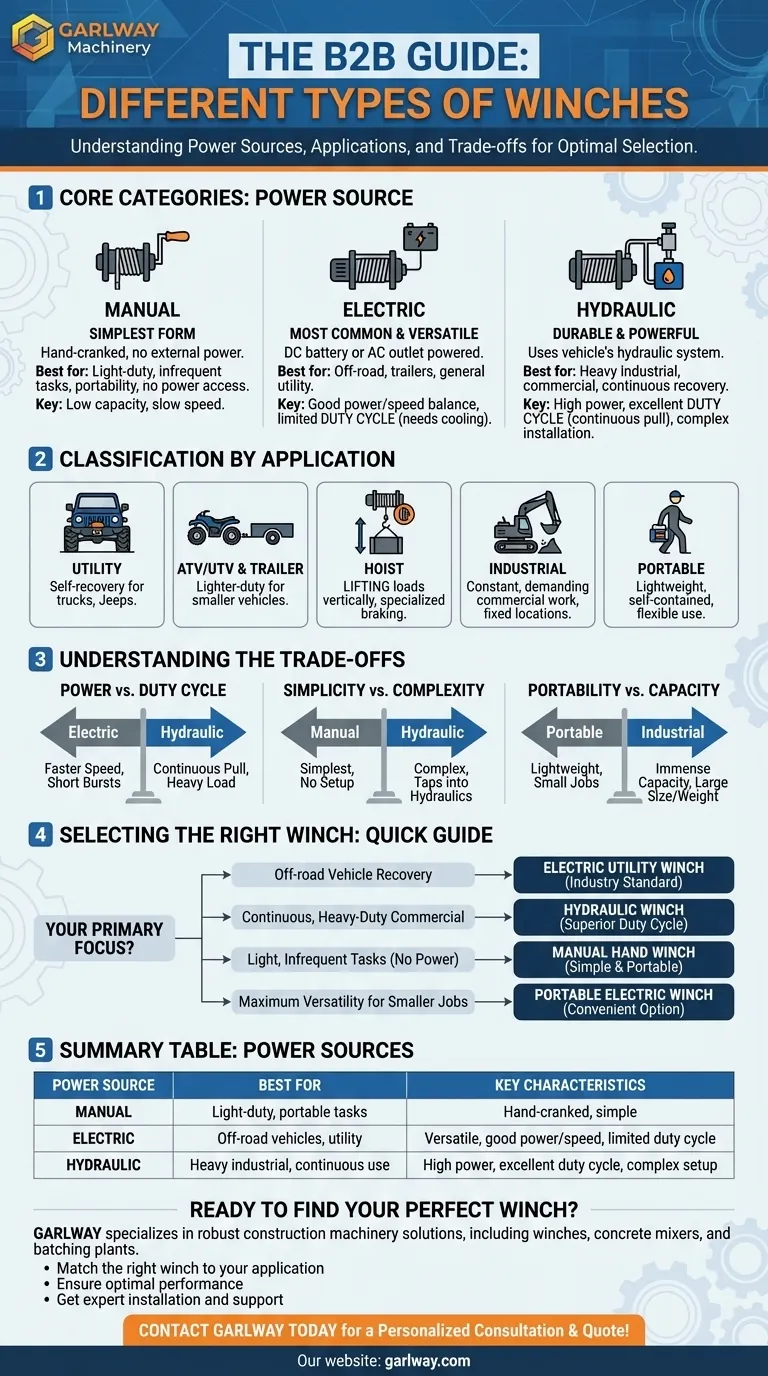
Visual Guide
Related Products
- Warn Winch Windlass Boat Trailer Winch
- Small Electric Winch 120V and 240V for Compact Applications
- Quick Windlass Portable Winch for Truck and Boat Best Boat Winch
- Electric and Hydraulic Winch for Heavy Duty Applications
- Portable Small Trailer Winch
People Also Ask
- What are the main components of a boat trailer winch? A Guide to Safe & Efficient Boat Loading
- What factors should be considered when choosing a boat trailer winch? Ensure Safe and Effortless Boat Loading
- What is the purpose of boat trailer winches? Safely and Efficiently Load Your Boat
- What are the two main types of boat trailer winches? Manual vs. Electric Explained
- How often should a boat trailer winch be replaced? Your Guide to Safety and Longevity