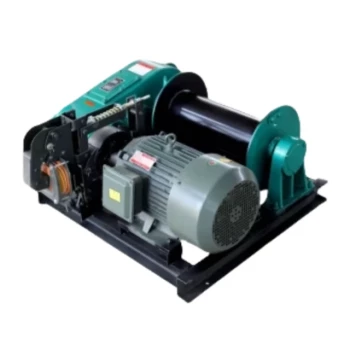
At its core, a winch's classification is defined by its power source. The most common types are electric, hydraulic, and manual, with more specialized options including pneumatic (air) and internal combustion (diesel) winches designed for specific industrial needs. While they all operate on the same principle of winding a cable or rope around a drum, their power source dictates their performance, application, and limitations.
Choosing the right winch isn't about the power source itself, but about matching the winch's operational characteristics—power availability, required duty cycle, and pulling capacity—to the specific demands of your environment and task.
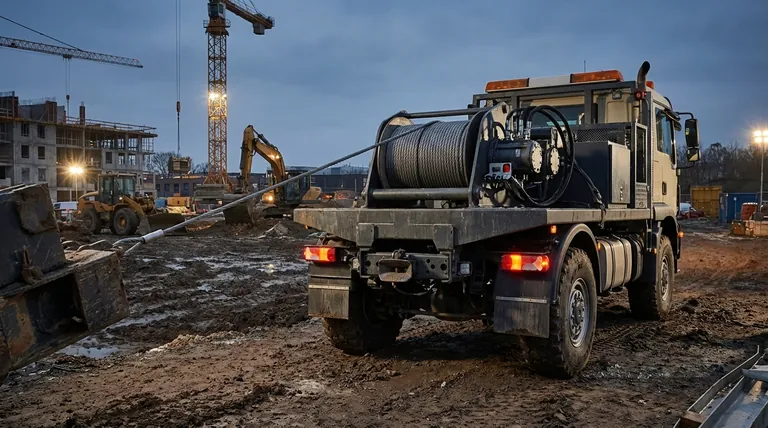
The Workhorse: Electric Winches
Electric winches are the most common type found in consumer and light commercial applications, especially for off-road vehicles.
How They Work
An electric winch uses a dedicated electric motor powered by a direct current (DC) source, typically a vehicle's 12-volt or 24-volt battery system. Some industrial models are designed to run on alternating current (AC) from a wall outlet.
Common Applications
Their primary use is in vehicle self-recovery for trucks, Jeeps, and ATVs. They are also used for light-duty tasks like pulling logs or loading equipment onto a trailer.
Key Advantages
Electric winches are relatively easy to install, widely available, and can be operated with the vehicle's engine turned off (for short periods). Many come with convenient remote controls.
Primary Limitation
Their main weakness is heat. The electric motor can overheat during long, continuous pulls, requiring a cool-down period. This is known as its duty cycle. Heavy use can also drain a vehicle's battery quickly.
The Powerhouse: Hydraulic Winches
Hydraulic winches are the standard for heavy-duty commercial and industrial work where reliability under constant load is critical.
How They Work
These winches are powered by a hydraulic system, typically tapping into a vehicle's power steering pump or a separate PTO (Power Take-Off) pump. The hydraulic fluid provides immense and consistent torque.
Common Applications
You will find hydraulic winches on tow trucks, industrial carriers, and in agricultural or logging operations where long, heavy pulls are routine.
Key Advantages
The primary advantage is the ability to pull for long periods without overheating. They offer tremendous power and are exceptionally durable.
Primary Limitation
Installation is significantly more complex and expensive than for electric winches. They can only operate when the host vehicle's engine is running to power the hydraulic pump.
The Foundation: Manual Winches
Manual winches are the simplest form of mechanical pulling device, relying on human strength for power.
How They Work
A manual winch uses a hand crank or lever combined with a gear system to multiply the user's force, allowing them to pull loads far heavier than they could alone.
Common Applications
They are perfect for small, controlled tasks like loading a boat onto a trailer, tensioning fences, or for use in workshops where no power source is readily available.
Key Advantages
Manual winches are portable, inexpensive, highly reliable, and require no external power.
Primary Limitation
Their pulling capacity is limited, and they are slow and labor-intensive to operate, making them unsuitable for heavy recovery or frequent use.
Understanding the Core Trade-offs
Choosing a winch involves balancing three critical factors that are directly tied to the power source.
Power Availability vs. Portability
Electric and hydraulic winches are tied to a vehicle or power grid. Manual and internal combustion winches, on the other hand, are completely self-sufficient and can be used in remote locations without a support vehicle.
Duty Cycle and Heat Management
This is the classic electric vs. hydraulic debate. An electric winch has a limited duty cycle and must rest to cool down. A hydraulic winch can run continuously as long as the engine is on, making it the superior choice for constant, heavy work.
Installation Complexity and Cost
Manual winches require simple bolting. Electric winches require wiring to the vehicle's battery. Hydraulic winches require tapping into the vehicle's hydraulic lines, making their installation the most complex and costly.
How to Select the Right Winch
Base your decision on the most demanding task you expect the winch to perform.
- If your primary focus is vehicle self-recovery and occasional use: An electric winch offers the best balance of performance, cost, and ease of installation.
- If your primary focus is commercial, industrial, or continuous heavy pulling: A hydraulic winch is the superior choice for its reliability and ability to run without overheating.
- If your primary focus is portability and power-independent tasks: A manual winch provides a simple, reliable solution for light-duty jobs where speed is not a factor.
- If your primary focus is operating in hazardous environments (e.g., mining or oil & gas): A pneumatic (air) winch is often required for its intrinsically safe, spark-free operation.
Understanding these power sources transforms your choice from a guess into a calculated decision based on your specific operational needs.
Summary Table:
| Power Source | Key Applications | Primary Advantage | Key Limitation |
|---|---|---|---|
| Electric | Vehicle self-recovery, light-duty tasks | Easy installation, remote control | Limited duty cycle, can overheat |
| Hydraulic | Tow trucks, heavy industrial work | Continuous power, no overheating | Complex installation, requires running engine |
| Manual | Boat loading, workshops, fencing | Portable, no external power needed | Labor-intensive, limited capacity |
Still unsure which winch is right for your project? The team at GARLWAY can help. We specialize in construction machinery, providing robust electric, hydraulic, and manual winches tailored for construction companies and contractors globally. Our experts will analyze your specific needs—whether it's for heavy-duty recovery, continuous industrial use, or portable applications—to recommend the perfect solution. Get a personalized recommendation today → Contact GARLWAY
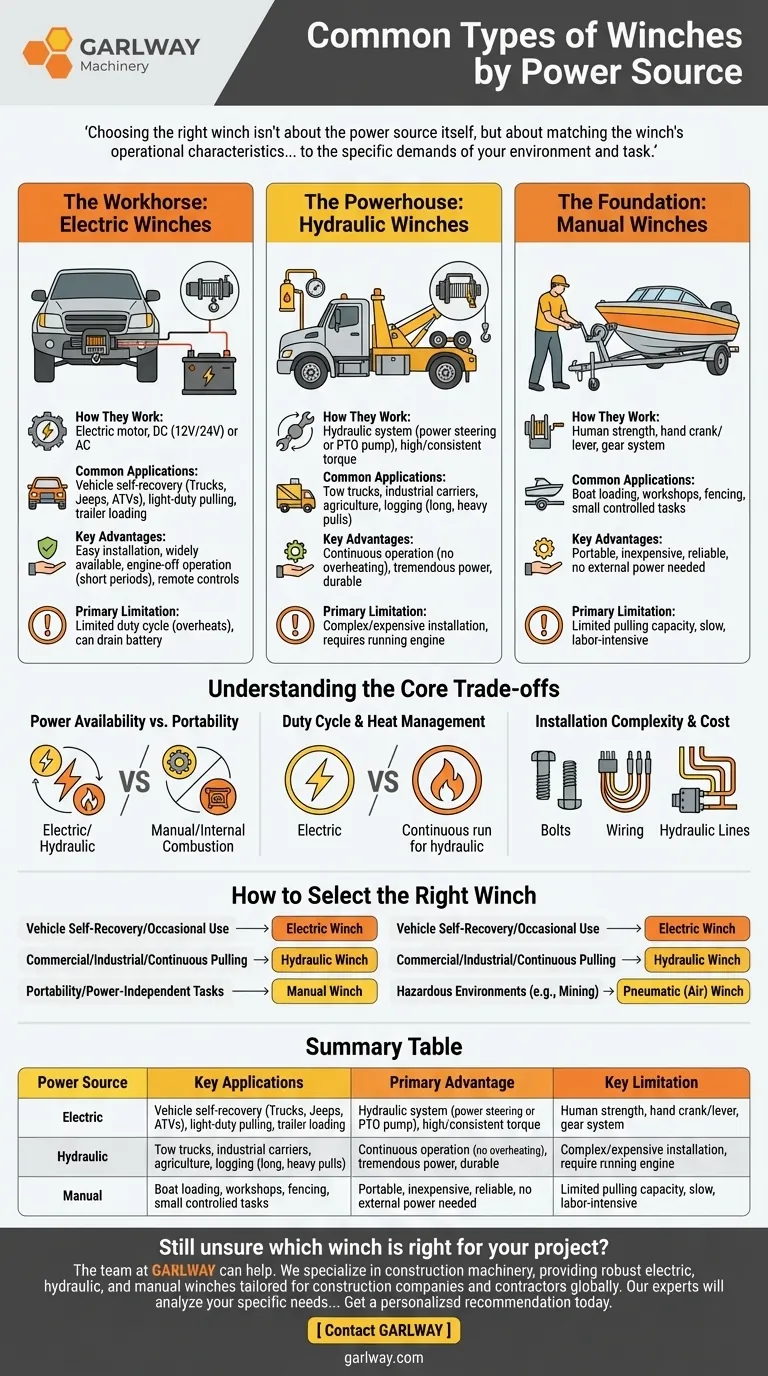
Visual Guide
Related Products
- Small Electric Winch 120V and 240V for Compact Applications
- Warn Winch Windlass Boat Trailer Winch
- Electric and Hydraulic Winch for Heavy Duty Applications
- Quick Windlass Portable Winch for Truck and Boat Best Boat Winch
- Hydraulic Winding Engine Harbor Freight Winch
People Also Ask
- What makes electric winches suitable for off-road use? Key Features for Reliable Vehicle Recovery
- What are the common applications of electric winches? Power Your Lifting & Pulling Tasks
- What are the common uses of an electric winch? A Guide to Safe and Efficient Heavy Lifting
- What are the uses of electric winches in mining and tunneling? Enhance Safety and Efficiency Underground
- How do electric winches contribute to energy savings? Maximize Efficiency and Lower Costs