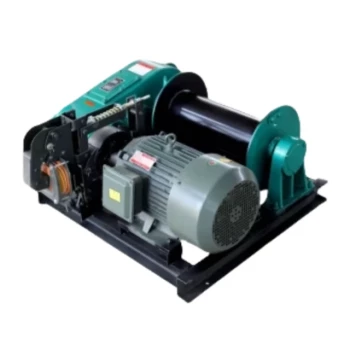
At its core, a winch's power source dictates its application and limitations. The most common power sources are electric, hydraulic, and manual, with more specialized types like pneumatic and internal combustion used for specific industrial needs. The choice depends entirely on the required pulling power, the duration of use, and the environment where the work will be performed.
The fundamental decision is not about finding the "strongest" winch, but about matching the power source to the demands of your specific task. Each type represents a distinct trade-off between power, duty cycle, portability, and installation complexity.
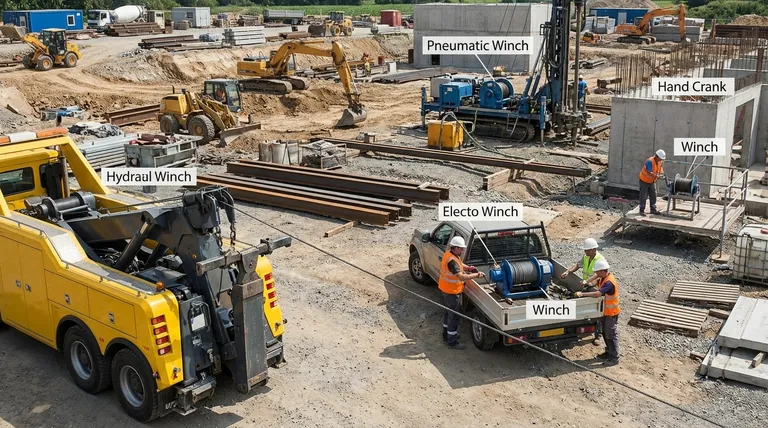
Deconstructing the Power Sources
Understanding the mechanism behind each winch type is the first step toward choosing the right tool. While they all wind a cable around a drum, how they generate that force changes everything.
Electric Winches (The Versatile Standard)
Electric winches are the most common type, particularly for consumer and light commercial applications. They draw power from an electrical source, making them highly versatile.
Their power source is typically a 12-volt or 24-volt DC battery system, found on vehicles like trucks and ATVs. Lighter-duty tasks are handled by 12V systems, while 24V systems provide the power needed for heavier workloads.
For fixed, industrial applications in construction or manufacturing, winches can be powered by AC wall outlets, providing consistent and powerful operation without draining a battery.
Hydraulic Winches (The Heavy-Duty Workhorse)
Hydraulic winches are designed for sustained, heavy-duty pulling. They are powered by a vehicle's power steering pump or a dedicated hydraulic pump driven by the engine.
Because they leverage the vehicle's engine, they can pull for long periods without overheating or draining a battery. This makes them the standard for commercial tow trucks, industrial recovery vehicles, and applications demanding a long duty cycle.
Manual Winches (The Reliable Backup)
Powered by human force via a hand crank, manual winches are the simplest and most reliable option. They require no external power, making them exceptionally portable and foolproof.
While they lack the power and speed of other types, they are perfect for smaller tasks, precise load positioning, or as an emergency backup when other power sources fail.
Specialized Industrial Power Sources
In certain industrial environments, standard power sources are not suitable. Two specialized types fill these niches.
Pneumatic (Air) Winches are powered by compressed air. Their key advantage is a complete lack of electrical components, making them intrinsically safe and spark-free for use in hazardous environments like oil rigs, mines, and chemical plants.
Internal Combustion Winches use a dedicated diesel or gas engine. This makes them completely self-contained, ideal for remote job sites like forestry or logging operations where no vehicle or electrical grid is available.
Understanding the Trade-offs
Choosing a winch means balancing its capabilities against its requirements. No single power source is universally superior.
Power vs. Duty Cycle
This is the classic trade-off between electric and hydraulic systems. An electric winch can offer immense pulling power but has a limited duty cycle; it generates significant heat and can drain a battery quickly under sustained load.
A hydraulic winch, while often more complex to install, can run for as long as the vehicle's engine is running. It is the definitive choice for continuous, demanding work.
Installation and Portability
Manual winches are the clear winner for portability and simplicity, requiring no setup beyond securing the winch itself.
Electric winches offer a good balance, being relatively easy to wire into a vehicle's electrical system. Modern systems with features like Anderson plugs allow for quick connection and disconnection.
Hydraulic winches are the most complex, requiring the installation of hydraulic lines and a pump, making them a permanent fixture on a dedicated vehicle.
Environmental Constraints
The operating environment can immediately disqualify certain winch types. Electric and internal combustion engines are sources of ignition and cannot be used in explosive atmospheres.
In these situations, a pneumatic winch is the only safe option. Similarly, the exhaust from an internal combustion winch makes it unsuitable for use in enclosed or poorly ventilated spaces.
Making the Right Choice for Your Application
Your final decision should be guided by your primary goal.
- If your primary focus is off-road vehicle recovery: An electric winch (12V or 24V) offers the best combination of immense pulling power, straightforward installation, and cost-effectiveness.
- If your primary focus is continuous industrial or heavy commercial use: A hydraulic winch is the superior choice for its unmatched duty cycle and consistent power delivery.
- If your primary focus is safety in a hazardous environment: A pneumatic (air) winch is the only appropriate and safe solution due to its spark-free operation.
- If your primary focus is a simple, foolproof tool for light tasks or emergencies: A manual winch provides ultimate reliability and portability without depending on any external power.
- If your primary focus is remote work without access to a vehicle or grid: An internal combustion winch offers a powerful, self-contained solution for demanding jobs in isolated locations.
Ultimately, selecting the correct power source ensures you have the right force, endurance, and safety for the task at hand.
Summary Table:
| Power Source | Key Characteristic | Best For |
|---|---|---|
| Electric | Versatile, uses 12V/24V DC or AC power | Off-road recovery, light commercial use |
| Hydraulic | Heavy-duty, sustained pulling from vehicle's engine | Commercial tow trucks, industrial recovery |
| Manual | Human-powered, portable, and reliable | Light tasks, emergencies, precise positioning |
| Pneumatic | Spark-free, powered by compressed air | Hazardous environments (oil rigs, mines) |
| Internal Combustion | Self-contained, uses dedicated engine | Remote job sites (forestry, logging) |
Struggling to choose the right winch for your construction or contracting project? GARLWAY specializes in construction machinery, offering a full range of durable and powerful winches, concrete mixers, and concrete batching plants tailored for construction companies and contractors globally. Our experts will help you select the perfect power source to maximize efficiency and safety on your job site. Contact GARLWAY today for a personalized consultation and discover how our reliable equipment can power your success.
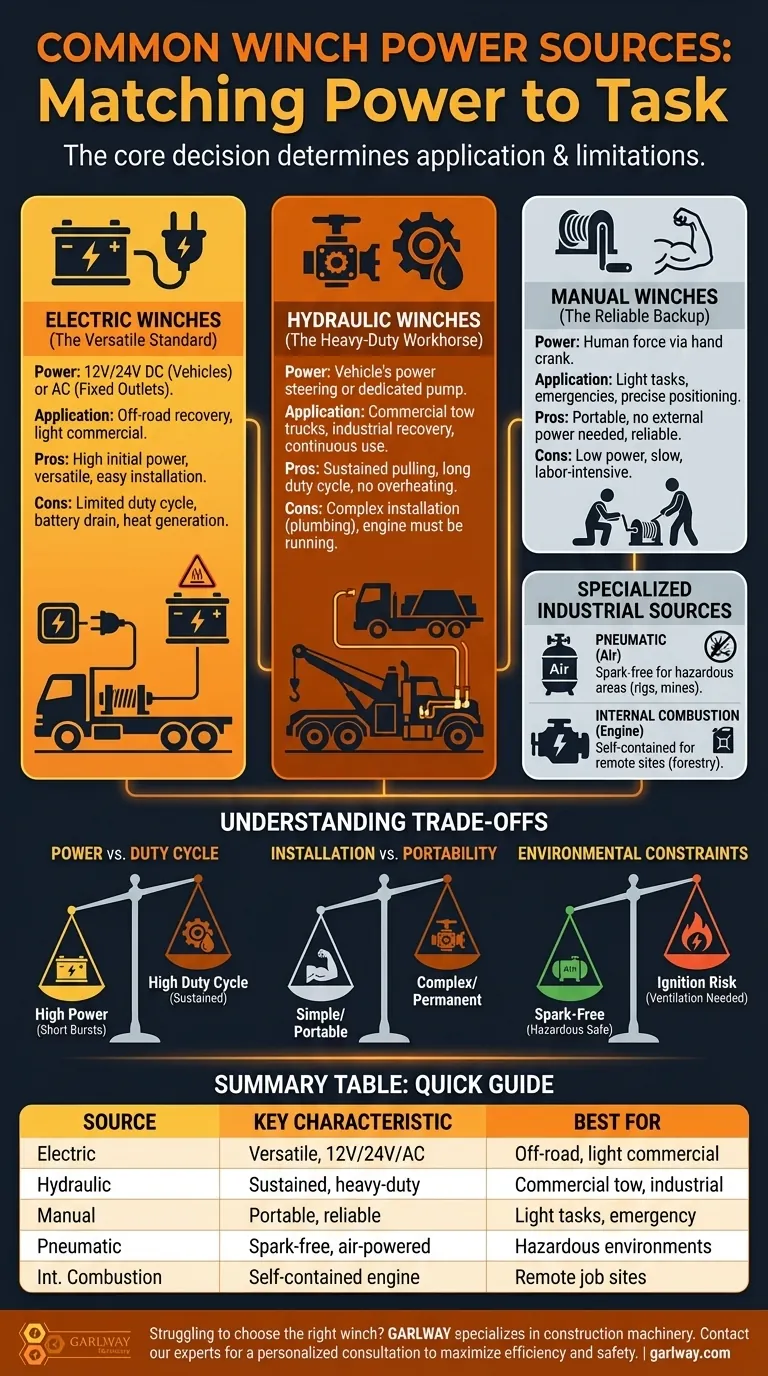
Visual Guide
Related Products
- Small Electric Winch 120V and 240V for Compact Applications
- Electric 120V Boat Winch by Badlands
- Electric and Hydraulic Winch for Heavy Duty Applications
- 12000 lb Electric Boat Trailer Winch with Windlass Anchor Warn
- Electric Hoist Winch Boat Anchor Windlass for Marine Applications
People Also Ask
- What makes electric winches suitable for off-road use? Key Features for Reliable Vehicle Recovery
- What are the common applications of electric winches? Power Your Lifting & Pulling Tasks
- What are the common uses of an electric winch? A Guide to Safe and Efficient Heavy Lifting
- What are the uses of electric winches in mining and tunneling? Enhance Safety and Efficiency Underground
- How do electric winches contribute to energy savings? Maximize Efficiency and Lower Costs