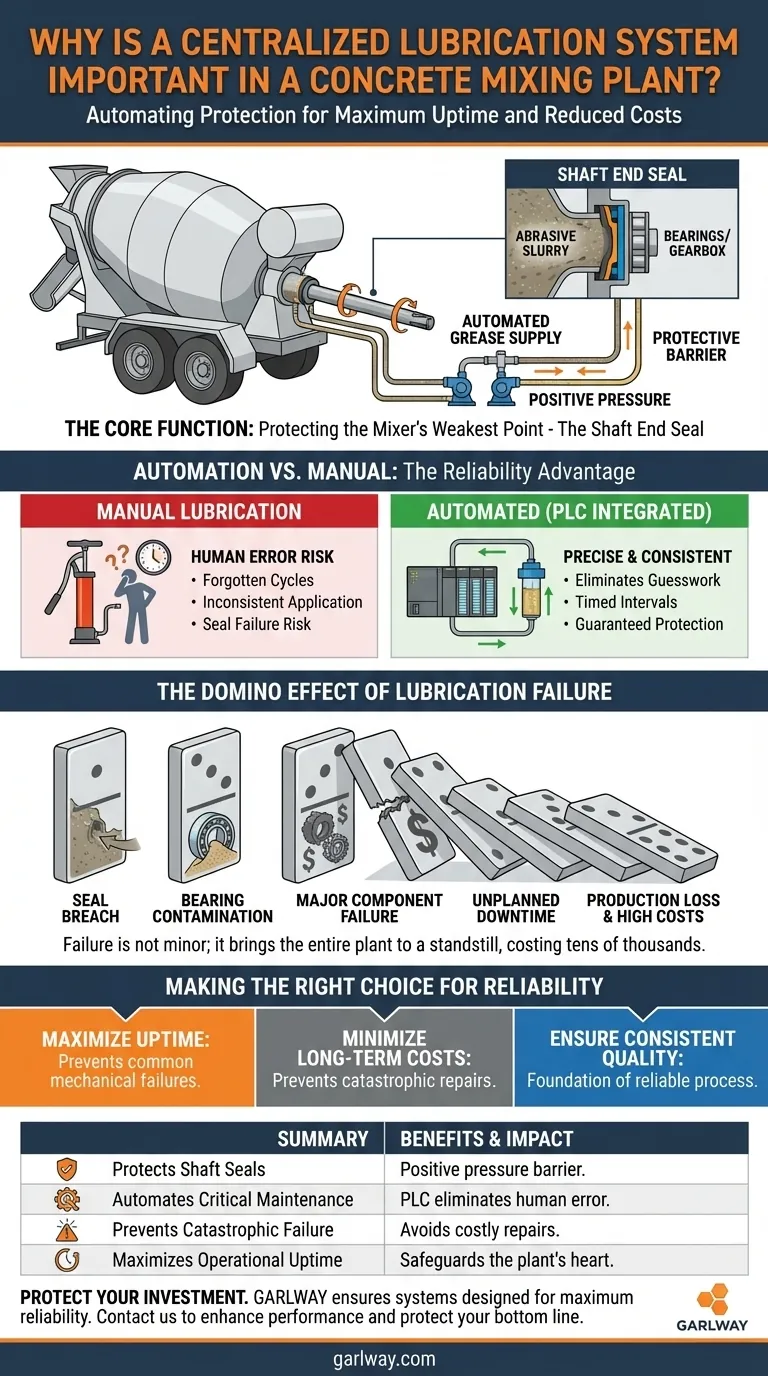
At its core, a centralized lubrication system is essential in a concrete mixing plant because it automates the protection of the mixer's most critical and vulnerable component: the shaft end seal. This system ensures a constant supply of grease, creating a barrier that prevents abrasive concrete slurry from causing catastrophic leaks and equipment failure.
The true importance of a centralized lubrication system is not merely about applying grease; it's about shifting a critical maintenance task from a point of potential human error to a reliable, automated process that ensures operational uptime and prevents costly, plant-halting damage.
The Core Function: Protecting the Mixer's Weakest Point
A concrete mixer, particularly a twin-shaft model, operates in an incredibly harsh environment. The central point of failure is where the rotating shafts exit the mixing drum.
The Critical Role of the Shaft End Seal
The shaft end seal is the barrier between the abrasive, high-pressure concrete slurry inside the mixer and the sensitive bearings and gearbox outside.
If this seal fails, the entire mixing operation is compromised. It is the single most important protective component in the mixer's powertrain.
How Lubrication Creates a Protective Barrier
A centralized lubrication system continuously pumps grease into the multi-layer sealing structure at the end of the shaft.
This action doesn't just lubricate; it creates positive pressure. This constant outward pressure effectively pushes back against the concrete mix, ensuring slurry cannot penetrate the seal and reach the bearings.
Why Automation is Superior to Manual Methods
While lubrication can be done manually, relying on it for such a critical component introduces significant risk. The control system of a modern plant acts as its central nervous system, and automated lubrication is a vital part of that system.
The Problem with Manual Lubrication
Manual lubrication relies on an operator remembering to use a hand pump at regular intervals. This process is prone to human error.
Forgetting a lubrication cycle, applying too little grease, or performing the task inconsistently can easily lead to seal failure.
The Advantage of PLC Integration
An automated, centralized system is typically controlled by the plant's PLC (Programmable Logic Controller).
The PLC ensures that precise amounts of grease are delivered at perfectly timed intervals whenever the mixer is in operation. This removes guesswork and human error, guaranteeing the protective barrier is always maintained.
Understanding the Consequences of Failure
Failing to properly lubricate the shaft end seal is not a minor oversight; it has a cascading effect that can bring the entire plant to a standstill.
The Domino Effect of a Seal Breach
Once the seal is breached, abrasive sand, aggregate, and cement slurry immediately begin to contaminate the mixer's main bearings.
This contamination rapidly destroys the bearings and can subsequently lead to catastrophic failure of the main shaft or gearbox, the most expensive components of the mixer.
Unplanned Downtime and Production Loss
A failed mixer means the entire concrete plant stops producing. This isn't a quick fix.
Replacing shaft seals and main bearings is a major, time-consuming repair that results in significant production loss and schedule delays.
Escalating Repair Costs
The cost of a proper centralized lubrication system is negligible compared to the cost of the damage it prevents.
Replacing a set of seals is routine maintenance. Replacing an entire gearbox and main bearings due to lubrication failure can cost tens of thousands of dollars in parts and labor, not including the cost of lost production.
Making the Right Choice for Plant Reliability
The decision to implement a centralized lubrication system is a strategic one that directly impacts operational efficiency and profitability.
- If your primary focus is maximizing uptime: An automated system is non-negotiable, as it prevents one of the most common and severe causes of mechanical mixer failure.
- If your primary focus is minimizing long-term costs: The initial investment pays for itself many times over by preventing catastrophic repairs and extending the life of the mixer.
- If your primary focus is ensuring consistent quality: Reliable equipment is the foundation of a reliable process; automated lubrication ensures the heart of your plant operates without interruption.
Ultimately, a centralized lubrication system transforms a critical maintenance task from a manual risk into a reliable, automated process that safeguards your entire operation.
Summary Table:
| Benefit | Impact on Your Plant |
|---|---|
| Protects Shaft Seals | Creates a positive pressure barrier against abrasive concrete slurry. |
| Automates Critical Maintenance | PLC-controlled system eliminates human error and ensures consistent lubrication. |
| Prevents Catastrophic Failure | Stops contamination of main bearings and gearbox, avoiding repairs costing tens of thousands. |
| Maximizes Operational Uptime | Prevents unplanned downtime by safeguarding the mixer, the heart of your plant. |
Protect your investment and maximize your plant's uptime. A reliable centralized lubrication system is key to preventing catastrophic mixer failure. GARLWAY specializes in construction machinery solutions for contractors and construction companies globally. Our expertise in concrete batching plants and mixers ensures you get a system designed for maximum reliability. Contact GARLWAY today to discuss how we can enhance your plant's performance and protect your bottom line.
Visual Guide
Related Products
- HZS180 Ready Mix Concrete Plant for Foundations with Sand and Cement
- HZS90 Large Multiquip Concrete Mixers for Construction
- HZS35 Small Cement Concrete Mixing Batch Plant
- HZS120 Ready Mix Concrete Batching Plant Commercial Mud Cement Mixer
- HZS75 Concrete Batching Plant Cement Mixer Price Concrete Mixer Bunnings Mixing Plant
People Also Ask
- What is a ready mix concrete batching plant? The Engine of Modern Construction
- What is the name of the machine used in ready mix? Unpacking the Complete Concrete System
- What systems are included in a ready-mix concrete plant? A Guide to the 6 Core Systems
- How does a ready-mix concrete plant work? A Guide to Efficient, High-Quality Production
- What are the components of a ready mix concrete plant? A Guide to Precision and Efficiency