
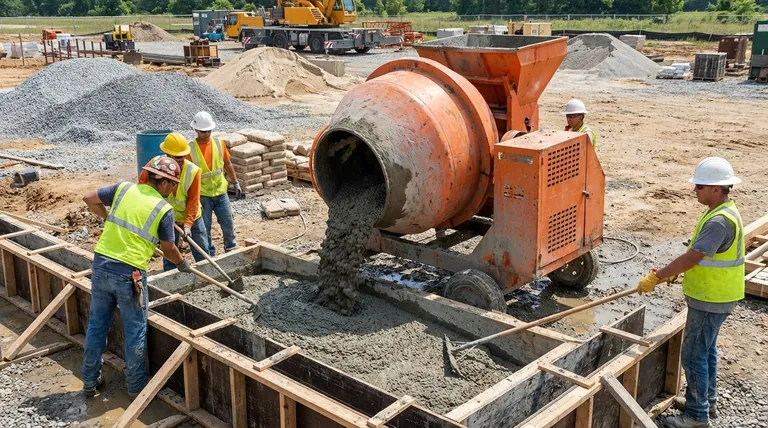
The defining characteristic of a tilting drum mixer is its ability to discharge contents by tilting the entire drum downward. This mechanism allows for a rapid, controlled, and nearly complete emptying of the mixed material, making it highly efficient for a wide range of applications, most notably for mixing concrete.
A tilting drum mixer's core value lies in its combination of efficient mixing and fast, controlled discharge. While its performance depends on specific design elements, its ability to quickly pour materials makes it a cornerstone for projects where speed and precision are paramount.
How a Tilting Drum Mixer Operates
A tilting drum mixer relies on a few key mechanical principles to ensure a homogenous mix and an effective discharge. The interaction between the drum's rotation, internal blades, and the tilting axis is what defines its performance.
The Mixing Action
The mixer uses a rotating drum fitted with internal blades. As the drum spins, these blades continuously lift and tumble the ingredients, ensuring all components like cement, aggregate, and water are thoroughly combined.
The efficiency of this process is not accidental. It is a direct result of the drum's shape, the angle of the drum during mixing, and the precise size and positioning of the blades.
The Tilting Discharge Mechanism
Once the material is mixed, the entire drum pivots on a frame, tilting downward to pour out the contents. This action provides a significant advantage over non-tilting designs.
The discharge is exceptionally fast and complete, minimizing the time between batches and reducing wasted material left inside the drum. This makes it ideal for continuous work on larger projects.
Loading and Unloading Design
Tilting drum mixers can be designed in two main ways. Some models use the same opening for both charging raw materials and discharging the final mix.
Others feature a more sophisticated design with separate openings at opposite ends for charging and discharging, which can streamline a continuous workflow.
Key Advantages Over Other Mixer Types
Choosing a tilting drum mixer often comes down to its distinct advantages in speed, control, and efficiency, especially when compared to non-tilting or reversing drum mixers.
Rapid and Complete Discharge
The ability to simply tip the contents out is the mixer's greatest strength. This rapid unloading process is far more efficient than the manual labor required to empty a non-tilting mixer.
Precise Pouring Control
The tilting feature is especially useful for projects that require placing concrete at lower levels or into specific forms. The operator can carefully control the angle of the tilt to ensure precise pouring and reduce spillage.
Overall Simplicity and Cost
Among various mixer types, drum mixers in general are known for being simple to operate and requiring less labor. They tend to have the lowest operating and maintenance costs, making them a cost-effective solution.
Understanding the Trade-offs and Limitations
No single piece of equipment is perfect for every job. While powerful, the tilting drum mixer has specific characteristics that require consideration and sometimes mitigation.
Potential for Material Sticking
A common issue is that freshly mixed concrete can stick to the bottom and blades of the drum, especially with the first batch of the day.
This can affect the consistency of subsequent mixes and lead to material buildup over time if not managed properly.
The "Buttering" Mitigation Technique
To counteract sticking, operators often "butter" the mixer before the first official batch. This involves mixing a small amount of cement mortar to coat the interior surfaces, preventing the main batch from adhering directly to the dry metal.
Comparison with Other Mixers
A non-tilting mixer has a simpler design and lower maintenance but is far less efficient due to its manual discharge. A reversing drum mixer is specifically suited for very dry concrete mixes, as it uses a reverse rotation and a second set of blades to push the material out.
Making the Right Choice for Your Project
Selecting the correct mixer depends entirely on the specific demands of your work, including the material you are mixing, the volume required, and your need for speed and precision.
- If your primary focus is speed and high-volume output: The tilting drum mixer is an excellent choice due to its rapid discharge capability.
- If your primary focus is precision and minimizing waste: The controlled pour offered by the tilting mechanism provides a significant advantage.
- If your primary focus is simplicity and handling dry mixes: A reversing drum mixer is specifically engineered for this task and may offer a more uniform result.
- If your primary focus is the lowest initial cost and maintenance: A basic non-tilting mixer is simpler, but you must account for the added labor and time for unloading.
Ultimately, understanding these core characteristics empowers you to match the right tool to the unique requirements of your job.
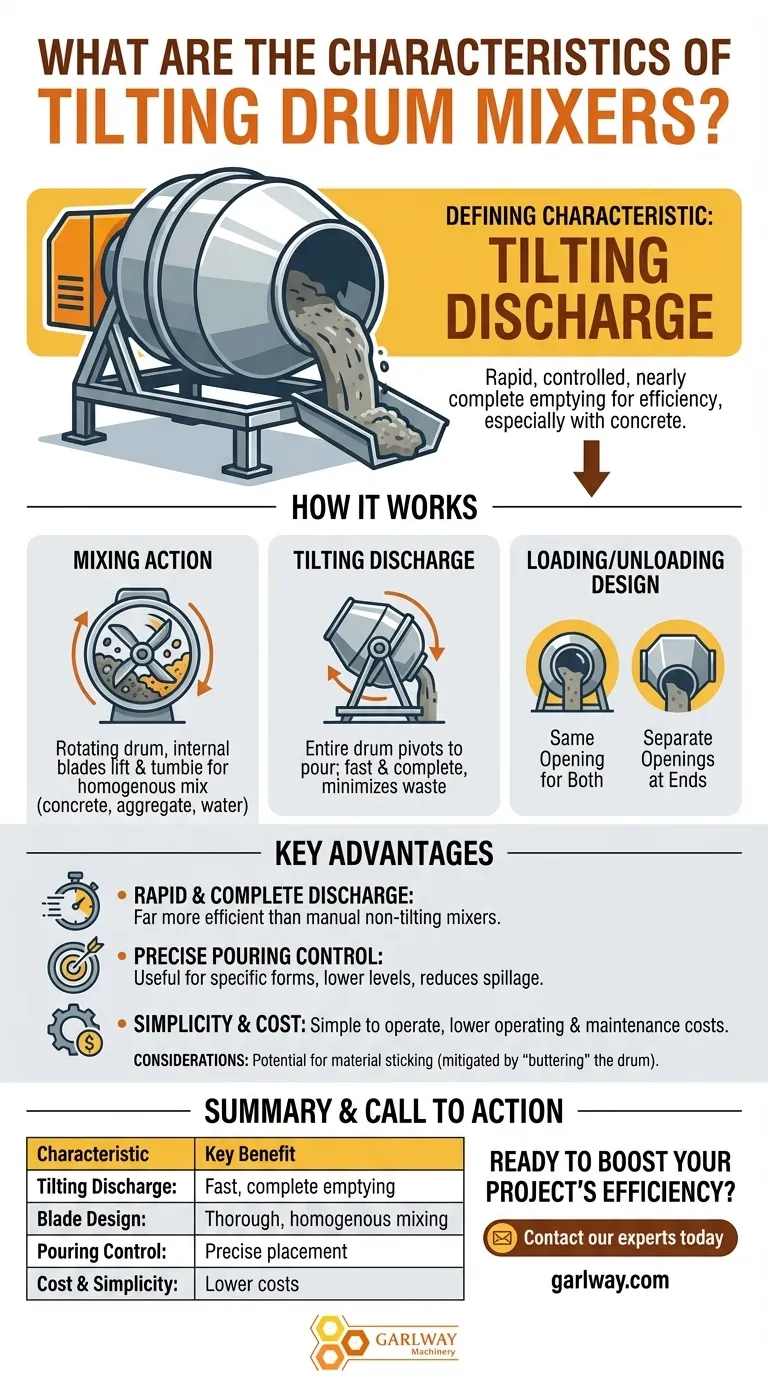
Summary Table:
| Characteristic | Key Benefit |
|---|---|
| Tilting Discharge | Fast, complete emptying of materials |
| Blade Design | Thorough and homogenous mixing |
| Pouring Control | Precise placement into forms or lower levels |
| Cost & Simplicity | Lower operating and maintenance costs |
Ready to boost your project's efficiency with the right mixer?
GARLWAY specializes in providing robust construction machinery, including concrete mixers, winches, and batching plants, tailored for construction companies and contractors worldwide. Our tilting drum mixers are designed to deliver the speed, control, and reliability your projects demand.
Contact our experts today to find the perfect mixing solution for your specific needs and see how GARLWAY can add value to your operations.
Visual Guide
Related Products
- Concrete Cement Mixer Machine Drum Mixer for Construction
- Belle Mixer Drum Self Loading Mortar Mixers JS3000
- Portable Cement Mixer with Lift Concrete Machine
- Skid Steer Self Loading Concrete Mixers for Construction
- Shaft Mixer Machine for Cement and Regular Concrete Mixing
People Also Ask
- What are the key advantages of using drum mixers in concrete mixing? Boost Volume & Efficiency on Your Site
- What are the key components that maintain concrete mix consistency in the drum? Ensure Uniform Quality from Plant to Site
- How do cement mixers enhance safety on construction sites? Reduce Strain, Hazards, and Accidents
- When was the first concrete mixer developed and by whom? Discover the 1900 Breakthrough
- What is the average lifespan of a concrete mixer? Maximize Your Equipment's Lifespan & ROI


