
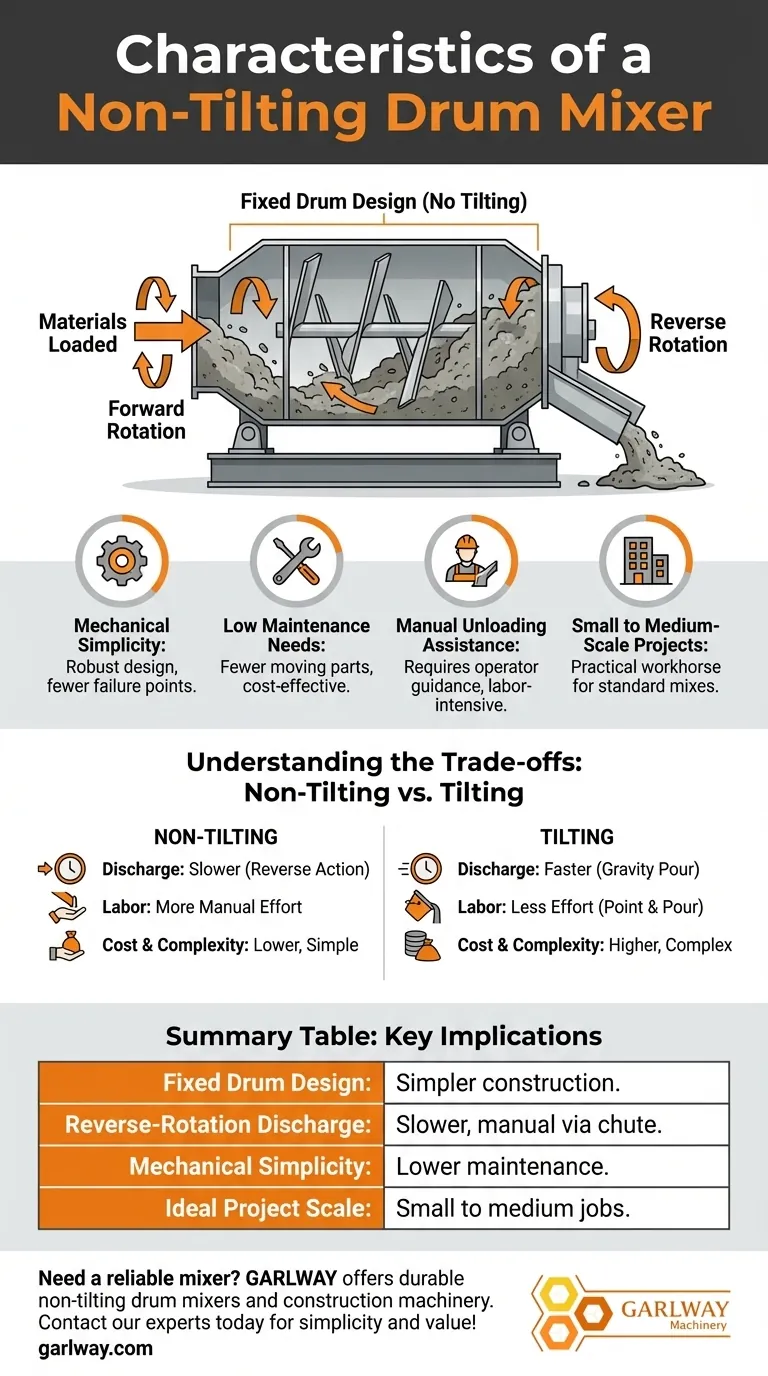
At its core, a non-tilting drum mixer is defined by its unique discharge method. Unlike models that pour out their contents, these mixers have a fixed drum and discharge the mixed concrete through a chute when the drum's rotation is reversed. This simple design results in a distinct set of characteristics, including mechanical simplicity, low maintenance requirements, and suitability for small to medium-scale projects.
The non-tilting mixer's primary advantage is its mechanical simplicity and low maintenance, which stems from its fixed drum. However, this design requires a reverse-rotation discharge mechanism that is inherently less efficient and more labor-intensive than the gravity-assisted pouring of a tilting mixer.
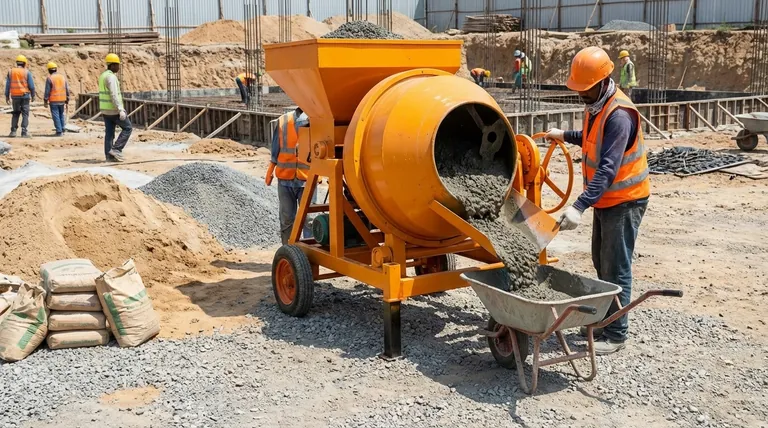
How a Non-Tilting Mixer Operates
The functionality of a non-tilting mixer is straightforward and built around its fixed orientation.
The Fixed Drum Design
A non-tilting mixer features a drum that rotates on a horizontal axis but does not have any mechanism to tilt up or down.
The Charging and Mixing Process
Materials like cement, sand, and aggregate are loaded into the drum through an opening at one end. As the drum rotates in its forward direction, internal blades lift the materials, which then tumble back down due to gravity. This continuous "self-falling" action ensures a uniform mix.
The Reversing Discharge Mechanism
This is the key characteristic. To discharge the concrete, the direction of the drum's rotation is reversed. This change in direction alters the angle of the internal blades, effectively pushing the mixed material out of the drum and into a connected discharge chute.
Key Characteristics and Their Implications
The fixed-drum design directly influences the mixer's performance, maintenance, and ideal use cases.
Mechanical Simplicity
The absence of a complex tilting gear or hydraulic system makes these machines fundamentally simpler. This results in a more robust design with fewer potential points of failure.
Low Maintenance Needs
With fewer moving parts compared to their tilting counterparts, non-tilting mixers generally require less maintenance and are often more cost-effective over their lifespan.
Manual Unloading Assistance
While the reversing drum pushes the concrete out, the process is not fully automated. It typically requires an operator to guide the flow from the chute, making the unloading process more manual than a simple pour.
Ideal Project Scale
These mixers are highly effective for small to medium-sized construction projects where high-volume, rapid output is not the primary requirement. Their reliability and simplicity make them a practical workhorse.
Understanding the Trade-offs: Non-Tilting vs. Tilting
Choosing a mixer often comes down to balancing efficiency against simplicity.
Discharge Speed and Efficiency
A tilting mixer discharges faster and more completely by using gravity to pour the contents out. The reverse-blade action of a non-tilting mixer is slower and can sometimes leave more residual material inside the drum after discharge.
Labor Intensity
The "point and pour" action of a tilting mixer requires less manual effort and supervision during discharge. A non-tilting mixer relies more on an operator to manage the chute and ensure the concrete is placed correctly.
Initial Cost and Complexity
The non-tilting mixer is the clear winner in terms of simplicity. Its design translates to a lower initial purchase price and reduced long-term maintenance costs compared to the more complex tilting systems.
Making the Right Choice for Your Project
Your decision should be based on your project's specific priorities regarding speed, labor, and budget.
- If your primary focus is low initial cost and minimal maintenance: A non-tilting mixer is an excellent choice due to its simpler, more robust mechanical design.
- If your primary focus is rapid production and labor efficiency: A tilting drum mixer is superior, as its gravity-assisted pouring mechanism allows for faster and more complete discharge.
- If your project is small-to-medium-scale with standard mixes: The non-tilting mixer provides a highly reliable and cost-effective solution for consistent output.
Ultimately, understanding this fundamental difference in discharge mechanisms is the key to selecting the right mixer for your project's goals.
Summary Table:
| Characteristic | Implication |
|---|---|
| Fixed Drum Design | No tilting mechanism; simpler, more robust construction. |
| Reverse-Rotation Discharge | Slower, more manual unloading via a chute. |
| Mechanical Simplicity | Fewer moving parts, leading to lower maintenance needs. |
| Ideal Project Scale | Best suited for small to medium-sized construction jobs. |
Need a reliable and cost-effective concrete mixer for your next project? GARLWAY specializes in construction machinery, offering durable non-tilting drum mixers, concrete batching plants, and winches designed for construction companies and contractors globally. Our equipment is built for simplicity and long-term value. Contact our experts today to find the perfect mixer for your needs!
Visual Guide
Related Products
- Belle Mixer Drum Self Loading Mortar Mixers JS3000
- Concrete Cement Mixer Machine Drum Mixer for Construction
- JDY350 Electric Hydraulic Mortar Mud Concrete Mixer
- JDC350 Small Cement Concrete Mortar Mixer
- Shaft Mixer Machine for Cement and Regular Concrete Mixing
People Also Ask
- What are the features of mobile transporting in a self loading mixer? Boost On-Site Efficiency
- Why is timely cleaning important for a self loading mixer? Prevent Costly Downtime and Mix Failure
- How is discharging accomplished in a self loading mixer? Master Precise Concrete Placement
- What is the purpose of keeping the drum rotating during transportation in a self loading concrete mixer? Ensure Quality & Consistency
- What components are involved in the loading process of a self loading concrete mixer? A Guide to the Key Systems





