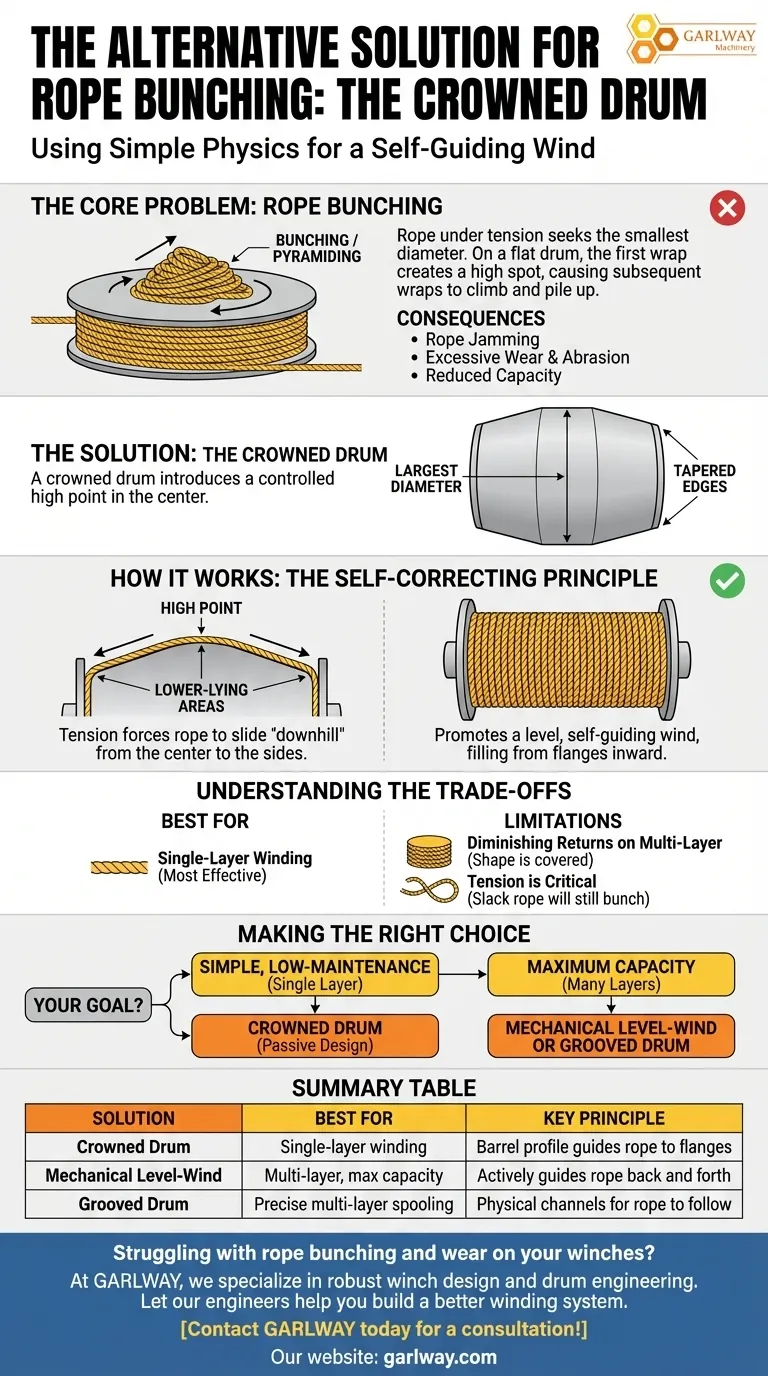
To prevent rope bunching on a drum, the recommended alternative solution is to modify the roller or drum itself. By making the drum significantly fatter in the middle, creating a "crowned" shape, the rope is encouraged to distribute itself more evenly across the full width of the drum.
A crowned drum uses simple physics to solve a common mechanical problem. By creating a high point in the center, the drum forces a rope under tension to automatically seek the lower-lying areas near the flanges, resulting in a more even, self-guiding wind.
The Core Problem: Why Rope Bunches
A rope or cable under tension will always try to find the path of least resistance, which on a drum means winding around the smallest possible diameter. This principle is what leads to uneven spooling.
The Flaw of a Flat Drum
On a perfectly flat, cylindrical drum, the first wrap of rope creates a slight "high spot." Subsequent wraps are naturally drawn to climb this initial high spot, compounding the problem.
This effect creates a pyramid-like pile in one area—usually the center—leaving the sides of the drum empty. This is known as bunching or pyramiding.
Consequences of Uneven Winding
Bunching is not just a cosmetic issue. It can lead to the rope jamming against the drum flanges, cause excessive wear and abrasion, and significantly reduce the effective capacity of the drum.
How a Crowned Drum Solves the Issue
A crowned drum turns the root cause of the problem into the solution. It introduces a precisely engineered high point to control how the rope behaves.
Creating a Controlled High Point
The drum is machined to have its largest diameter in the very center, gently tapering down towards the flanges on each side. This shape is often referred to as a "crown" or a "barrel."
The Self-Correcting Principle
When the rope is wound onto the crowned drum, it immediately encounters the high point in the middle. The tension in the rope forces it to slide "downhill" from the larger-diameter center towards the smaller-diameter areas near the sides.
This action happens continuously, forcing the rope to fill the drum from the flanges inward, promoting a much more level and evenly distributed wind without any active mechanical guidance.
Understanding the Trade-offs
While effective, a crowned drum is not a universal solution for every application. It's important to recognize its limitations.
Best for Single-Layer Winding
The self-guiding effect of a crowned drum is most pronounced and reliable for applications involving a single layer of rope.
Diminishing Returns on Multi-Layer Winding
Once the first layer is complete, the crowned surface is covered. The effectiveness of the shape is significantly reduced for subsequent layers, which may still require a mechanical guide (a level-wind) for perfect spooling.
Tension is Critical
This method relies entirely on the rope being under sufficient tension. A slack rope will not be forced to move away from the center and can still wind unevenly.
Making the Right Choice for Your Goal
The best solution depends entirely on the specific requirements of your winding system.
- If your primary focus is a simple, low-maintenance system for a single layer: A crowned drum is an excellent, passive design choice that eliminates the need for complex level-wind mechanisms.
- If your primary focus is maximum capacity with many layers of rope: You will likely need a system with a mechanical level-wind or a precisely grooved drum to ensure perfect spooling beyond the first layer.
By understanding how a simple change in geometry can influence spooling, you can design more reliable and efficient winding systems.
Summary Table:
| Solution | Best For | Key Principle |
|---|---|---|
| Crowned Drum | Single-layer winding applications | Uses a barrel-shaped profile to guide rope towards drum flanges |
| Mechanical Level-Wind | Multi-layer winding for maximum capacity | Actively guides the rope back and forth across the drum |
| Grooved Drum | Precise spooling for multiple layers | Provides physical channels for the rope to follow |
Struggling with rope bunching and premature wear on your winches?
At GARLWAY, we specialize in designing and manufacturing robust construction machinery, including winches built for reliability. Our expertise in drum engineering can help you select the right spooling solution—whether a crowned drum for simplicity or a system with a level-wind for high-capacity needs—to maximize your equipment's performance and lifespan.
Let our engineers help you build a better winding system. Contact GARLWAY today for a consultation!
Visual Guide
Related Products
- Concrete Cement Mixer Machine Drum Mixer for Construction
- Best 18000 Pound Drum Anchor Trailer Winch
- Belle Mixer Drum Self Loading Mortar Mixers JS3000
- Portable Concrete Mixer Machine Equipment for Mixing Concrete
- Small Electric Winch 120V and 240V for Compact Applications
People Also Ask
- What are the key advantages of using drum mixers in concrete mixing? Boost Volume & Efficiency on Your Site
- What are the key components that maintain concrete mix consistency in the drum? Ensure Uniform Quality from Plant to Site
- How do cement mixers enhance safety on construction sites? Reduce Strain, Hazards, and Accidents
- When was the first concrete mixer developed and by whom? Discover the 1900 Breakthrough
- What is the average lifespan of a concrete mixer? Maximize Your Equipment's Lifespan & ROI