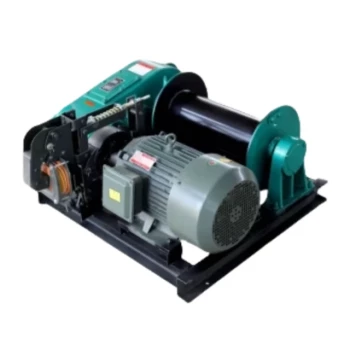
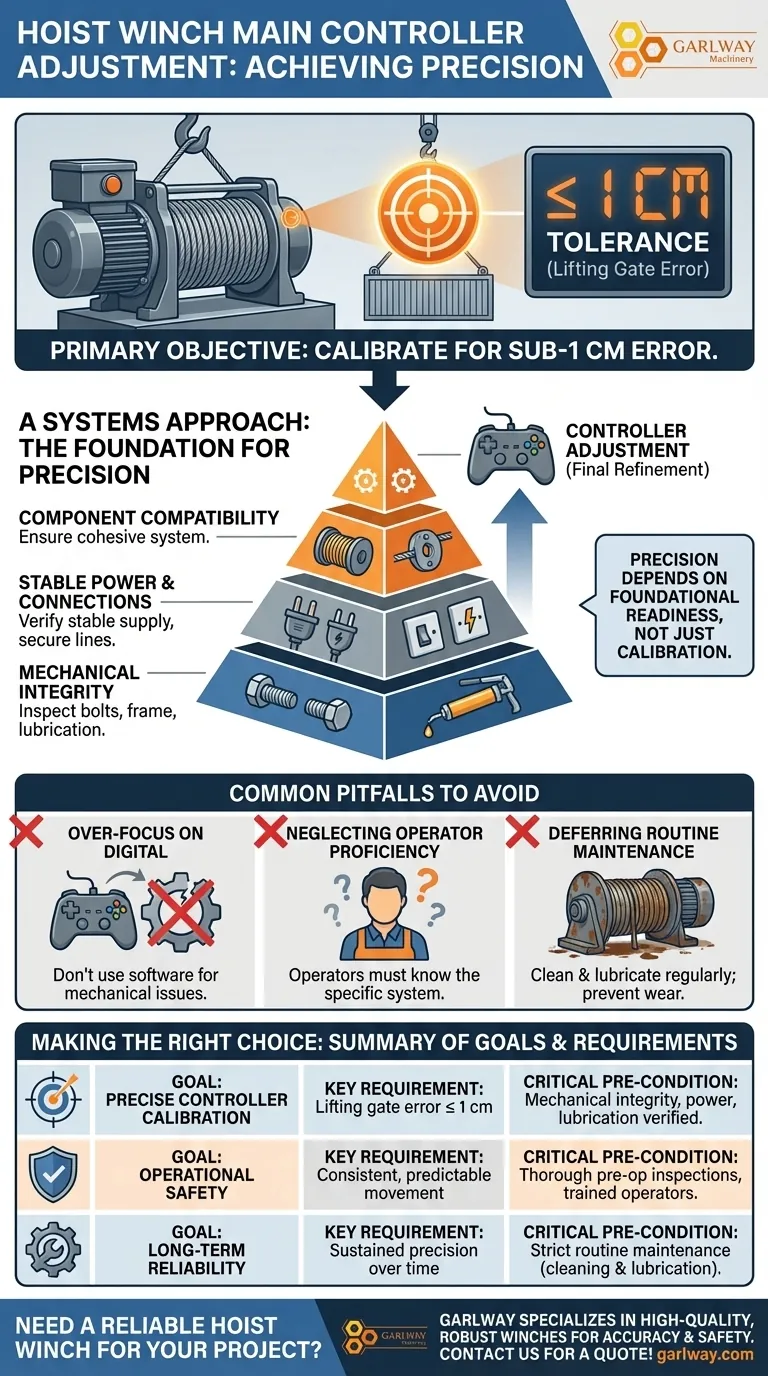
The primary adjustment for the hoist winch's main controller is to calibrate its output to ensure the lifting gate error does not exceed a tolerance of 1 centimeter. This specific requirement is the central focus of any controller tuning.
The precision of a hoist winch's main controller is fundamentally linked to the mechanical integrity and proper maintenance of the entire system. Adjusting the controller is a final step in calibration, not a substitute for foundational operational readiness.
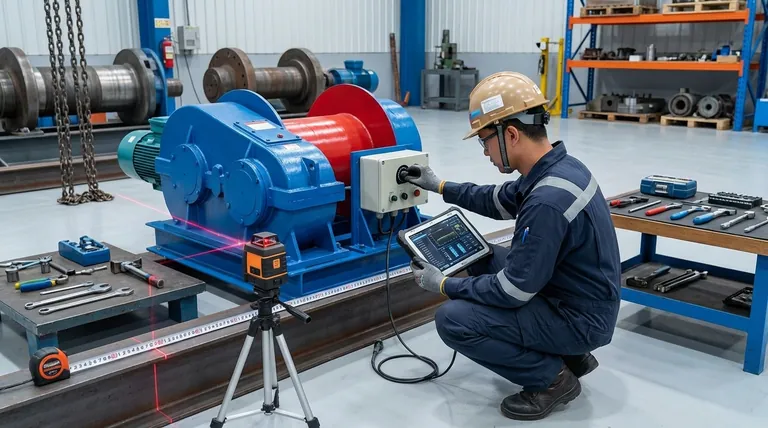
The Core Objective: Precision in Lifting Operations
The main controller acts as the brain of the hoist winch. Its adjustments are not arbitrary; they are directly tied to achieving the precise and safe movement of loads.
Defining "Lifting Gate Error"
"Lifting gate error" refers to the deviation between the intended position of the gate or load and its actual final position after a lifting or lowering operation.
An error margin of 1 cm is a strict tolerance, indicating that the operation requires a high degree of accuracy to function correctly and safely.
The Significance of the 1 cm Tolerance
This level of precision is critical for ensuring components align correctly, preventing damage to the load or machinery, and maintaining predictable, safe operational cycles.
Achieving this tolerance consistently is the key performance indicator for a properly adjusted main controller.
Beyond the Controller: A Systems Approach to Adjustment
A perfectly calibrated controller cannot compensate for underlying mechanical or operational issues. The entire system must be sound for any controller adjustment to be effective.
Mechanical Integrity is Non-Negotiable
Before adjusting the controller, a thorough inspection is essential. Ensure all bolts are tight and the winch frame is secure.
Proper lubrication is also critical. A controller's commands can be executed incorrectly if moving parts face excessive friction due to poor lubrication.
Verifying Power and Connections
Stable operation requires a stable power supply. Check that all power line connections are secure and switches are functioning correctly.
Inconsistent power can lead to erratic motor performance, making precise controller adjustments impossible to maintain.
Ensure Component Compatibility
The winch system must be cohesive. Ensure the strap or rope being used is compatible with the winch, and that the winch itself is attached correctly to its mounting point, such as a trailer.
An improperly sized rope or a loose attachment point will introduce variables that even a sophisticated controller cannot overcome.
Common Pitfalls to Avoid
Achieving precision requires avoiding common mistakes that can undermine the adjustment process and create safety risks.
Over-Focusing on Digital Calibration
The most common pitfall is attempting to solve a mechanical problem with a software or controller setting.
If the winch is binding, slipping, or vibrating, investigate the physical cause before attempting to recalibrate the controller.
Neglecting Operator Proficiency
The system's operator is a crucial component. They must be familiar with the winch's specific performance, structure, and operation methods.
An untrained operator can introduce errors or fail to notice early signs of malfunction, regardless of how well the controller is tuned.
Deferring Routine Maintenance
During maintenance, the load must be removed to allow for safe and thorough service.
Regularly clean the screw mechanism, remove old grease, and apply fresh lubricating oil. This prevents rust and wear, which are the primary enemies of long-term precision.
Making the Right Choice for Your Goal
Your approach should be dictated by your primary objective, as each goal builds upon the last.
- If your primary focus is long-term reliability: Implement a strict, regular maintenance schedule focused on lubrication and cleaning, as this provides the foundation for all other goals.
- If your primary focus is operational safety: Prioritize comprehensive pre-operation inspections and ensure operators are thoroughly trained on the winch's specific behavior.
- If your primary focus is achieving precision: Calibrate the main controller to meet the sub-1 cm lifting gate error tolerance, but only after all mechanical and safety checks are confirmed complete.
Ultimately, precise controller adjustment is the final refinement of a safe, well-maintained, and properly operated hoist winch system.
Summary Table:
| Adjustment Goal | Key Requirement | Critical Pre-Condition |
|---|---|---|
| Precise Controller Calibration | Lifting gate error ≤ 1 cm | Mechanical integrity, stable power, and proper lubrication verified |
| Operational Safety | Consistent, predictable load movement | Thorough pre-operation inspections and trained operators |
| Long-Term Reliability | Sustained precision over time | Strict routine maintenance schedule (cleaning and lubrication) |
Need a Reliable Hoist Winch for Your Project?
Achieving sub-1 cm precision requires a winch built for performance and durability. GARLWAY specializes in high-quality construction machinery, including robust winches designed for construction companies and contractors who demand accuracy and safety.
Let us provide you with a winch that delivers the precision you need. Contact GARLWAY today to discuss your requirements and get a quote!
Visual Guide
Related Products
- Electric Hoist Winch Boat Anchor Windlass for Marine Applications
- Electric and Hydraulic Winch for Heavy Duty Applications
- Hydraulic Winding Engine Harbor Freight Winch
- Small Electric Winch 120V and 240V for Compact Applications
People Also Ask
- How does an electric anchor winch work? Power, Safety, and Reliable Operation Explained
- What are the advantages of installing an electric anchor winch on a boat? Boost Safety & Ease for Boaters
- What are the operational differences between electric hoists and winches? A Guide to Safe Lifting vs. Pulling
- What are the main benefits of a boat anchor winch? Boost Safety & Efficiency for Your Vessel
- How does a boat anchor winch work? A Guide to Reliable Anchor Handling