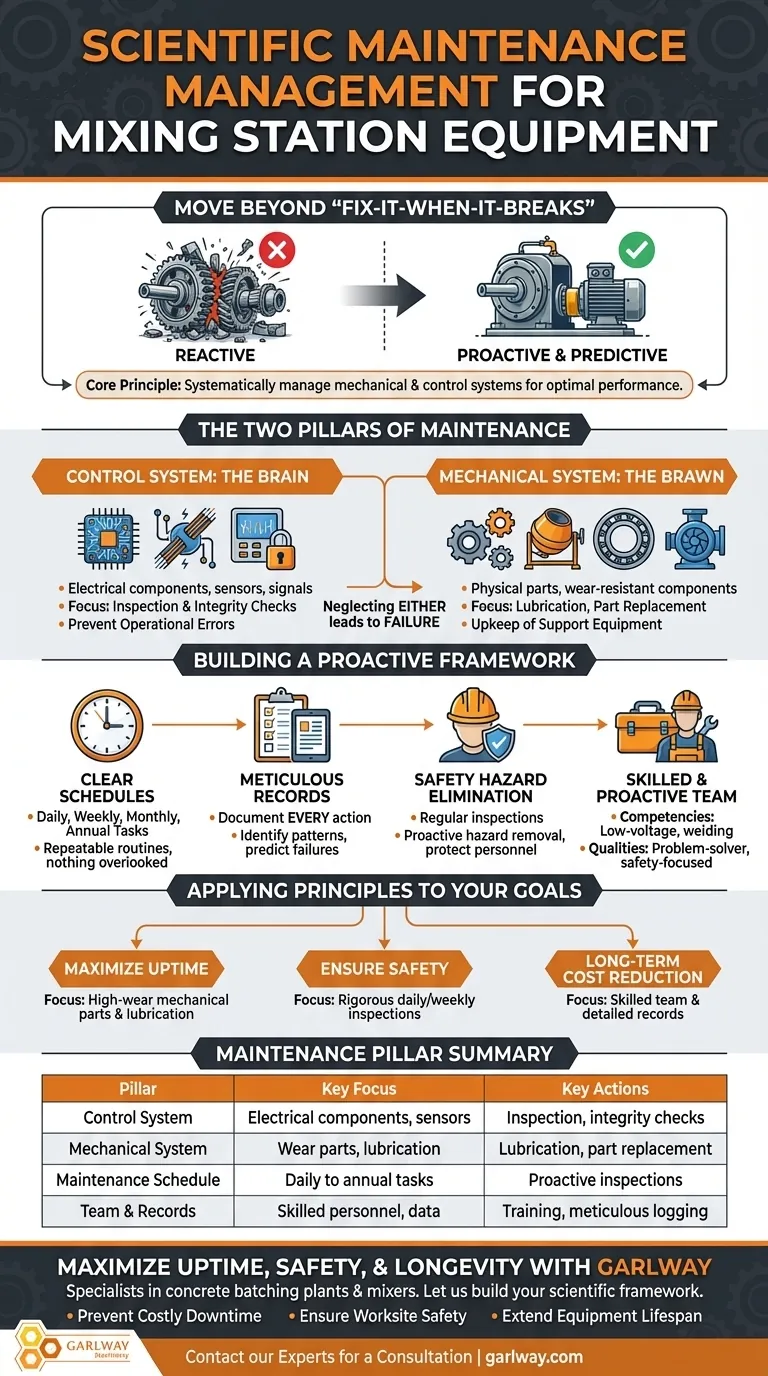
To manage the maintenance of mixing station equipment scientifically, you must implement a structured system that combines a professional team, clearly defined maintenance schedules, and meticulous record-keeping. This approach moves beyond simple repairs and establishes a proactive framework for ensuring long-term operational reliability and safety.
The core principle of scientific maintenance is shifting from a reactive "fix-it-when-it-breaks" model to a proactive, predictive system. This involves systematically managing both the mechanical and control systems to keep the entire station in optimal working condition at all times.
The Two Pillars of Mixing Station Maintenance
Effective maintenance requires a deep understanding of the two interconnected systems that form your mixing station: the control system and the mechanical system. Neglecting either one will inevitably lead to failure.
The Control System: The Station's Brain
The control system consists of all the electrical components that manage the station's operations. This includes motors, solenoid valves, sensors, heating elements, and the associated cables.
Proper maintenance here focuses on inspection and integrity checks. It ensures that the "brain" is giving and receiving the correct signals, preventing costly operational errors or shutdowns.
The Mechanical System: The Station's Brawn
The mechanical system includes all the physical parts that handle materials and endure physical stress. This is where most wear and tear occurs.
Key components include the internal wear-resistant parts of the mixer, aggregate storage bins, shaft seals, and pump seals. Maintenance of this system is heavily focused on lubrication, replacement of wear parts, and upkeep of support equipment like reducers and air compressors.
Building a Proactive Maintenance Framework
A scientific approach is built on structure and discipline. Random checks and undocumented repairs are insufficient for ensuring safety and efficiency.
Define Clear Maintenance Schedules
Your maintenance plan must be broken down into clear, repeatable tasks performed on a set schedule. This ensures nothing is overlooked.
These schedules should be personalized to your specific equipment and operational intensity, but they generally fall into four categories: daily, weekly,monthly, and annual tasks.
Meticulous Record-Keeping
Every maintenance action, from a simple lubrication check to a major part replacement, must be documented.
This data is not just for compliance; it creates a history of your equipment's health. Over time, these records allow you to identify patterns, predict potential failures, and make informed decisions about future upgrades or replacements.
Prioritize Safety Hazard Elimination
A core function of any maintenance program is to ensure a safe working environment.
Regular and timely inspections are critical for identifying and eliminating potential hazards before they can cause an accident. This proactive safety focus protects your personnel and prevents costly downtime.
The Foundation: A Skilled and Proactive Team
The most sophisticated plan is useless without the right people to execute it. The quality of your maintenance team is the single most important factor in the success of your program.
Core Technical Competencies
Your maintenance personnel must be multi-talented. They should possess a good grasp of low-voltage electrical work to handle the control system and be proficient in welding and gas cutting for mechanical repairs. Skill in using and maintaining a variety of tools and instruments is also essential.
Critical Professional Qualities
Technical skill alone is not enough. A truly effective maintenance professional is a proactive problem-solver with clear thinking and an unwavering focus on safety. They should take the initiative to find and fix issues and be committed to continuous improvement for themselves and the equipment they manage.
How to Apply This to Your Operation
Use these principles to build a maintenance strategy that aligns with your primary business goals.
- If your primary focus is maximizing uptime: Prioritize the scheduled inspection and replacement of high-wear mechanical parts, such as mixer liners and shaft seals, and ensure all lubrication points are meticulously maintained.
- If your primary focus is operational safety: Implement a rigorous daily and weekly inspection checklist for both electrical and mechanical systems to identify and neutralize potential hazards immediately.
- If your primary focus is long-term cost reduction: Invest in a skilled, proactive maintenance team and enforce detailed record-keeping to prevent catastrophic failures and extend the life of your equipment.
Ultimately, scientific maintenance transforms your equipment from a liability into a reliable, high-performing asset.
Summary Table:
| Maintenance Pillar | Key Focus | Key Actions |
|---|---|---|
| Control System | Electrical components, sensors, signals | Inspection, integrity checks |
| Mechanical System | Wear parts, lubrication, physical stress | Lubrication, part replacement, upkeep |
| Maintenance Schedule | Daily, weekly, monthly, annual tasks | Proactive inspections, defined routines |
| Team & Records | Skilled personnel, documentation | Training, meticulous logging, pattern analysis |
Maximize the uptime, safety, and longevity of your mixing station with GARLWAY.
As a specialist in construction machinery, including concrete batching plants and mixers, we understand the critical importance of proactive maintenance. Our expertise can help you build a scientific maintenance framework tailored to your operation.
Let us help you:
- Prevent costly downtime with predictive maintenance strategies.
- Ensure worksite safety through systematic hazard elimination.
- Extend equipment lifespan and optimize your total cost of ownership.
Ready to transform your mixing station into a reliable asset? Contact our experts today for a personalized consultation.
Visual Guide
Related Products
- HZS90 Large Multiquip Concrete Mixers for Construction
- HZS35 Small Cement Concrete Mixing Batch Plant
- HZS75 Concrete Batching Plant Cement Mixer Price Concrete Mixer Bunnings Mixing Plant
- Portable Concrete Mixer Machine Equipment for Mixing Concrete
- HZS120 Ready Mix Concrete Batching Plant Commercial Mud Cement Mixer
People Also Ask
- What are the types of concrete mixers used in batching plants? Choose the Right Mixer for Your Project
- What is the core component of a concrete batching plant? The Mixer Unit Defines Your Concrete Quality
- What are the different power sources for concrete mixers? Choose the Right Power for Your Project
- What are the main types of concrete mixers? A Guide to Batch, Continuous & More
- What are the main types of concrete mixers mentioned? Find the Perfect Mixer for Your Project