While the core concept remains, the modern concrete mixer truck has fundamentally evolved from early designs by integrating key technologies. The most significant changes include the addition of on-board water tanks for on-site mixing, the development of far more powerful engines to handle immense weight, and the adoption of automatic transmissions for operational efficiency.
The evolution of the concrete mixer truck is a story of solving a core logistical problem: how to transform a simple mixing drum into a mobile, high-precision batch plant capable of delivering perfectly timed, high-quality concrete to any job site.
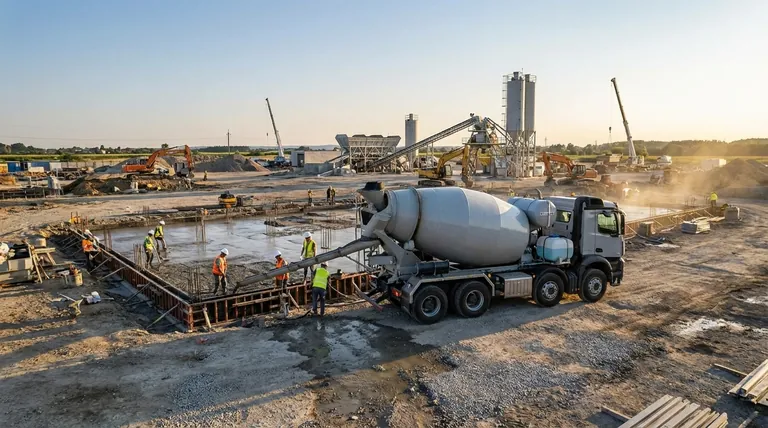
From Basic Tumbler to Mobile Batch Plant
The journey from T.L. Smith's 1900 invention to today's vehicles was driven by the practical demands of the modern construction industry. Early designs solved the basic problem of mixing, while modern designs solve the complex problem of logistics and quality control.
The Original Concept: A Simple Rotating Drum
The first motorized concrete mixers were a revolutionary step up from manual mixing. Their function was straightforward: combine cement, aggregate, and water at a central plant and keep the mixture agitated during transport to prevent it from setting.
This "central-mix" approach was effective but had a critical limitation. The clock started ticking the moment water was added, creating a race to the job site before the concrete began to harden.
The Game-Changer: On-Site Hydration
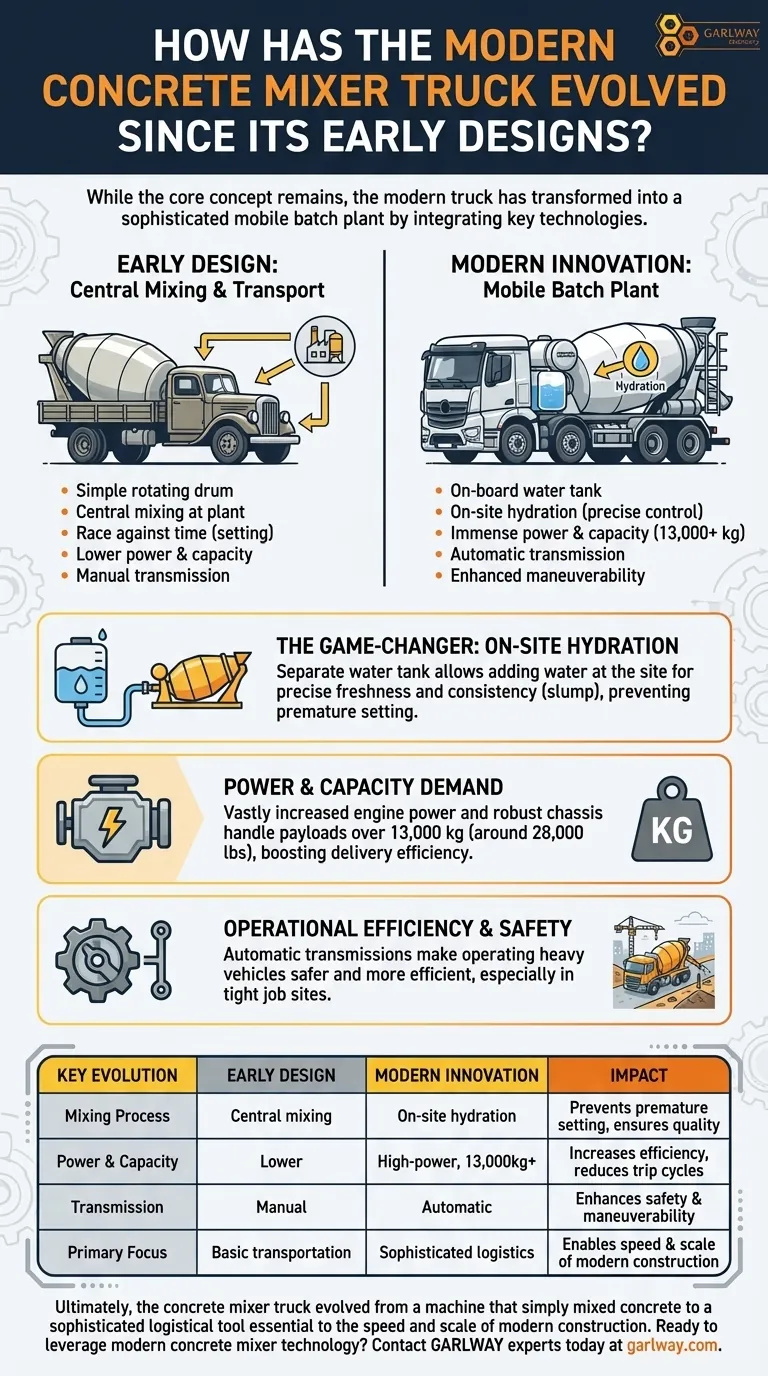
The most pivotal evolution was the addition of a separate water tank on the truck itself. This transformed the vehicle from a simple transporter into a mobile mixing station.
With this system, dry ingredients (cement and aggregate) are loaded at the plant. Water is added from the onboard tank only when the truck is at or near the construction site, a process known as hydration.
This innovation gives contractors precise control over the concrete's freshness and final consistency (slump), ensuring a higher-quality pour.
The Demand for Greater Power and Capacity
Modern construction projects require vast quantities of concrete. To meet this demand, mixer trucks grew significantly in size and weight.
A modern truck can carry over 13,000 kg (around 28,000 lbs) of concrete. Moving this immense, constantly shifting load requires a massive increase in engine power and a robust chassis compared to early models.
Coupled with this power are automatic transmissions, which became common after World War II. They make operating these heavy vehicles far safer and more efficient, especially in the tight confines of a construction site.
Understanding the Trade-offs
Each technological advancement, while solving a problem, introduced new complexities and compromises that define the modern vehicle.
Weight vs. Road Regulations
While a larger drum and more powerful engine allow a truck to carry more concrete, they are constrained by public road weight limits. The design of every mixer truck is a careful balance between maximizing payload and remaining street-legal.
Efficiency vs. Maintenance
Modern hydraulic systems, water pumps, and advanced drivetrains are essential for performance. However, they add significant complexity and require specialized maintenance compared to the mechanically simple early designs.
Flexibility vs. Plant Control
On-site mixing provides incredible flexibility. However, the most precise quality control still occurs in a computer-controlled central batch plant. The modern truck bridges this gap, but the potential for on-site error (like adding too much water) remains a factor operators must manage carefully.
The Impact of Modern Mixer Design
The evolution of the concrete mixer was not just about better parts, but about enabling new possibilities in construction.
- If your primary focus is concrete quality: The separate water tank is the most critical evolution, allowing for precise, on-demand hydration that prevents premature setting.
- If your primary focus is project efficiency: Increased engine power and larger drum capacities mean more concrete delivered per trip, reducing vehicle cycles and on-site congestion.
- If your primary focus is operational safety and logistics: Automatic transmissions and improved vehicle maneuverability have made it safer and simpler to position these massive vehicles on crowded job sites.
Ultimately, the concrete mixer truck evolved from a machine that simply mixed concrete to a sophisticated logistical tool essential to the speed and scale of modern construction.
Summary Table:
| Key Evolution | Early Design | Modern Innovation | Impact |
|---|---|---|---|
| Mixing Process | Central mixing at plant | On-site hydration via onboard water tank | Prevents premature setting, ensures concrete quality |
| Power & Capacity | Lower power, smaller capacity | High-power engines, payloads over 13,000 kg | Increases delivery efficiency, reduces trip cycles |
| Transmission | Manual operation | Automatic transmissions | Enhances safety and maneuverability on job sites |
| Primary Focus | Basic transportation | Sophisticated logistics and quality control | Enables speed and scale of modern construction projects |
Ready to leverage modern concrete mixer technology for your projects? As GARLWAY, a leading provider of construction machinery including high-performance concrete mixers and batching plants, we help construction companies and contractors globally achieve superior efficiency, quality, and safety. Let us equip you with the right machinery to meet your project demands—contact our experts today to discuss your needs and discover how our solutions can drive your success!
Visual Guide
Related Products
- Ready Mixer Machine for Construction Ready Mix Machinery
- JW1000 Mobile Cement Mixer Concrete Mixer Truck and Batching Plant
- Mini Cement Mortar Mixer Truck for Construction
- Harbor Freight JS1500 On Site Concrete Mixing Volumetric Cement Mixer
- HZS90 Large Multiquip Concrete Mixers for Construction
People Also Ask
- What are the purposes of low-speed agitation in truck mixers? Preserve Concrete Quality During Transit
- How is ready-mixed concrete transported from a commercial concrete batching plant? Ensuring Quality & Timely Delivery
- What are the main ingredients mixed in a concrete mixer truck? Master the Formula for Strong Concrete
- In what ways does a mobile concrete mixer improve quality control and consistency? Achieve Superior On-Site Concrete Quality
- What types of construction projects typically use concrete mixer trucks? From Highways to Home Foundations