At its core, a 55-gallon drum roller operates by rotating a sealed drum on its horizontal axis, much like rolling it across the floor. This simple mechanical action causes the contents inside to tumble and mix together. The entire process is accomplished without ever opening the drum, making it a non-invasive and clean method for homogenizing materials.
The fundamental value of a drum roller is its ability to provide safe, efficient mixing while eliminating direct contact with the contents. By keeping the drum sealed, it drastically reduces worker exposure and simplifies cleanup.
The Mechanics of Horizontal Rotation
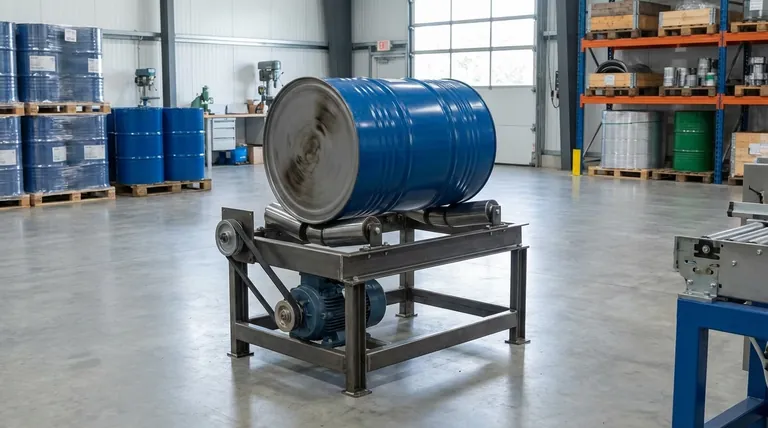
A drum roller's design is straightforward but highly effective. It relies on a motorized base with rollers that cradle and spin the drum.
The Principle of Operation
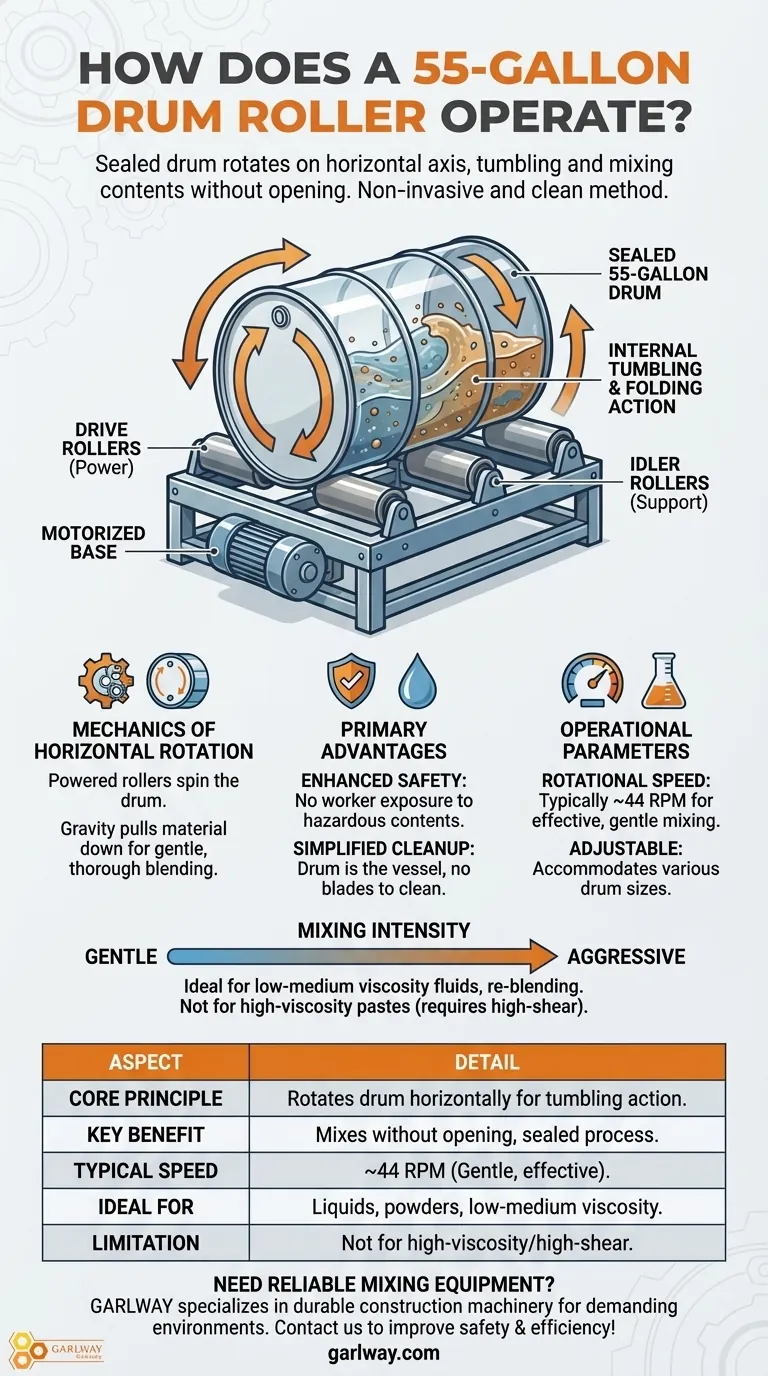
The equipment uses a set of powered rollers to turn the drum on its side. As the drum rotates, gravity continuously pulls the material downward, causing a gentle but thorough tumbling and folding action that blends the contents.
Internal Mixing Action
This method is ideal for re-homogenizing settled liquids, blending powders, or mixing low-to-medium viscosity fluids. The constant lifting and falling of the material ensures a consistent mixture is achieved throughout the drum.
Critical Components
The system consists of a sturdy frame, an electric motor providing the rotational force, and the drive and idler rollers that support and turn the drum. The simplicity of these components leads to high reliability and low maintenance.
The Primary Advantages of Sealed Drum Mixing
The decision to use a drum roller often centers on its significant operational benefits, particularly concerning safety and efficiency.
Enhanced Worker Safety
Because the drum remains sealed from start to finish, worker exposure to potentially hazardous chemicals, fumes, or fine powders is eliminated. This is a critical advantage in industries with strict safety protocols.
Simplified Cleanup
There are no mixing shafts, blades, or impellers to clean. The drum itself is the mixing vessel, which means the cleanup process is virtually nonexistent, saving significant time and labor.
Versatility in Application
Drum rollers are effective for a wide range of materials, including paints, oils, adhesives, slurries, and dry powders. They ensure contents are ready for use without requiring transfer to another mixing container.
Understanding the Operational Parameters and Trade-offs
While effective, it's important to understand the specific parameters and limitations of this mixing method.
Rotational Speed
Most models operate at a fixed or variable speed, often around 44 revolutions per minute (RPM). This speed is chosen to provide effective mixing without creating excessive foam or damaging shear-sensitive materials.
Adjustability and Sizing
Many drum rollers are not limited to a single size. They can often be adjusted to accommodate drums of various diameters and lengths, adding to their operational flexibility.
The Limitation of Gentle Mixing
The primary trade-off is mixing intensity. For extremely high-viscosity materials or applications that require aggressive high-shear mixing to combine immiscible liquids, a more powerful immersion mixer may be necessary.
Making the Right Choice for Your Goal
Selecting the correct mixing method depends entirely on your material and operational priorities.
- If your primary focus is safety and minimizing contamination: A drum roller is the ideal choice as it keeps the container sealed, preventing spills and exposure.
- If your primary focus is re-blending settled liquids or powders: The gentle tumbling action of a roller provides an effective and energy-efficient solution.
- If your primary focus is aggressive mixing for thick pastes: You may need to consider an immersion mixer with a specialized impeller to achieve the necessary shear force.
By understanding its simple and reliable mechanical principle, you can leverage the drum roller for safer, cleaner, and more efficient mixing operations.
Summary Table:
| Aspect | Detail |
|---|---|
| Core Principle | Rotates drum on horizontal axis for tumbling action. |
| Key Benefit | Mixes contents without opening the drum. |
| Typical Speed | ~44 RPM for gentle, effective blending. |
| Ideal For | Re-homogenizing liquids, blending powders, low-medium viscosity fluids. |
| Limitation | Not for high-viscosity pastes or aggressive, high-shear mixing. |
Need reliable and safe mixing equipment for your construction site?
GARLWAY specializes in durable construction machinery designed for demanding environments. Our range of equipment, including robust mixers, can help your company improve operational safety and efficiency.
Contact us today to discuss how our solutions can meet your specific project requirements!
Visual Guide
Related Products
- Portable Concrete Mixer Machine Equipment for Mixing Concrete
- Concrete Cement Mixer Machine Drum Mixer for Construction
- Portable Small Trailer Winch
- Harbor Freight JS1500 On Site Concrete Mixing Volumetric Cement Mixer
- Belle Mixer Drum Self Loading Mortar Mixers JS3000
People Also Ask
- Why is it necessary to use a portable concrete mixer? Gain Total Control & Efficiency
- How much concrete can you pour with a portable mixer? Find the Perfect Fit for Your Project
- What types of projects are portable concrete mixers suitable for? Ideal for DIY & Small-Scale Construction
- How much does a portable concrete mixer hold? A Guide to Choosing the Right Capacity
- What types of portable concrete mixers exist? Find the Perfect Mixer for Your Project