
The fundamental difference is that planetary mixers have significantly more demanding maintenance requirements due to their complex internal mechanics, while drum mixers are simpler and far easier to clean and maintain. This distinction is a direct result of their respective designs, which are engineered for entirely different mixing applications and performance levels.
The higher maintenance of a planetary mixer is the necessary trade-off for its high-shear, thorough mixing capability. Conversely, the low-maintenance simplicity of a drum mixer comes at the cost of less uniform, gravity-based mixing action.
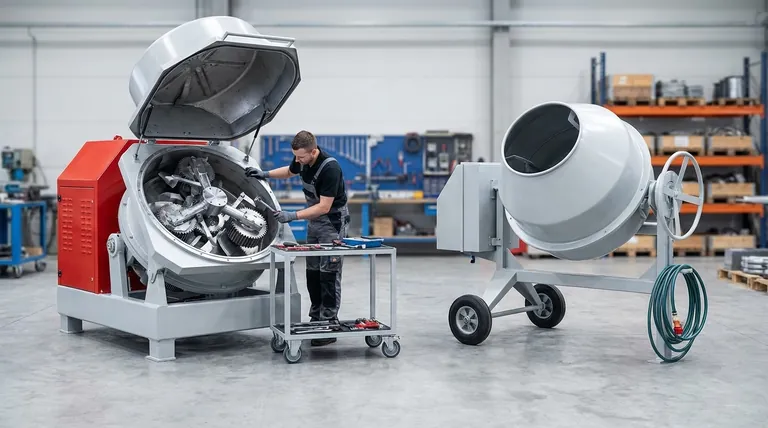
The Core Design Difference Driving Maintenance
The maintenance required by each mixer type is not arbitrary; it's a direct consequence of how they are built to function.
Planetary Mixer Mechanics: Engineered Complexity
A planetary mixer features one or more mixing blades that rotate on their own axes while simultaneously revolving around the center of the mixing bowl, much like planets orbiting the sun.
This complex, gear-driven motion ensures the blades reach every point within the vessel, creating the high-shear action needed for completely uniform mixtures, especially with fine or varied particle sizes. However, this complexity creates numerous maintenance challenges.
Drum Mixer Mechanics: Elegant Simplicity
A drum mixer, by contrast, is a simple hollow vessel that rotates on a single axis. It relies on gravity and the tumbling motion of the rotation to mix materials.
The interior is typically a smooth, continuous surface with few, if any, internal moving parts. This minimalist design makes it inherently easier to service and clean.
A Practical Breakdown of Maintenance Tasks
Understanding the design differences makes the practical maintenance tasks for each mixer clear.
Cleaning a Planetary Mixer
The intricate system of blades, arms, and gearboxes creates multiple "dead spots" where material can accumulate. Cleaning requires careful disassembly of mixing tools and meticulous attention to ensure no residue is left behind, which could contaminate future batches.
Cleaning a Drum Mixer
With its smooth interior and lack of complex parts, a drum mixer is often cleaned by simply rinsing or tumbling a cleaning agent inside. There are far fewer crevices for material to become trapped, drastically reducing cleaning time and effort.
Mechanical Upkeep and Repairs
Planetary mixers have more points of potential failure, including gearboxes, seals, bearings, and drive motors for the mixing stars. Regular lubrication and inspection are critical.
Drum mixers have a much simpler mechanical profile, typically limited to the main rotational bearings and the drive system. This results in fewer required inspections and a lower likelihood of complex mechanical failure.
Understanding the Trade-off: Performance vs. Simplicity
The choice between these mixers comes down to a clear trade-off between mixing performance and operational simplicity.
When High Performance Justifies High Maintenance
A planetary mixer is the correct choice when the final product's quality depends on a perfectly homogeneous and consistent mixture. Its high-shear action is essential for applications involving fine powders, viscous pastes, or materials with disparate particle sizes that would otherwise segregate.
When Simplicity Outweighs Mixing Intensity
A drum mixer is ideal for applications where gentle tumbling is sufficient and absolute uniformity is not the primary goal. It excels at blending granules or powders of similar size and density where the risk of segregation is low and operational efficiency is paramount.
Making the Right Choice for Your Operation
The decision hinges on the specific requirements of your material and process.
- If your primary focus is process-critical uniformity and high-shear mixing: The intensive maintenance of a planetary mixer is a necessary investment for superior product quality.
- If your primary focus is operational simplicity, lower cost, and gentle blending: The easy maintenance and straightforward design of a drum mixer make it the more efficient choice.
Ultimately, aligning the mixer's capabilities and maintenance profile with your production goals is the key to an effective and efficient operation.
Summary Table:
| Mixer Type | Maintenance Complexity | Key Maintenance Tasks | Ideal For |
|---|---|---|---|
| Planetary Mixer | High | Disassembly, meticulous cleaning, gearbox & seal inspection | High-shear, uniform mixing (fine powders, viscous pastes) |
| Drum Mixer | Low | Simple rinsing, bearing inspection | Gentle blending of similar materials (granules, low-segregation risk) |
Struggling to choose the right mixer for your project's maintenance and performance needs?
GARLWAY specializes in providing durable and efficient construction machinery, including concrete mixers and batching plants, tailored for construction companies and contractors globally. Our experts can help you select the perfect equipment to balance mixing performance with operational simplicity, ensuring your site runs smoothly and cost-effectively.
Contact GARLWAY today for a personalized consultation and discover how our solutions can enhance your productivity and bottom line.
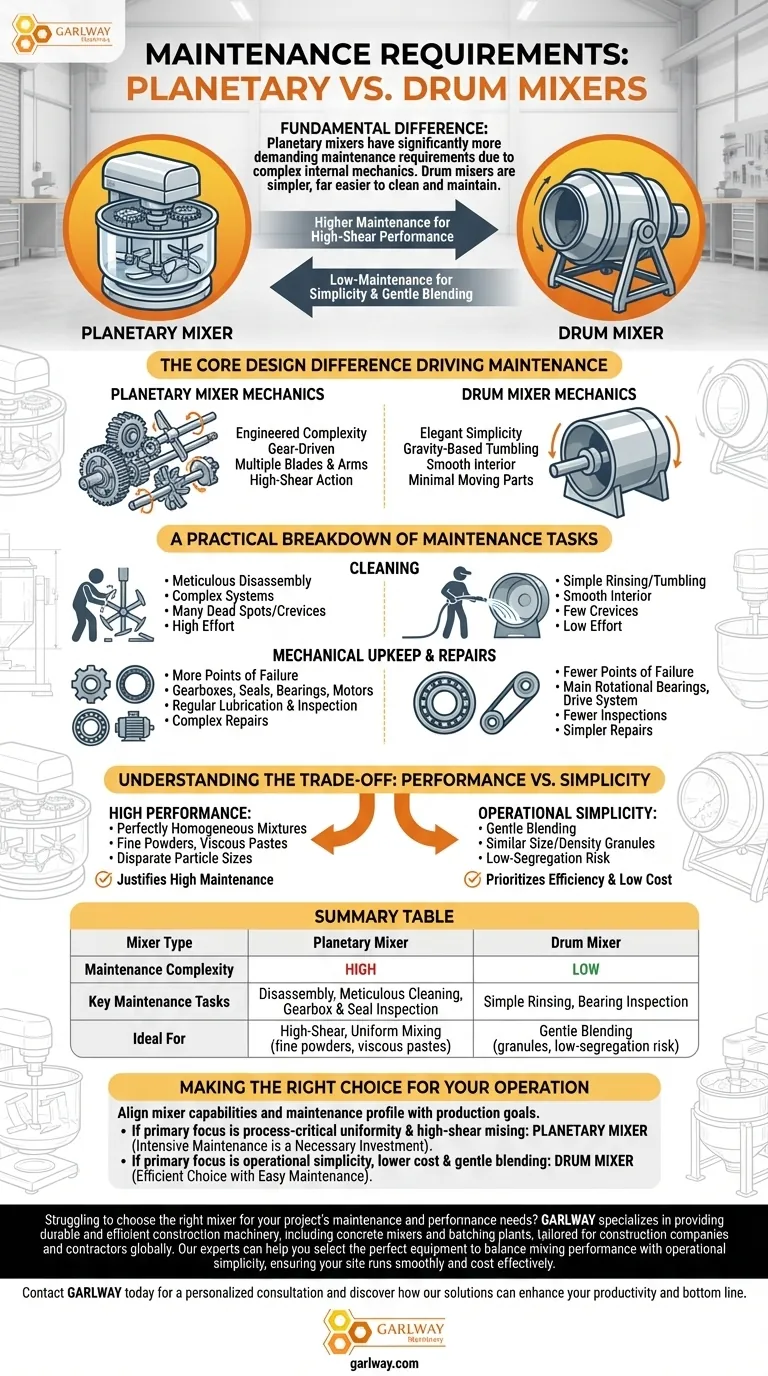
Visual Guide
Related Products
- Belle Mixer Drum Self Loading Mortar Mixers JS3000
- Concrete Cement Mixer Machine Drum Mixer for Construction
- JS1000 Volumetric Concrete Mortar Mixer for Sale Skid Steer Cement Mixer
- Portable Ready Mix Concrete Mixer Equipment
- Portable Concrete Mixer Machine Equipment for Mixing Concrete
People Also Ask
- What are the features of mobile transporting in a self loading mixer? Boost On-Site Efficiency
- Why is timely cleaning important for a self loading mixer? Prevent Costly Downtime and Mix Failure
- How is discharging accomplished in a self loading mixer? Master Precise Concrete Placement
- What is the purpose of keeping the drum rotating during transportation in a self loading concrete mixer? Ensure Quality & Consistency
- What components are involved in the loading process of a self loading concrete mixer? A Guide to the Key Systems


