
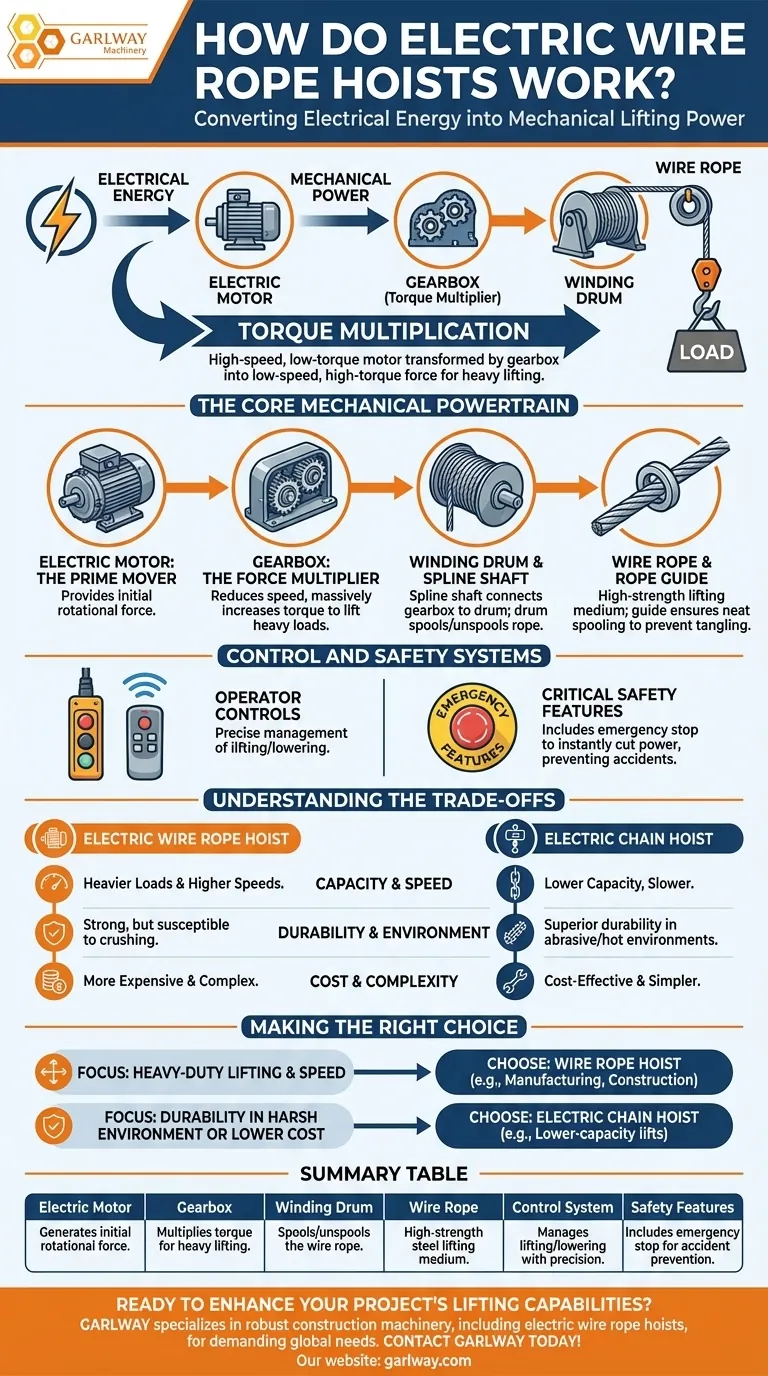
At its core, an electric wire rope hoist works by converting electrical energy into mechanical lifting power. An electric motor drives a gearbox, which multiplies the torque to rotate a winding drum. A steel wire rope, guided to prevent tangling, wraps around this drum, lifting or lowering the attached load with precision control.
The essential principle is torque multiplication. A high-speed, low-torque motor is transformed by a gearbox into a low-speed, high-torque force capable of rotating the drum and lifting heavy loads far beyond the motor's direct capacity.
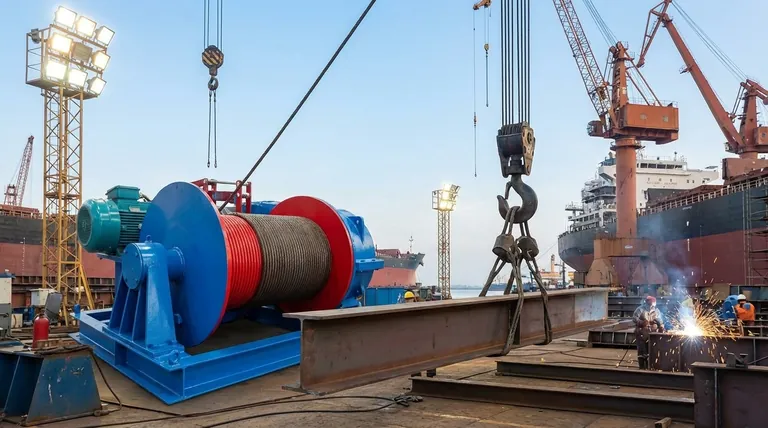
The Core Mechanical Powertrain
An electric wire rope hoist is a system of interconnected components, each with a specific function. Understanding how they work in sequence is key to understanding the entire machine.
The Electric Motor: The Prime Mover
The electric motor is the heart of the hoist. It provides the initial rotational force needed to power the entire lifting operation.
The Gearbox: The Force Multiplier
The motor connects to a gearbox (also called a gear reducer). This critical component uses a series of gears to reduce the rotational speed from the motor while massively increasing its torque, or rotational force.
This amplification is what allows a relatively compact motor to lift extremely heavy objects.
The Winding Drum and Spline Shaft
The output of the gearbox turns a spline shaft, which is directly connected to the large winding drum. As the drum rotates, it spools (wraps) or unspools (unwraps) the wire rope.
The Wire Rope and Rope Guide
The wire rope itself is the lifting medium, typically made from high-strength carbon or stainless steel. A rope guide moves along the drum as it turns, ensuring the rope wraps neatly into the drum's grooves, which prevents tangling and ensures smooth operation.
Control and Safety Systems
Power without control is useless. Hoists are equipped with precise systems to manage their operation and ensure safety.
Operator Controls
Hoists are governed by control mechanisms that allow the operator to manage lifting and lowering. These are commonly push-button pendants connected by a wire or wireless remote controls for greater flexibility.
Critical Safety Features
Modern hoists include essential safety mechanisms. The most prominent is the emergency stop button, which allows an operator to instantly cut all power to the hoist in an unforeseen or dangerous situation, preventing accidents.
Understanding the Trade-offs
Electric wire rope hoists are powerful tools, but they are not the only option. Their primary alternative is the electric chain hoist, and the choice between them involves distinct trade-offs.
Capacity and Speed
Wire rope hoists are engineered for heavier loads and higher lifting speeds. Their design makes them the standard choice for demanding, heavy-duty industrial applications where cycle time is critical.
Durability and Environment
While strong, the individual wires in a rope can be susceptible to damage from crushing or harsh environmental factors. A chain may offer superior durability in abrasive or high-temperature environments.
Cost and Complexity
Due to their design for higher performance and capacity, wire rope hoists are generally more expensive and structurally more complex than their chain hoist counterparts.
Making the Right Choice for Your Application
Selecting the right hoist depends entirely on the demands of the job.
- If your primary focus is heavy-duty lifting and speed: A wire rope hoist is the superior choice for high-capacity, fast-paced environments like manufacturing, bridge construction, and shipbuilding.
- If your primary focus is durability in a harsh environment or lower cost: An electric chain hoist may be a more suitable and cost-effective solution, especially for lower-capacity lifts.
Ultimately, understanding the core mechanical principles of the hoist empowers you to select the right tool for the task.
Summary Table:
| Component | Primary Function |
|---|---|
| Electric Motor | Generates initial rotational force |
| Gearbox | Multiplies torque for heavy lifting |
| Winding Drum | Spools/unspools the wire rope |
| Wire Rope | High-strength steel lifting medium |
| Control System | Manages lifting/lowering with precision |
| Safety Features | Includes emergency stop for accident prevention |
Ready to enhance your project's lifting capabilities?
GARLWAY specializes in providing robust construction machinery, including electric wire rope hoists, winches, and concrete batching plants, designed for the demanding needs of construction companies and contractors globally. Our solutions ensure efficiency, safety, and reliability for heavy-duty lifting tasks.
Contact GARLWAY today to discuss your specific requirements and discover the right hoist for your application!
Visual Guide
Related Products
- Electric Hoist Winch Boat Anchor Windlass for Marine Applications
- Electric and Hydraulic Winch for Heavy Duty Applications
People Also Ask
- How does an electric anchor winch work? Power, Safety, and Reliable Operation Explained
- What are the advantages of installing an electric anchor winch on a boat? Boost Safety & Ease for Boaters
- What are the operational differences between electric hoists and winches? A Guide to Safe Lifting vs. Pulling
- What are the main benefits of a boat anchor winch? Boost Safety & Efficiency for Your Vessel
- How does a boat anchor winch work? A Guide to Reliable Anchor Handling

