The key to selecting a volumetric mixer is understanding that each model is a specialized tool designed for a specific operational environment. Different models accommodate project needs by offering distinct combinations of physical size, production capacity, and automation level, allowing you to match the machine directly to the demands of the job site and your business goals.
Choosing the right volumetric mixer is not about finding the "best" machine overall, but about identifying the model whose specific design—its physical footprint, output volume, and automation features—aligns perfectly with your project's unique constraints and production targets.
Matching Mixer Size to Your Job Site
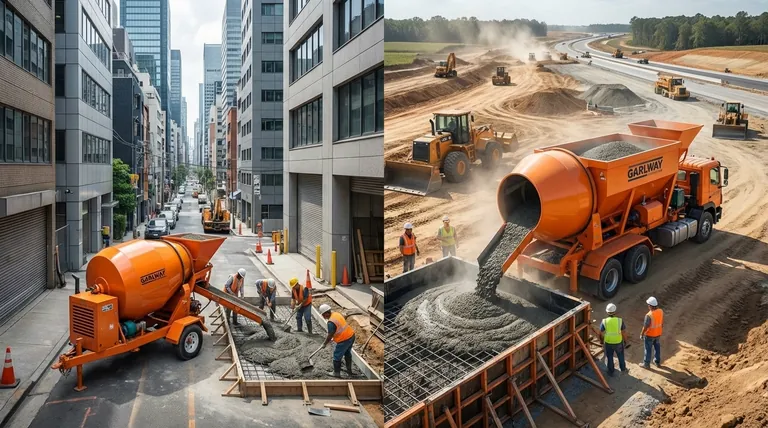
The physical dimensions of a mixer are often the first and most critical consideration. The environment you work in dictates the feasibility of using certain equipment.
The Compact Solution for Urban Environments
For projects in dense, tight urban spaces, maneuverability is paramount. A smaller model, like the P50, is engineered specifically for these conditions.
Its compact design allows access to job sites that larger trucks simply cannot reach, all while maintaining a high production output relative to its size.
The High-Capacity Choice for Large-Scale Projects
Conversely, when the primary goal is maximum concrete production and space is not a constraint, a large model is the logical choice.
A mixer like the P95 is built for high-volume, continuous pours, making it ideal for large infrastructure projects, highway work, or remote job sites where efficiency is measured in cubic meters per hour.
Aligning Production Needs with Mixer Capabilities
Beyond physical size, the internal features and automation level determine how a mixer fits into your operational workflow. This is where you balance performance with budget.
Balancing Features and Price Point
Mid-range models like the P75 and P85 serve as versatile workhorses for a wide array of common applications.
These mixers strike a crucial balance, offering robust capabilities without the maximum footprint of the largest models, making them a practical and cost-effective choice for many businesses.
The Role of Automation in Efficiency
For operations prioritizing consistency and streamlined workflows, automation is a key differentiator.
A model like the P85 offers full automation capabilities. This feature ensures precise mix designs, reduces the potential for operator error, and can lead to significant long-term gains in material efficiency and product quality.
Understanding the Core Trade-offs
Every equipment decision involves trade-offs. Recognizing them is essential for making an informed choice that aligns with your business priorities.
Maneuverability vs. Maximum Output
The most fundamental trade-off is between the agility of a small mixer and the sheer volume of a large one.
Opting for a compact model like the P50 grants you access to more restrictive job sites but means sacrificing the top-end production capacity of a larger model like the P95.
Upfront Cost vs. Automation Benefits
The decision between a standard mid-range model and one with full automation involves balancing initial investment against long-term operational returns.
A fully automated model like the P85 may carry a higher upfront cost, but its precision can reduce material waste and enhance mix consistency, offering a return on investment over time.
How to Select the Right Model for Your Operation
Choosing the correct mixer requires a clear understanding of your most common project types and primary business objectives.
- If your primary focus is maneuverability in constrained urban areas: A compact model like the P50 is engineered for your exact needs.
- If your primary focus is maximizing production on large-scale jobs: A high-capacity model like the P95 provides the necessary output.
- If your primary focus is a versatile balance of performance and budget: A mid-range model like the P75 or P85 offers the most flexibility.
- If your primary focus is achieving maximum consistency and efficiency through technology: The full automation offered by a model like the P85 is the superior choice.
Ultimately, the right volumetric mixer is the one that functions as a seamless extension of your operational strategy.
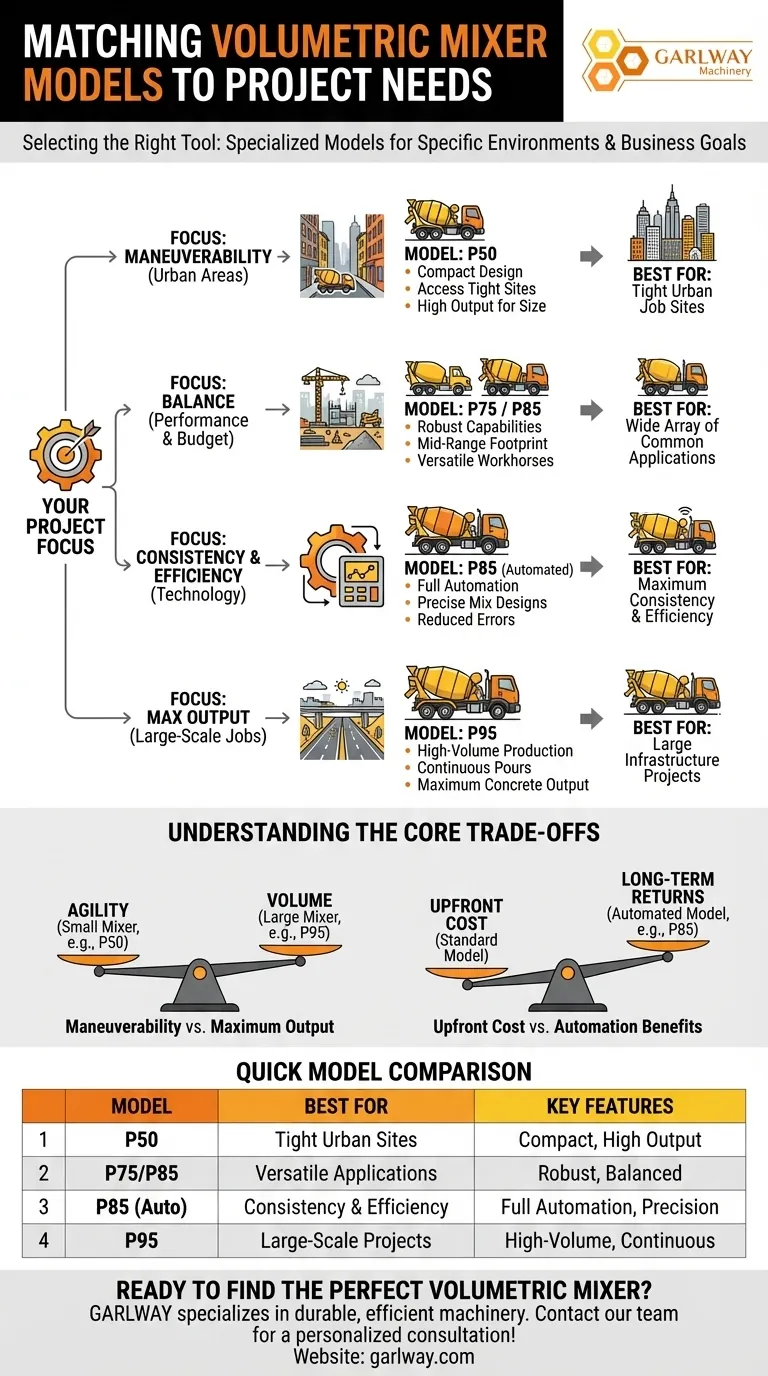
Summary Table:
| Model | Best For | Key Features |
|---|---|---|
| P50 | Tight urban job sites, high maneuverability | Compact design, high output for size |
| P75/P85 | Versatile applications, balance of performance & budget | Robust capabilities, mid-range footprint |
| P85 (Automated) | Maximum consistency & efficiency | Full automation, precise mix designs |
| P95 | Large-scale projects, maximum output | High-volume production, continuous pours |
Ready to find the perfect volumetric mixer for your projects?
GARLWAY specializes in providing durable and efficient construction machinery, including volumetric mixers, for construction companies and contractors worldwide. Our experts can help you select the ideal model—whether you need a compact P50 for city work or a high-capacity P95 for large-scale projects—to maximize your on-site efficiency and profitability.
Contact our team today for a personalized consultation and quote!
Visual Guide
Related Products
- Harbor Freight JS1500 On Site Concrete Mixing Volumetric Cement Mixer
- Belle Cement Mixer JS2000 Volumetric Concrete Mixer for Harbor Freight
- JS1000 Volumetric Concrete Mortar Mixer for Sale Skid Steer Cement Mixer
- Portable Concrete Mixer Machine Equipment for Mixing Concrete
- JDC350 Small Cement Concrete Mortar Mixer
People Also Ask
- What is the basic working principle of volumetric concrete mixers? On-Demand Mixing for Zero Waste
- How does a volumetric concrete mixer contribute to sustainability? Reduce Waste, Water, and Emissions On-Site
- What is a volumetric concrete mixer? A Mobile Concrete Batch Plant for On-Demand Mixing
- What is the predicted future for volumetric concrete mixers? Growth Driven by On-Demand Efficiency
- How does volumetric concrete compare to ready-mix concrete? Choose the Right Method for Your Project