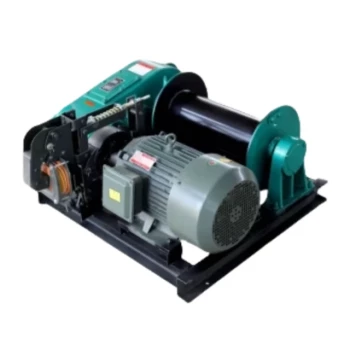
Yes, virtually all modern electric winches are equipped with a brake. This is not an optional feature but an integral safety system designed to automatically hold a load in place. When you release the control button, cutting power to the motor, the internal braking mechanism engages instantly to prevent the cable from spooling out and the load from slipping.
The crucial takeaway is that an electric winch's brake is an automatic holding system, not a manually operated one. It is engineered to engage the moment motor operation ceases, ensuring the load is held securely and safely without any further user input.
How an Electric Winch Brake Works
Understanding the brake's function is key to operating a winch safely. It is designed for simplicity and reliability, engaging by default as a fail-safe.
The Principle of Automatic Braking
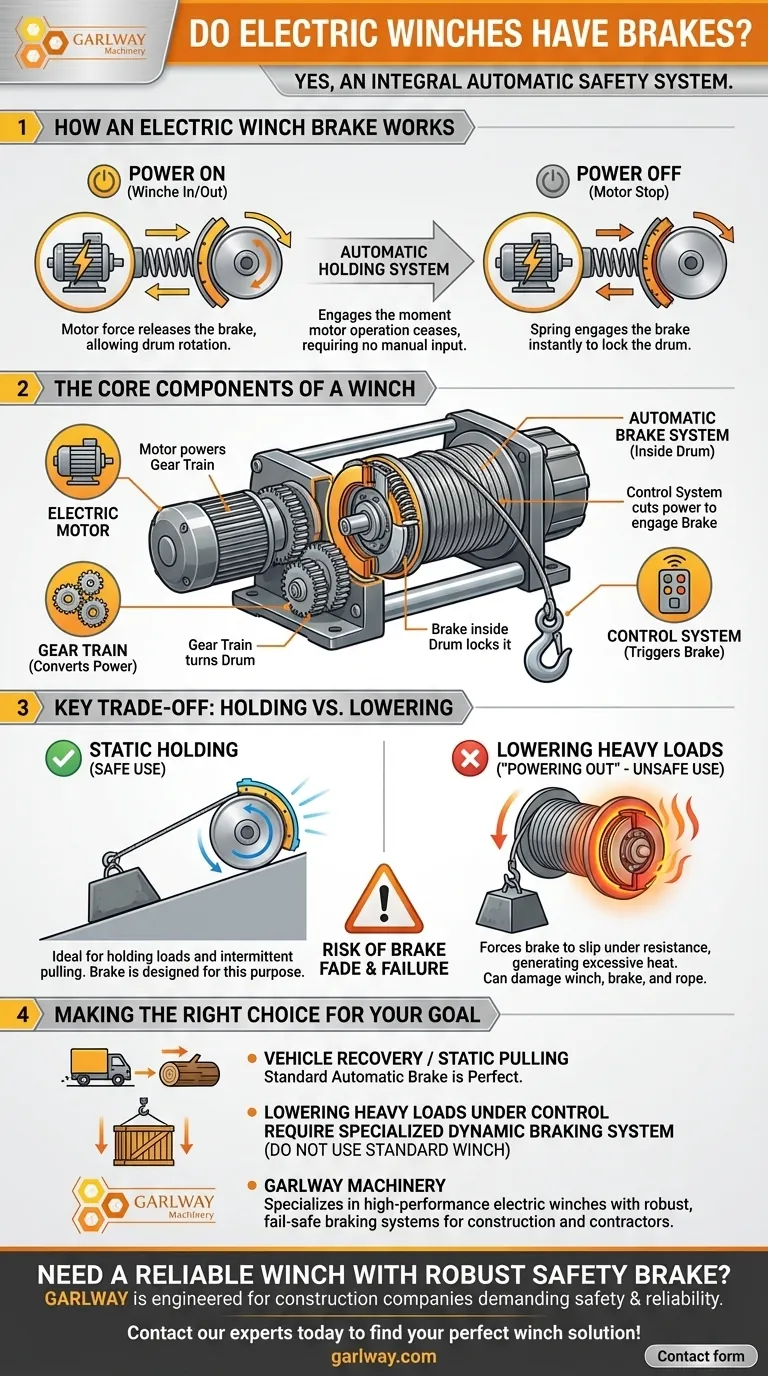
The braking system in an electric winch is typically spring-applied and power-released. This means a mechanical spring forces the brake to be engaged by default.
When you power the winch (either in or out), the motor's force overcomes the spring, releasing the brake and allowing the drum to turn. The moment you stop powering the motor, the spring instantly re-engages the brake, locking the drum.
Common Brake Locations and Types
Most modern vehicle and utility winches house the brake assembly inside the winch drum. This design is compact and protects the mechanism from the elements.
As the winch operates, especially under heavy load, this internal brake can generate significant heat. This is a normal part of its operation but highlights why proper usage is critical.
The "Hold" Function in Practice
The automatic brake is what gives you control. It allows you to pull a load a few inches at a time, stop to reassess, and be confident the winch will hold the tension without you needing to do anything other than take your finger off the button.
The Core Components of an Electric Winch System
The brake is one of several key components that work together. Understanding how they interrelate clarifies the brake's role.
The Electric Motor
This is the heart of the winch, providing the power to turn the gear train. It can be a permanent magnet or series wound motor, each with different performance characteristics.
The Gear Train
The motor's high-speed, low-torque power is converted by a planetary or spur gear train into the low-speed, high-torque force needed to pull a heavy load.
The Winch Drum and Cable
The drum is what the wire or synthetic rope winds onto. The brake is typically located inside this drum, locking it in place.
The Braking System
As discussed, this is the critical safety component. It works in tandem with the gearbox to hold the full rated load of the winch.
The Control System
Whether a wired remote or a wireless unit, the controller simply sends power to the motor. Releasing the button on the controller cuts the power, which is the trigger for the automatic brake to engage.
Understanding the Key Trade-off: Holding vs. Lowering
While essential, it's critical to understand what a standard winch brake is—and is not—designed to do. This is the most common point of failure and misunderstanding.
Most Winch Brakes Are for Static Holding
The vast majority of electric winches on the market use a mechanical brake for static holding. It excels at one thing: locking the drum to hold a stationary load.
Not Designed for "Powering Out" a Heavy Load
These brakes are not designed for dynamic braking, which is the process of safely lowering a heavy load under power. Powering out a heavy load forces the brake to slip under resistance, generating immense heat inside the drum.
This excessive heat can damage the brake, the winch lubricants, and, most dangerously, can weaken synthetic winch ropes to the point of failure.
The Risk of Brake Fade
Just like in a car, a winch brake that overheats can "fade," losing its ability to hold the load. This is why you should never use a standard winch as a hoist or to lower a heavy vehicle down a long, steep decline.
Making the Right Choice for Your Goal
Your intended use should dictate how you evaluate a winch's braking system.
- If your primary focus is vehicle recovery: Your winch's automatic mechanical brake is perfectly suited for the intermittent pulling and holding required for this task.
- If your primary focus is static pulling: For tasks like dragging a log or tensioning a line, the standard automatic brake provides the essential safety hold you need.
- If you must lower a heavy load under control: Do not use a standard recovery winch. You must seek out a specialized winch or hoist specifically designed with a dynamic braking system built to handle and dissipate heat safely.
Ultimately, recognizing the winch brake as an automatic holding device is the foundation for using it safely and effectively.
Summary Table:
| Feature | Description |
|---|---|
| Brake Type | Automatic, spring-applied, power-released mechanical brake. |
| Primary Function | Static holding of a load when the motor is not powered. |
| Common Location | Inside the winch drum for a compact, protected design. |
| Key Limitation | Not designed for dynamic braking (lowering heavy loads under power). |
Need a reliable electric winch with a robust safety brake for your construction or recovery project?
GARLWAY specializes in high-performance construction machinery, including durable electric winches built with fail-safe braking systems. Our winches are engineered for construction companies and contractors who demand safety and reliability under heavy loads.
Contact our experts today to find the perfect winch solution for your specific needs!
Visual Guide
Related Products
- Electric 120V Boat Winch by Badlands
- Electric and Hydraulic Winch for Heavy Duty Applications
- Small Electric Winch 120V and 240V for Compact Applications
- 12000 lb Electric Boat Trailer Winch with Windlass Anchor Warn
- Electric Hoist Winch Boat Anchor Windlass for Marine Applications
People Also Ask
- How do electric boat winches work? Unlock Effortless Launching & Retrieval
- How much current does an electric boat winch draw? Plan Your Electrical System for Peak Performance
- Can I run a winch straight from a battery? Essential Power Setup for Safe Operation
- What are the types of electric winches available? Choose the Right Winch for Your Job
- What are the uses of electric winches in mining and tunneling? Enhance Safety and Efficiency Underground