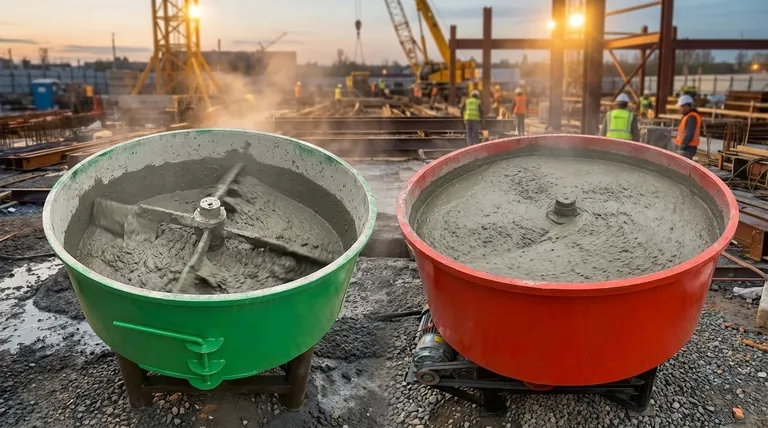
The Illusion of a Full Load
On a busy construction site, the arrival of a concrete mixer truck feels like progress. The spinning drum is a symbol of momentum. A project manager, under pressure, sees the truck and thinks in cubic meters and timelines. The temptation is to maximize every single delivery.
But a fundamental misunderstanding often lurks here. We see a container, and our instinct is to fill it. This instinct, when applied to a concrete mixer, is not just wrong—it's dangerous. The most important part of a concrete mixer isn't just what's inside it, but the empty space that's intentionally left.
That empty space is a non-negotiable component of quality, and its required volume depends entirely on one question: is the truck a factory or is it just a courier?
A Machine with Two Identities
A mixer truck is not one machine; it is two. Its function, and therefore its capacity, is dictated by where the concrete is actually made.
The Mobile Factory: Truck-Mixing
When raw cement, aggregate, and water are loaded directly into the drum, the truck becomes a mobile mixing plant. The goal is transformation—turning inert ingredients into a homogenous, high-strength building material.
This transformation requires violence. The helical blades inside the drum must lift, drop, fold, and churn the materials in a chaotic but essential dance. For this to work, there must be room.
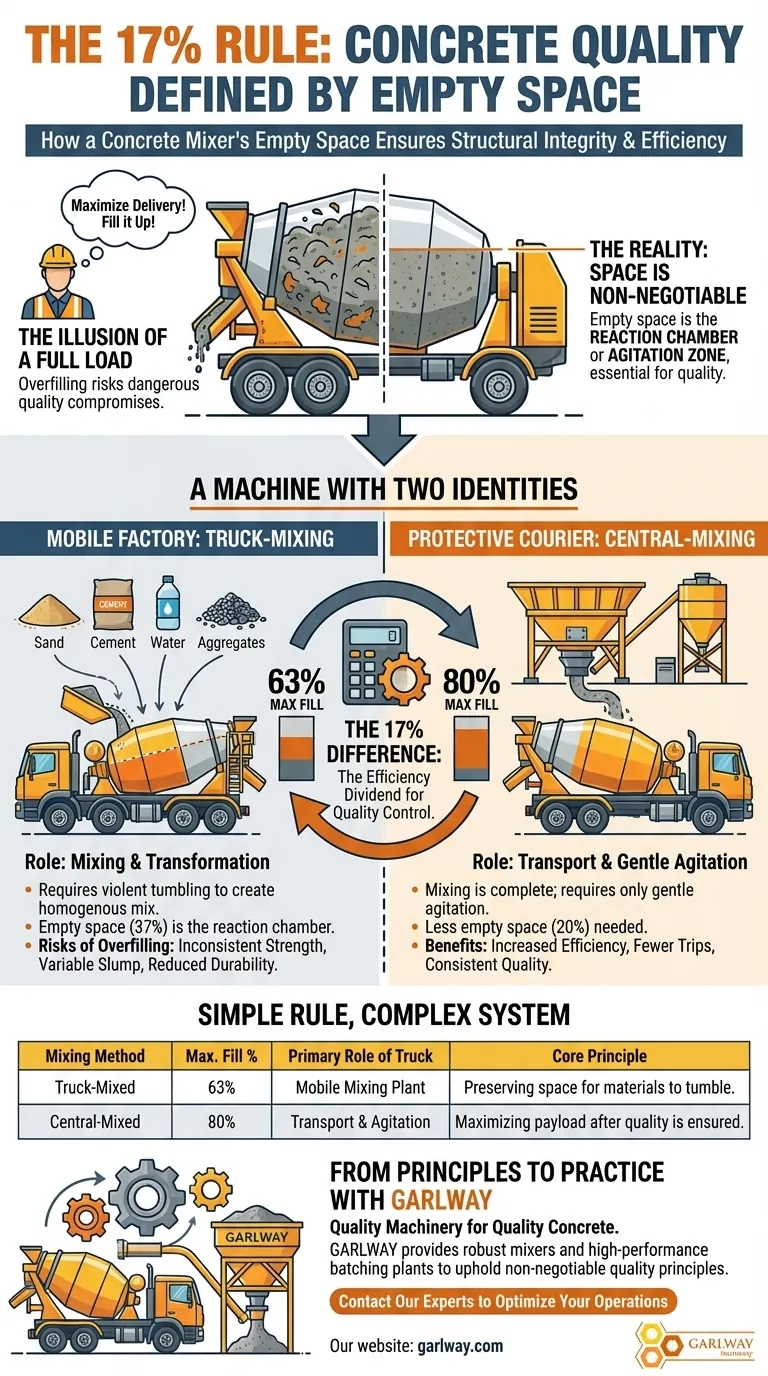
This is the reason for the 63% maximum fill rule. That 37% of empty space isn't waste; it's the reaction chamber. Without it, the materials can't tumble. They just slide and slosh, resulting in a poorly blended mix with weak spots and inconsistent performance.
The Protective Courier: Central-Mixing
When concrete is prepared at a stationary batching plant, the truck’s role changes dramatically. The complex work of mixing is already complete. The truck is no longer a factory; it's a specialized transport vessel.
Its only job is gentle agitation—keeping the perfectly mixed concrete from segregating on its way to the site. Since no violent tumbling is needed, far less empty space is required.
The fill limit can therefore be increased to 80% of the drum's total volume. This 17% difference is not an arbitrary number; it's the dividend paid for the quality control and power of a central plant.
The Physics of Failure vs. The Psychology of Efficiency
The decision to respect these limits is a constant battle between physics and perceived efficiency.
Overfilling a truck-mixed batch is a classic example of a short-term optimization that creates long-term risk. The desire to haul a little more in one trip directly compromises the chemical and physical process happening inside the drum. This can lead to:
- Inconsistent Strength: Pockets of unmixed aggregate or cement create hidden vulnerabilities in the final structure.
- Variable Slump: The concrete’s workability becomes unpredictable, causing issues during the pour and finishing.
- Reduced Durability: A non-homogenous mix is more susceptible to cracking and degradation over time.
The real efficiency isn't found in pushing a single truck past its physical limit. It's found in designing a system that delivers reliable, high-quality concrete at scale. That’s the strategic advantage of central-mixing, where the 80% fill limit enables fewer truck journeys, less site congestion, and lower transport costs—all without sacrificing quality.
A Simple Rule for a Complex System
The choice between methods depends on project scale, location, and quality control requirements. But the governing principles are universal. Adhering to the correct fill percentage, based on the total geometric volume of the drum, is fundamental.
| Mixing Method | Maximum Fill Percentage | Primary Role of Truck | Core Principle |
|---|---|---|---|
| Truck-Mixed | 63% | Mobile Mixing Plant | Preserving empty space for materials to tumble. |
| Central-Mixed | 80% | Transport & Agitation | Maximizing payload after quality is ensured at the plant. |
From Principles to Practice
Understanding why these limits exist is the first step. The next is having the right equipment to execute your strategy flawlessly. Whether your operation depends on the flexibility of truck-mixing or the high-volume efficiency of a central plant, the quality of your machinery is paramount.
GARLWAY provides the robust concrete mixers and high-performance concrete batching plants that successful construction firms rely on. We build our equipment to uphold the non-negotiable principles of quality and durability, ensuring that every batch meets specification.
To optimize your concrete operations with machinery built for excellence, Contact Our Experts.
Visual Guide
Related Products
- Portable Concrete Mixer Machine Equipment for Mixing Concrete
- Construction Products Concrete Plant Machine Mixing Concrete Mixer
- Portable Electric Concrete Mixer Machine for Cement Mixing
- JZC400 Mobile Small Concrete Mixer Cement Mixer Machine
- Hydraulic Concrete Mixer Machine Cement Mixing Equipment for Mixture Concrete
Related Articles
- How to Diagnose and Prevent Sensor Resistance Failures in Concrete Mixing Equipment
- How to Build an OSHA-Compliant Safety System for Concrete Mixer Workspaces
- The Downtime Equation: How a Manufacturer's Support System Defines Your Concrete Mixer's True Cost
- How to Choose Concrete Mixers for Long-Term Reliability and Cost Savings
- How Concrete Composition Works: The Science Behind Stronger Structures






