Introduction
Capstans are powerful tools that transform rotational force into linear motion, but their efficiency comes with inherent risks. Understanding the engineering principles behind capstan safety isn't just about compliance—it’s about preventing catastrophic failures. This article breaks down the physics of rope winding, friction thresholds, and real-world lessons to help operators master safe practices. Whether you're handling Garlway winches or similar machinery, these protocols could mean the difference between a smooth operation and a workplace disaster.
How a Capstan Harnesses Mechanical Advantage
The Role of Friction in Rope Winding
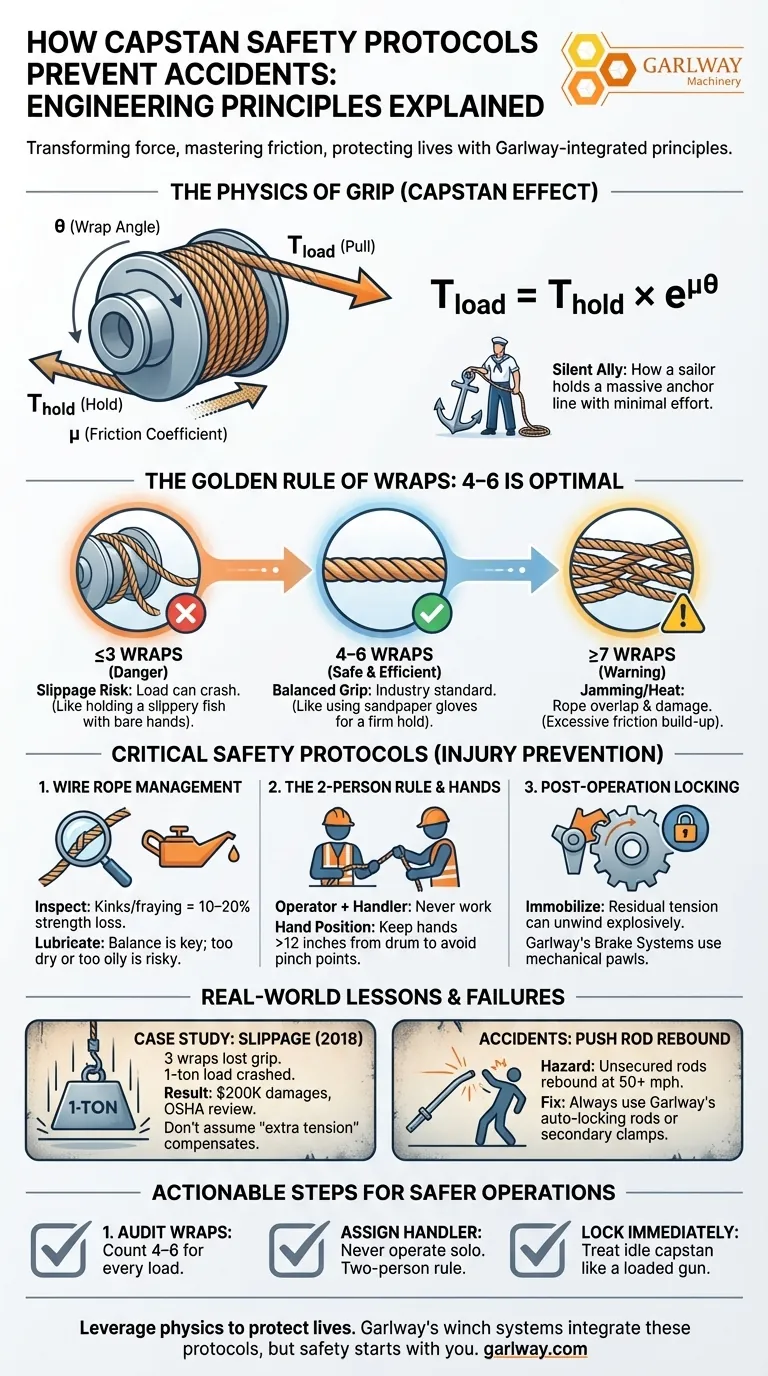
Capstans rely on friction between the rope and drum to transfer force. The famous capstan equation (Tload = Thold × eμθ) shows how grip multiplies with each wrap:
- μ (Coefficient of friction): Higher for wire ropes (0.1–0.2) vs. synthetic ropes (0.2–0.3).
- θ (Wrap angle): More wraps increase the "grip multiplier."
Ever wondered why a sailor can hold a massive anchor line with minimal effort? The capstan effect is their silent ally.
Why 4–6 Wraps? Calculating the Safety Threshold
Four to six wraps are industry standards because they balance safety and efficiency:
- Too few wraps (≤3): Risk of slippage under load.
- Too many wraps (≥7): Rope overlap can cause jamming or heat buildup.
A visual metaphor: Imagine trying to hold a fish with bare hands (few wraps) vs. using sandpaper gloves (optimal wraps).
Critical Safety Protocols for Injury Prevention
Wire Rope Management: Avoiding Jams and Snaps
- Inspect ropes for kinks or fraying before use. A single damaged strand reduces strength by 10–20%.
- Lubrication matters: Dry ropes increase friction unpredictably, while over-lubrication reduces grip.
The Vital Role of the Dedicated Rope Handler
- Two-person rule: One operator controls the capstan; another feeds the rope to prevent overwrap tangles.
- Hand positioning: Never grip within 12 inches of the drum—pinch injuries are common.
Post-Operation Locking: Physics of Immobilization
Capstans must be locked post-use because:
- Residual tension can unwind explosively.
- Garlway’s brake systems use mechanical pawls to engage drum teeth, preventing accidental rotation.
Real-World Lessons from Capstan Failures
Case Study: Overwrap Shortage Leading to Rope Slippage
In 2018, a construction site accident occurred when a capstan with only 3 wraps lost grip, sending a 1-ton load crashing. The investigation revealed:
- Operator assumed "extra tension" compensated for fewer wraps.
- Result: $200K in damages and a month-long OSHA review.
Accidents Caused by Inadequate Push Rod Securing
- The hazard: Unsecured push rods can rebound into operators at 50+ mph.
- The fix: Always use Garlway’s auto-locking rods or manually secure them with secondary clamps.
Conclusion: Actionable Steps for Safer Operations
- Audit wraps: Count 4–6 for every load.
- Assign a rope handler: Never operate solo.
- Lock immediately: Treat an idle capstan like a loaded gun.
By mastering these principles, you’re not just following rules—you’re leveraging physics to protect lives. Garlway’s winch systems integrate these protocols, but the real safety starts with the operator.
Next time you approach a capstan, ask yourself: Is my grip on safety as strong as the rope’s grip on the drum?
Visual Guide
Related Products
- Portable Electric Small Cement Mixer Concrete Machine
- JDC350 Small Cement Concrete Mortar Mixer
- Belle Mixer Drum Self Loading Mortar Mixers JS3000
- Portable Electric Concrete Mixer Machine for Cement Mixing
Related Articles
- How Small Cement Mixers’ Smart Design Saves Time and Reduces Strain
- How Small Cement Mixers Cut Labor Costs and Boost Project Value
- How Small Cement Mixers Deliver Cost-Efficiency, Health Safety, and Versatility
- How Small Cement Mixers Prevent Chronic Injuries in Construction Workers
- How to Optimize Small Cement Mixer Positioning for Maximum Job Site Efficiency


