The Silent Failure of a Perfect Formula
Imagine a construction site. The concrete mix design is flawless, the aggregate is clean, the water-to-cement ratio is perfect. Yet, weeks later, the strength tests come back worryingly low. The structure is compromised.
The team is baffled. They review every variable, but the culprit isn't in the recipe. It's in the process. The problem lies in a fundamental misunderstanding of the physics of mixing—a detail often overlooked in the rush to pour.
We have a psychological blind spot for processes we deem simple. We think of mixing as just "stirring." But for concrete, mixing isn't just agitation; it's a violent, controlled process that dictates the final molecular bond and, ultimately, the integrity of a bridge, a foundation, or a skyscraper.
The machine that performs this task, the concrete mixer, is not a one-size-fits-all tool. Its design is a declaration of its purpose, and its classification reveals the engineering philosophy behind it.
The Core Distinction: How Force Shapes Strength
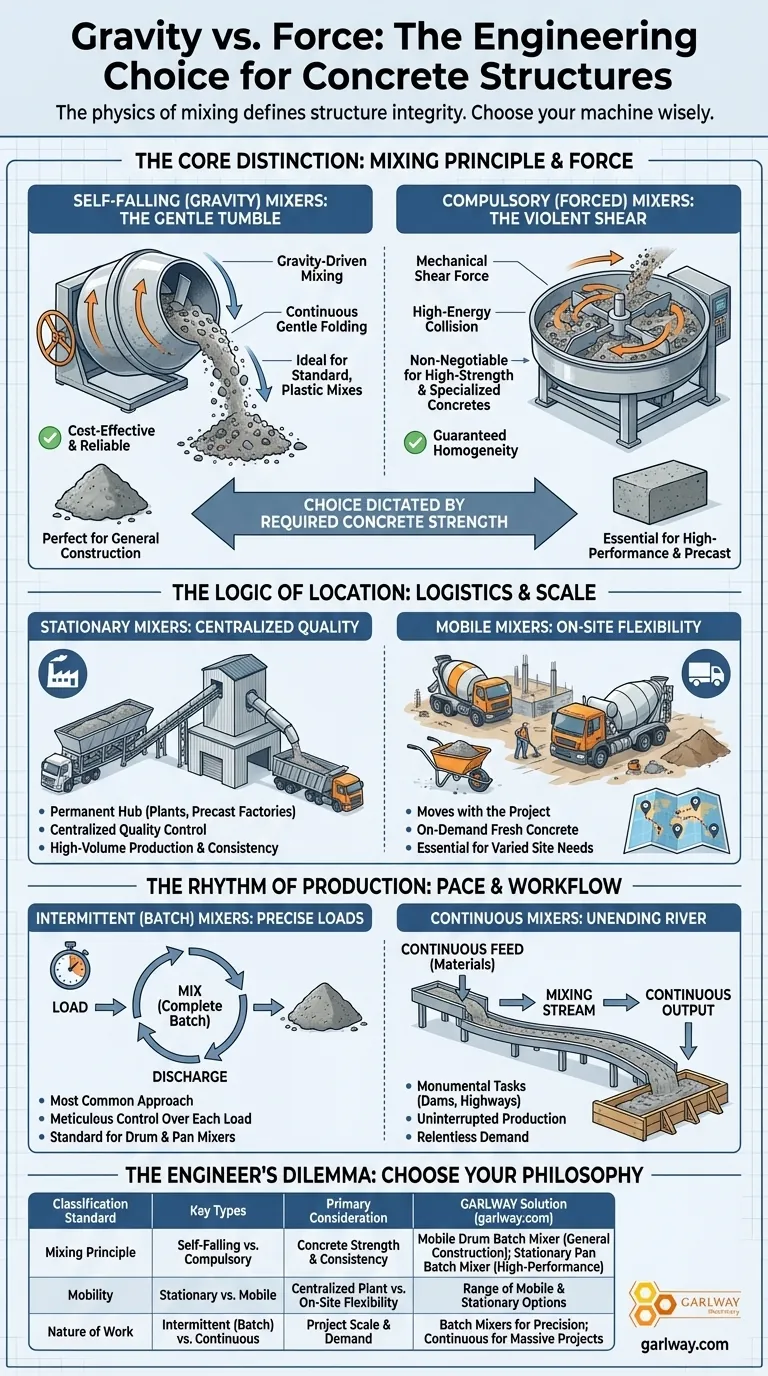
The most critical classification is based on the mixing principle. It’s a choice between two opposing physical forces: the gentle pull of gravity or the aggressive shear of mechanical force.
The Gentle Tumble: Self-Falling (Gravity) Mixers
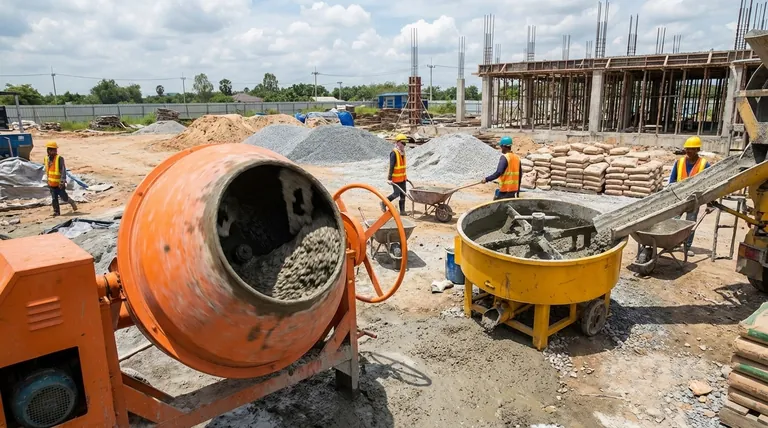
A self-falling, or drum, mixer is an exercise in elegant simplicity. It uses a rotating drum with fixed internal blades to lift materials. At the peak of their arc, the materials cascade back down, relying on gravity to do the mixing.
It's a continuous, gentle folding action. This method is perfectly sufficient for standard, plastic concrete mixes and is the workhorse of countless construction sites. Its mechanical simplicity makes it reliable, affordable, and easy to maintain.
The Violent Shear: Compulsory (Forced) Mixers
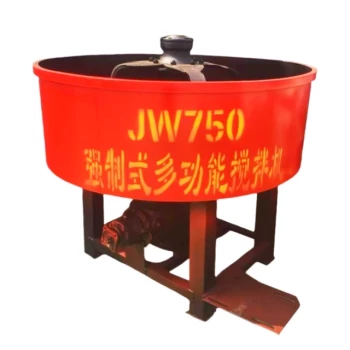
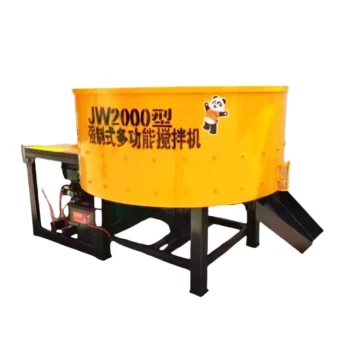
A compulsory, or pan, mixer is the opposite. The drum remains stationary while internal paddles or blades rotate at high speed, forcing the materials through a powerful shearing action.
This isn't a gentle tumble; it's a high-energy collision that ensures every particle of sand and aggregate is coated in cement paste. This method is non-negotiable for high-strength, low-slump, or specialized concretes. It achieves a level of homogeneity that gravity alone can never match.
The Logic of Location: Where the Mix Happens
The second classification is about logistics. Is the factory a permanent hub, or does it need to move with the project?
-
Stationary Mixers: These are the heart of ready-mix plants and precast factories. They represent a commitment to centralized quality control and high-volume production. Their fixed location allows for immense scale and unwavering consistency.
-
Mobile Mixers: These embody flexibility. Ranging from small wheelbarrow mixers to large truck-mounted units, they bring the production capability directly to the point of use. This is essential for most on-site construction, where fresh concrete is needed on demand across various locations.
The Rhythm of Production: The Pace of the Pour
Finally, mixers are classified by their operational workflow. Do you need precise, individual loads, or an unending river of concrete?
-
Intermittent (Batch) Mixers: This is the most common approach. The mixer is loaded, mixes one complete batch to exact specifications, and then discharges it. This allows for meticulous control over every single load, making it the standard for both drum and pan mixers.
-
Continuous Mixers: These machines are designed for monumental tasks. Materials are fed continuously into one end, and a steady, uninterrupted stream of concrete emerges from the other. This is the only way to meet the relentless demand of projects like dam construction or highway paving.
The Engineer's Dilemma: Choosing Your Philosophy
Selecting a mixer isn't a simple choice of capacity. It’s a strategic decision based on the trade-offs between precision, cost, mobility, and scale.
| Classification Standard | Key Types | Primary Consideration |
|---|---|---|
| Mixing Principle | Self-Falling (Gravity), Compulsory (Forced) | Required concrete strength and consistency. |
| Mobility | Stationary, Mobile | Centralized plant vs. on-site flexibility. |
| Nature of Work | Intermittent (Batch), Continuous | Project scale and demand for continuous pouring. |
Your choice reveals your project's core priority:
- For general on-site construction, a mobile, self-falling (drum) batch mixer from a trusted provider like GARLWAY offers the perfect blend of portability and cost-effectiveness.
- For high-performance or precast concrete, a stationary, compulsory (pan) batch mixer is the only tool that can deliver the necessary mixing intensity for guaranteed results.
- For massive infrastructure projects, a continuous mixer is the only viable solution for unstoppable production.
The foreman at our failed construction site learned a hard lesson: the "how" of mixing is just as important as the "what." The integrity of his structure wasn't compromised by the materials, but by choosing a tool whose physics couldn't meet the engineering demands of the design.
Choosing the right machine isn't just a procurement decision; it's an engineering one. To ensure your project is built on a foundation of certainty, not chance, Contact Our Experts.
Visual Guide
Related Products
- Portable Concrete Mixer Machine Equipment for Mixing Concrete
- Construction Products Concrete Plant Machine Mixing Concrete Mixer
- Portable Electric Concrete Mixer Machine for Cement Mixing
- JZC400 Mobile Small Concrete Mixer Cement Mixer Machine
- Hydraulic Concrete Mixer Machine Cement Mixing Equipment for Mixture Concrete
Related Articles
- How to Diagnose and Prevent Sensor Resistance Failures in Concrete Mixing Equipment
- How to Build an OSHA-Compliant Safety System for Concrete Mixer Workspaces
- The Downtime Equation: How a Manufacturer's Support System Defines Your Concrete Mixer's True Cost
- How to Choose Concrete Mixers for Long-Term Reliability and Cost Savings
- How Concrete Composition Works: The Science Behind Stronger Structures