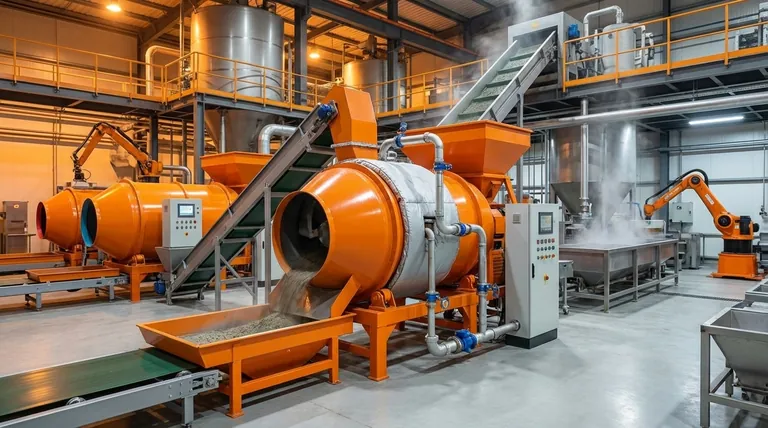
Beyond a simple rotating drum, modern rotary mixers can be configured as highly specialized process vessels equipped with a wide range of advanced features. These options include systems for liquid injection, continuous mixing, precise temperature control via jackets or cryogenics, specialized atmospheric controls, and automated cleaning systems designed for hazardous or high-purity environments.
The true value of a rotary drum mixer lies not just in its gentle blending action but in its adaptability. Available features transform it from a basic blender into a sophisticated, multi-stage processing tool tailored to specific material and production requirements.
The Core Principle: Gentle and Precise Mixing
At its heart, a rotary drum mixer is designed for one primary purpose: creating a highly consistent mix with minimal damage to the product. Understanding this core function is key to appreciating its specialized features.
How Gentle Blending Works
Rotary drum mixers operate at slow rotational speeds. Internal flights or chutes gently lift, fold, and turn the materials, introducing them back into the main batch.
This mechanism ensures a thorough, homogeneous blend without the aggressive shearing or high impact found in other mixer types.
The Impact on Material Integrity
The gentle action produces very little frictional heat and prevents the breakage of fragile or sensitive products. This makes it the ideal choice for applications involving delicate crystals, coated particles, or ingredients that could be easily damaged.
Key Features for Advanced Process Control
The most significant options available for rotary drum mixers are those that allow you to precisely control the environment and actions inside the mixing chamber.
Temperature and Atmosphere Management
Many processes require strict thermal control. Features like heating and cooling jackets circulate steam, water, or oil to maintain a specific product temperature.
For more extreme applications, cryogenic mixing uses liquid nitrogen to rapidly cool materials, which is vital for preserving sensitive compounds or controlling exothermic reactions.
Systems for air drying, heating, or cooling can also be integrated to manage the atmosphere within the drum, removing moisture or pre-conditioning ingredients.
Liquid Addition and Coating
Liquid injection systems are a critical feature for applications beyond simple dry blending. A spray bar or nozzles can be used to precisely add liquids for coating, impregnation, or agglomeration, turning the mixer into a multi-functional processing unit.
Pressure, Vacuum, and Safety Compliance
For processes involving volatile substances or requiring an inert atmosphere, mixers can be built for pressure or vacuum operation.
Furthermore, for environments with explosive dust or vapors, ATEX-compliant construction is available, ensuring the equipment meets stringent safety standards for hazardous locations.
Features for Operational Efficiency and Integration
Beyond process control, many features are designed to improve uptime, reduce manual labor, and seamlessly integrate the mixer into a larger production line.
Streamlining Material Flow
While traditionally used for batch processing, many rotary drums can be configured for continuous mixing. This allows for a constant in-feed and discharge, ideal for high-volume production lines.
Retractable inlet and outlet systems (often called Quick-Release) simplify connection to upstream and downstream equipment, speeding up a fully integrated process.
Simplifying Cleaning and Maintenance
To minimize downtime and prevent cross-contamination between batches, mixers can be equipped with Wash-in-Place (WIP) or Clean-in-Place (CIP) systems. These automated cleaning cycles ensure product purity with minimal manual intervention.
Extra-large, easy-opening doors provide full access to the mixer's interior, making inspection, manual cleaning, and maintenance significantly faster and easier.
Understanding the Trade-offs
While highly versatile, the rotary drum mixer is not a universal solution. Its primary strengths also define its limitations.
Not Suited for High-Shear Applications
The gentle blending action that protects fragile materials makes it unsuitable for applications requiring high-shear force, such as creating fine emulsions, intense de-agglomeration, or high-energy dispersions.
Efficiency Depends on Fill Volume
The mixing action relies on material tumbling over itself. While they can handle variable batch sizes, performance and homogeneity can suffer if the drum is significantly underfilled, as the "folding" action becomes less effective.
Added Features Increase Complexity
Each specialized feature—from heating jackets to vacuum systems—adds to the machine's initial cost, complexity, and maintenance requirements. It's crucial to specify only the options necessary to achieve the process goal.
Making the Right Choice for Your Goal
Selecting the correct features requires a clear understanding of your primary objective.
- If your primary focus is product integrity: Prioritize the inherent gentle mixing action and consider cryogenic cooling for extremely sensitive or reactive materials.
- If your primary focus is advanced processing: Specify features like liquid injection for coating, heating/cooling jackets, and pressure/vacuum capabilities to create a controlled reaction vessel.
- If your primary focus is operational efficiency: Focus on continuous mixing configurations, CIP cleaning systems, and quick-release connections to maximize uptime.
- If your primary focus is safety: Ensure the mixer has the appropriate ATEX rating if you are handling any potentially explosive materials.
Ultimately, a rotary drum mixer should be specified not by its potential features, but by the precise demands of your application.
Summary Table:
| Feature Category | Key Options | Primary Benefit |
|---|---|---|
| Process Control | Liquid injection, heating/cooling jackets, vacuum/pressure | Precise environment management for complex reactions |
| Operational Efficiency | Continuous mixing, CIP/WIP systems, quick-release connections | Reduced downtime and seamless production line integration |
| Safety & Compliance | ATEX-rated construction, inert atmosphere systems | Safe handling of hazardous or explosive materials |
| Material Integrity | Gentle tumbling action, cryogenic cooling | Protection of fragile or sensitive products from damage |
Optimize your material processing with a custom-configured rotary drum mixer from GARLWAY.
GARLWAY specializes in heavy-duty construction and industrial machinery, offering robust and reliable equipment tailored to your specific needs. Whether you're a construction company, contractor, or industrial processor, our expertise ensures you get a mixer with the exact features you require—from precise temperature control and liquid addition systems to automated cleaning and safety compliance.
Let us help you enhance efficiency, protect product integrity, and streamline your operations. Contact GARLWAY today for a personalized consultation and discover the right mixer solution for your application.
Visual Guide

Related Products
- Belle Mixer Drum Self Loading Mortar Mixers JS3000
- Concrete Cement Mixer Machine Drum Mixer for Construction
- Portable Concrete Mixer Machine Equipment for Mixing Concrete
- JS1000 Volumetric Concrete Mortar Mixer for Sale Skid Steer Cement Mixer
- Shaft Mixer Machine for Cement and Regular Concrete Mixing
People Also Ask
- What are the features of mobile transporting in a self loading mixer? Boost On-Site Efficiency
- Why is timely cleaning important for a self loading mixer? Prevent Costly Downtime and Mix Failure
- How is discharging accomplished in a self loading mixer? Master Precise Concrete Placement
- What is the purpose of keeping the drum rotating during transportation in a self loading concrete mixer? Ensure Quality & Consistency
- What components are involved in the loading process of a self loading concrete mixer? A Guide to the Key Systems