
Contrary to common assumptions, the primary maintenance issue reported for manual windlasses is seizing from corrosion and lack of use, particularly on long passages. Conversely, many modern electric windlasses have proven surprisingly reliable in harsh saltwater environments, with their most common failures stemming from the electrical system—such as corroded connections or faulty solenoids—rather than the mechanics.
The core difference isn't about one being inherently more reliable than the other. It's about understanding their distinct failure modes: manual windlasses tend to fail gradually through mechanical seizure, while electric windlasses are more prone to sudden electrical failure.
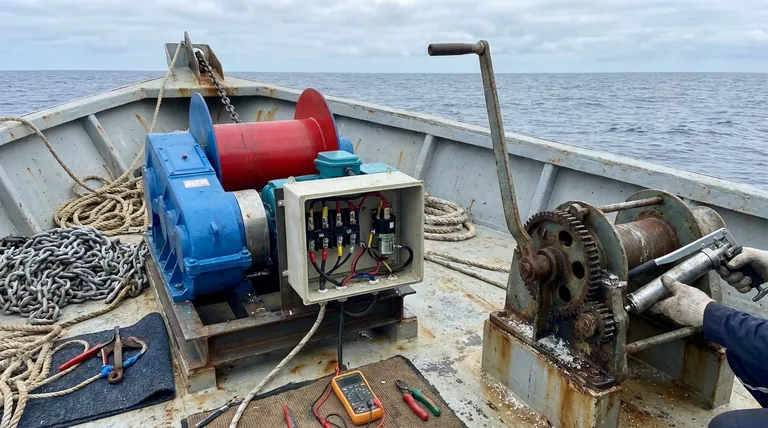
The Maintenance Profile of Manual Windlasses
A manual windlass operates on simple mechanical principles. Its reliability is directly tied to preventative care and protecting it from the elements.
The Primary Failure Mode: Seizing
The most frequently cited problem with manual windlasses is the gearbox or handle mechanism seizing up.
This is almost always caused by saltwater intrusion, which leads to internal corrosion, especially if the unit is not used and lubricated regularly.
Simplicity Requires Discipline
While a manual system has no electrical components to fail, its mechanical parts demand consistent attention.
Regular disassembly, cleaning, and greasing of gears and pawls are essential to prevent the slow creep of corrosion that can render it useless when you need it most.
The Maintenance Profile of Electric Windlasses
An electric windlass adds a layer of complexity with its motor and control system. Its maintenance profile is therefore split between its mechanical and electrical components.
Electrical System Vulnerabilities
The weak points of an electric windlass are almost always electrical.
Corrosion on wiring terminals, a failing control solenoid, or a worn-out motor brush are the most common causes of failure. These issues often appear suddenly.
Mechanical Robustness
The mechanical gearbox on a quality electric windlass is often a well-sealed, robust unit.
Because it gets used more frequently due to its ease of operation, it is less likely to seize from inactivity compared to a manual counterpart.
Understanding the Trade-offs
Choosing between manual and electric is not just about maintenance, but about understanding the consequences of a potential failure.
Manual: Gradual Failure vs. Physical Effort
A manual windlass rarely fails suddenly; it typically becomes progressively harder to operate as it corrodes, giving you warning.
However, even when working perfectly, it requires significant physical exertion, which can be a major challenge in heavy weather or for a single-handed sailor.
Electric: Convenience vs. Abrupt Failure
An electric windlass makes anchoring effortless, encouraging its use. This convenience is its greatest strength.
Its greatest weakness is the potential for sudden, total failure if an electrical component gives out. Some models lack an effective manual override, which can create a critical situation if the anchor must be retrieved in an emergency.
The Power Dependency
An electric windlass is entirely dependent on a healthy electrical system. It requires sufficient battery capacity and robust wiring.
This means its reliability is tied to the maintenance of not just the windlass itself, but also your boat's batteries, engine alternator, and cabling.
Making the Right Choice for Your Goal
Your decision should be based on your boat's systems, your anchoring style, and your tolerance for different types of risk.
- If your primary focus is absolute independence from electrical systems: A manual windlass is your only option, but you must commit to a rigorous, proactive maintenance schedule.
- If your primary focus is ease of use, especially for single-handing: An electric windlass is superior, provided you ensure a high-quality installation and perform regular checks of all electrical connections.
- If your primary focus is maximum resilience: The ideal choice is a high-quality electric windlass that features a robust, fully functional manual override for emergency retrieval.
Ultimately, consistent maintenance is the true source of reliability, regardless of which system you choose.
Summary Table:
| System | Primary Failure Mode | Key Maintenance Focus |
|---|---|---|
| Manual Windlass | Gradual mechanical seizure from corrosion | Regular disassembly, cleaning, and greasing |
| Electric Windlass | Sudden electrical failure (corroded connections, solenoids) | Regular checks of wiring, terminals, and battery system |
Ensure your anchoring system is as reliable as your vessel. GARLWAY specializes in robust marine equipment, including winches suitable for demanding maritime applications. Our engineering expertise ensures durability and performance for commercial and recreational boaters globally. Contact GARLWAY today to discuss a reliable solution for your vessel's needs.
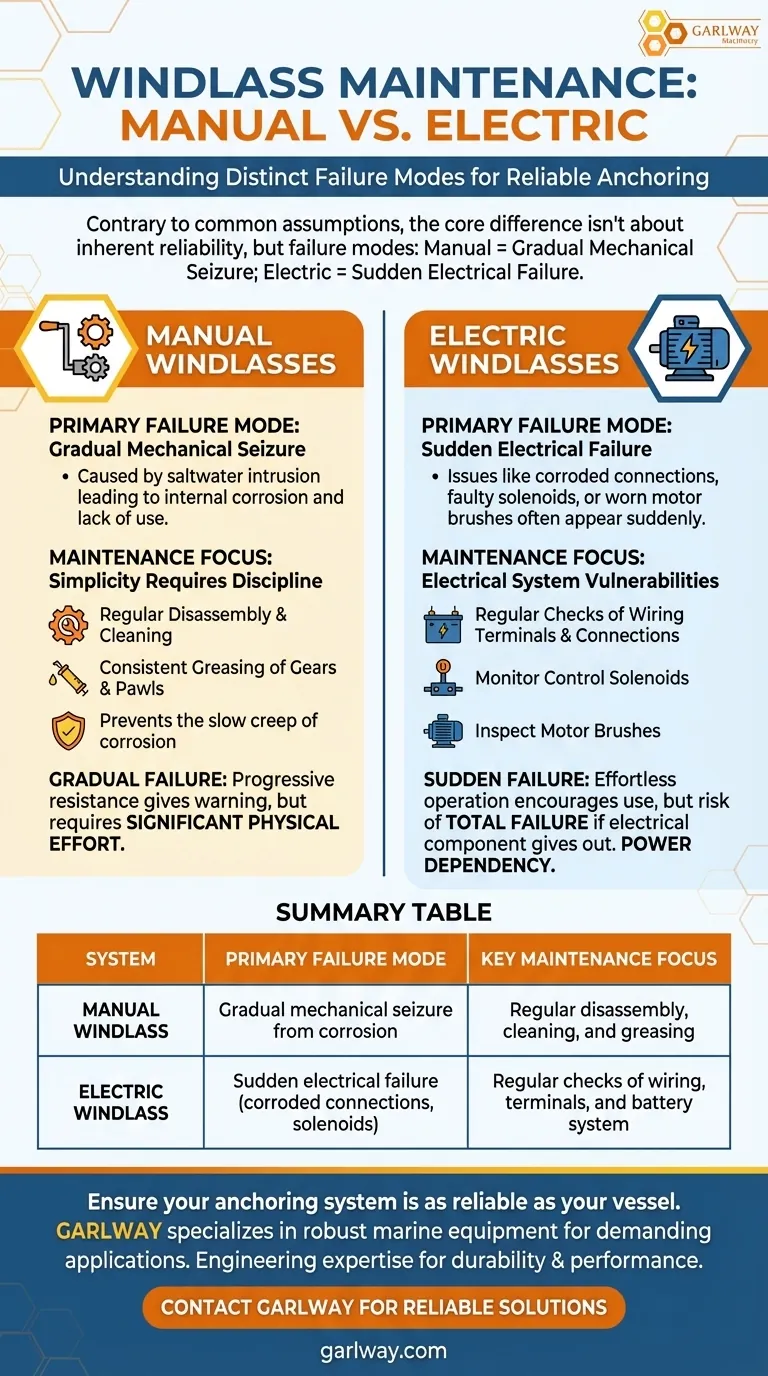
Visual Guide
Related Products
- Warn Winch Windlass Boat Trailer Winch
- Quick Windlass Portable Winch for Truck and Boat Best Boat Winch
- Electric Hoist Winch Boat Anchor Windlass for Marine Applications
- Heavy Duty Electric Boat Winch Windlass Anchor
- 12000 lb Electric Boat Trailer Winch with Windlass Anchor Warn
People Also Ask
- What are the main components of a boat trailer winch? A Guide to Safe & Efficient Boat Loading
- What factors should be considered when choosing a boat trailer winch? Ensure Safe and Effortless Boat Loading
- What is the purpose of boat trailer winches? Safely and Efficiently Load Your Boat
- What are the two main types of boat trailer winches? Manual vs. Electric Explained
- How often should a boat trailer winch be replaced? Your Guide to Safety and Longevity


