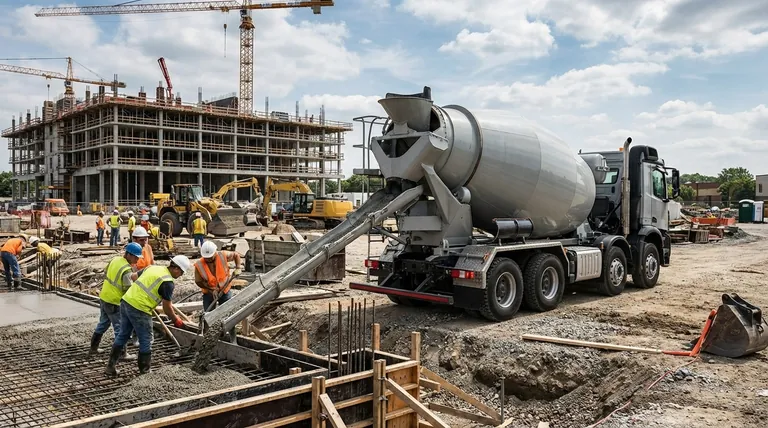
At its core, a concrete mixer truck is a mobile batching plant and delivery vehicle in one. This specialized truck is engineered to continuously mix cement, aggregates (like sand and gravel), and water to create concrete. Its primary function is to transport this perishable mixture from a production facility to a construction site, ensuring it arrives in a ready-to-pour, uniform state.
A concrete mixer truck's fundamental purpose is not just to transport material, but to maintain the precise chemical reaction and consistency of concrete during transit. It delivers a time-sensitive, ready-to-use product that is critical for ensuring the structural integrity of the final build.
How a Concrete Mixer Truck Works: The Key Components
The effectiveness of a concrete mixer truck comes from the synergy of its specialized parts, each designed to manage the volatile nature of fresh concrete.
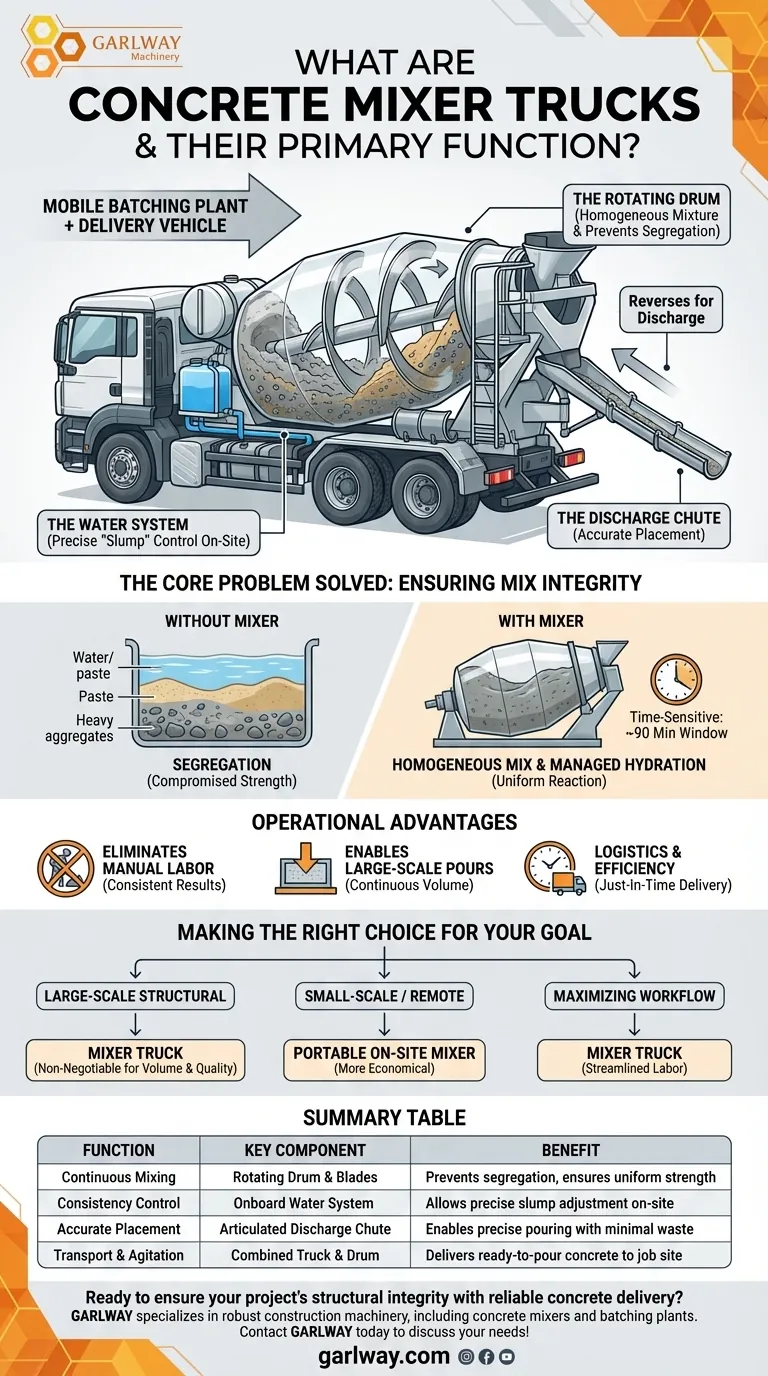
The Rotating Drum
The most recognizable feature is the large, revolving drum. This drum is fitted with internal blades, or fins, arranged in a spiral pattern.
As the drum rotates one way, the blades continuously lift and fold the material over itself, ensuring a homogeneous mixture and preventing the heavier aggregates from settling. This process is essential for consistent concrete strength.
When the drum's rotation is reversed, the spiral blades push the concrete out of the opening and down the discharge chute.
The Water System
Each truck is equipped with a water tank and a system for introducing water into the mixing drum.
This allows for precise control over the concrete's consistency, known as its "slump." An operator can add a measured amount of water on-site to meet specific project requirements just before the pour.
The Discharge Chute
The chute is a series of articulated channels at the rear of the truck.
It guides the flow of concrete from the drum, allowing operators to place the material accurately into forms, trenches, or concrete pump hoppers with minimal waste.
The Core Problem It Solves: Ensuring Mix Integrity
The real value of a mixer truck is its ability to overcome the fundamental challenges of working with concrete, which begins hardening the moment water is added.
Preventing Segregation
Without constant agitation, the heavier aggregates in a concrete mix will sink, and the lighter cement paste and water will rise to the surface.
This separation, called segregation, severely compromises the strength and durability of the finished product. The truck's rotating drum makes this impossible.
Managing the Hydration Process
The chemical reaction between cement and water, known as hydration, is what gives concrete its strength. This is a time-sensitive process.
The mixer truck ensures that this reaction proceeds uniformly throughout the entire batch during transport, preventing premature hardening or weak spots.
Understanding the Operational Advantages
Using mixer trucks provides significant advantages over older, on-site mixing methods, but it also introduces logistical dependencies.
Eliminating Manual Labor
These trucks completely remove the need for manual concrete mixing on-site, a process that is slow, physically demanding, and often produces inconsistent results.
Enabling Large-Scale Pours
The capacity of a standard mixer truck allows for the delivery of large, continuous volumes of concrete. This is essential for pouring large foundations, slabs, and structural elements where stopping midway is not an option.
A Note on Logistics
The primary trade-off is time. Most concrete has a window of about 90 minutes from initial mixing to final placement. This makes the entire operation dependent on efficient scheduling, dispatching, and clear travel routes to the job site. Delays can result in the entire load being rejected.
Making the Right Choice for Your Goal
The decision to use a concrete mixer truck is directly tied to the scale and requirements of your construction project.
- If your primary focus is large-scale structural construction (foundations, bridges): The ready-mix concrete delivered by a mixer truck is non-negotiable for ensuring the required volume and consistent quality.
- If your primary focus is small-scale repairs or remote projects: The logistics and volume of a mixer truck may be impractical; smaller, portable on-site mixers are often a more economical choice.
- If your primary focus is maximizing workflow efficiency: The just-in-time delivery from a mixer truck is a core component of modern construction, minimizing on-site material storage and streamlining labor.
Ultimately, the concrete mixer truck is the critical link that guarantees the quality of materials from the plant translates directly into the strength of the final structure.
Summary Table:
| Function | Key Component | Benefit |
|---|---|---|
| Continuous Mixing | Rotating Drum with Blades | Prevents segregation, ensures uniform strength |
| Consistency Control | Onboard Water System | Allows precise slump adjustment on-site |
| Accurate Placement | Articulated Discharge Chute | Enables precise pouring with minimal waste |
| Transport & Agitation | Combined Truck & Drum System | Delivers ready-to-pour concrete to the job site |
Ready to ensure your project's structural integrity with reliable concrete delivery?
GARLWAY specializes in providing robust construction machinery, including concrete mixers and batching plants, for construction companies and contractors globally. Our equipment is engineered for durability and efficiency, helping you deliver high-quality results on time and on budget.
Contact GARLWAY today to discuss your concrete needs and find the perfect solution for your next project!
Visual Guide
Related Products
- Ready Mixer Machine for Construction Ready Mix Machinery
- JW1000 Mobile Cement Mixer Concrete Mixer Truck and Batching Plant
- Mini Cement Mortar Mixer Truck for Construction
- Harbor Freight JS1500 On Site Concrete Mixing Volumetric Cement Mixer
- HZS90 Large Multiquip Concrete Mixers for Construction
People Also Ask
- What are the purposes of low-speed agitation in truck mixers? Preserve Concrete Quality During Transit
- How is ready-mixed concrete transported from a commercial concrete batching plant? Ensuring Quality & Timely Delivery
- What are the main ingredients mixed in a concrete mixer truck? Master the Formula for Strong Concrete
- In what ways does a mobile concrete mixer improve quality control and consistency? Achieve Superior On-Site Concrete Quality
- What types of construction projects typically use concrete mixer trucks? From Highways to Home Foundations