
At its core, a concrete batch plant's weighing system operates as an automated, high-precision measurement process. It uses a network of hoppers, conveyors, pumps, and electronic sensors—all governed by a central control system—to measure the exact required weight of aggregates, powders, and liquids before they are sent to the mixer. This ensures every batch of concrete adheres strictly to the specified mix design.
The weighing system is the single most critical component for guaranteeing concrete quality and managing production costs. Its purpose is to translate an abstract recipe into a physical product with absolute precision, eliminating the inconsistencies and material waste inherent in manual methods.
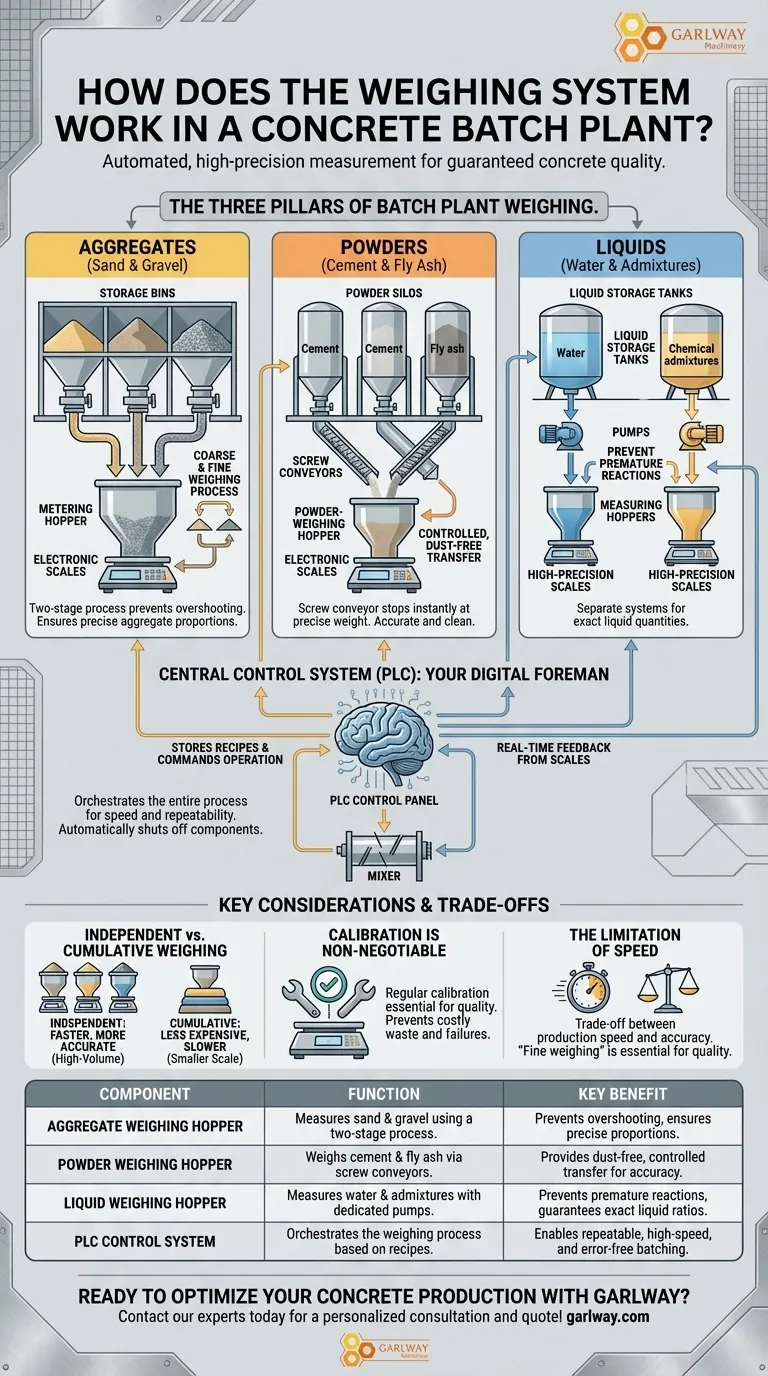
The Three Pillars of Batch Plant Weighing
The entire system is logically divided into three independent sub-systems that work in parallel to measure the core components of concrete.
Weighing Aggregates (Sand & Gravel)
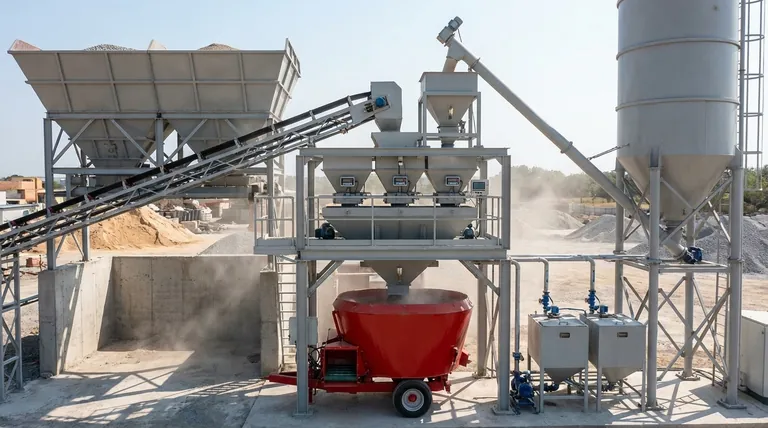
Aggregates are stored in large overhead bins. When the batching process begins, gates at the bottom of these bins open, allowing sand and stone to fall into a dedicated metering hopper.
This hopper sits on electronic scales or load cells. To ensure accuracy, the system uses a two-stage "coarse and fine" weighing process, where the flow of material slows down as it approaches the target weight, preventing overshooting.
Weighing Powders (Cement & Fly Ash)
Powders like cement and fly ash are stored in silos. They are transferred to a separate, dedicated powder-weighing hopper using enclosed screw conveyors.
This method provides a controlled, dust-free transfer. The screw conveyor runs until the electronic scales connected to the hopper register the precise weight required by the recipe, at which point it stops instantly.
Weighing Liquids (Water & Admixtures)
Water and liquid chemical admixtures are each handled by their own distinct systems. Pumps transfer the liquids from storage tanks into their respective measuring hoppers.
Each liquid hopper has its own high-precision scale. Keeping these liquids separate until they enter the mixer is crucial to prevent any premature chemical reactions and to ensure their individual quantities are exact.
The Role of the Central Control System
The weighing process is not manual; it is orchestrated by a sophisticated digital "brain" that ensures speed and repeatability.
The PLC: Your Digital Foreman
The entire operation is commanded by a Programmable Logic Controller (PLC), which is part of the plant's main control panel. The PLC stores all the specific mix designs or recipes.
From Recipe to Reality
Once an operator selects a recipe and starts the batch, the PLC sends signals to all the system components. It commands which aggregate bin gate to open, which screw conveyor to start, and which pump to activate.
Continuous Feedback and Adjustment
As materials flow into the weighing hoppers, the electronic scales send real-time weight data back to the PLC. The moment a material reaches its preset value, the PLC commands the corresponding gate, conveyor, or pump to shut off, guaranteeing perfect proportions every time.
Understanding the Trade-offs and Key Considerations
While automated weighing is highly effective, it's important to understand the principles and potential issues that influence its performance.
Independent vs. Cumulative Weighing
In plants producing over 50 cubic meters per hour, independent weighing—where each material has its own dedicated hopper—is standard. It is faster and more accurate. Smaller plants may use cumulative weighing, where multiple aggregates are weighed one after another in the same hopper, which is less expensive but slower.
Calibration is Non-Negotiable
An automated system is only as accurate as its last calibration. Regular inspection and calibration of the electronic scales are essential. A poorly calibrated system will consistently produce bad concrete, leading to costly waste or structural failures.
The Limitation of Speed
There is an inherent trade-off between production speed and weighing accuracy. The "fine weighing" phase, where material flow is slowed for precision, is essential for quality but adds seconds to the overall cycle time. Bypassing this for speed compromises the integrity of the mix.
Making the Right Choice for Your Goal
Understanding the weighing system allows you to align plant capabilities with project demands.
- If your primary focus is high-volume production: You require a plant with independent weighing systems for all components to minimize cycle time and maximize throughput.
- If your primary focus is uncompromising quality control: Prioritize a system with a modern PLC that offers precise "coarse and fine" weighing controls and provides detailed data logging for every batch.
- If your primary focus is cost-effectiveness on a smaller scale: A plant using a cumulative aggregate weighing system can be a viable option, but you must accept the trade-off in production speed.
Ultimately, mastering the weighing system is the key to transforming raw materials into predictable, high-performance concrete.
Summary Table:
| Component | Function | Key Benefit |
|---|---|---|
| Aggregate Weighing Hopper | Measures sand & gravel using a two-stage "coarse and fine" process. | Prevents overshooting, ensures precise aggregate proportions. |
| Powder Weighing Hopper | Weighs cement & fly ash via screw conveyors. | Provides dust-free, controlled transfer for accuracy. |
| Liquid Weighing Hopper | Measures water & admixtures with dedicated pumps and scales. | Prevents premature reactions, guarantees exact liquid ratios. |
| PLC Control System | Orchestrates the entire weighing process based on stored recipes. | Enables repeatable, high-speed, and error-free batching. |
Ready to optimize your concrete production with a reliable and precise batching system?
At GARLWAY, we specialize in engineering high-performance construction machinery, including advanced concrete batching plants, mixers, and winches. Our solutions are designed for construction companies and contractors who demand unwavering quality control, cost efficiency, and maximum throughput.
Let us help you select the perfect weighing system for your project's needs.
Contact our experts today for a personalized consultation and quote!
Visual Guide
Related Products
- HZS35 Small Cement Concrete Mixing Batch Plant
- HZS120 Ready Mix Concrete Batching Plant Commercial Mud Cement Mixer
- HZS75 Concrete Batching Plant Cement Mixer Price Concrete Mixer Bunnings Mixing Plant
- Commercial Electric Concrete Mixer Machine HZS 50 Small Batch Plant for Sale
- HZS180 Ready Mix Concrete Plant for Foundations with Sand and Cement
People Also Ask
- Why buy concrete batch plant parts only from the manufacturer? Protect Your Investment and Maximize Uptime
- Why is proper maintenance important for a concrete batch mix plant? Maximize Uptime & Profitability
- What is the advantage of a mobile concrete batching plant? Achieve On-Site Production & Total Control
- What are the advantages and disadvantages of concrete batching plants? Maximize Quality & Efficiency
- What are the two methods of material charging in a concrete mixing station? Single vs. Multiple Charging Explained





