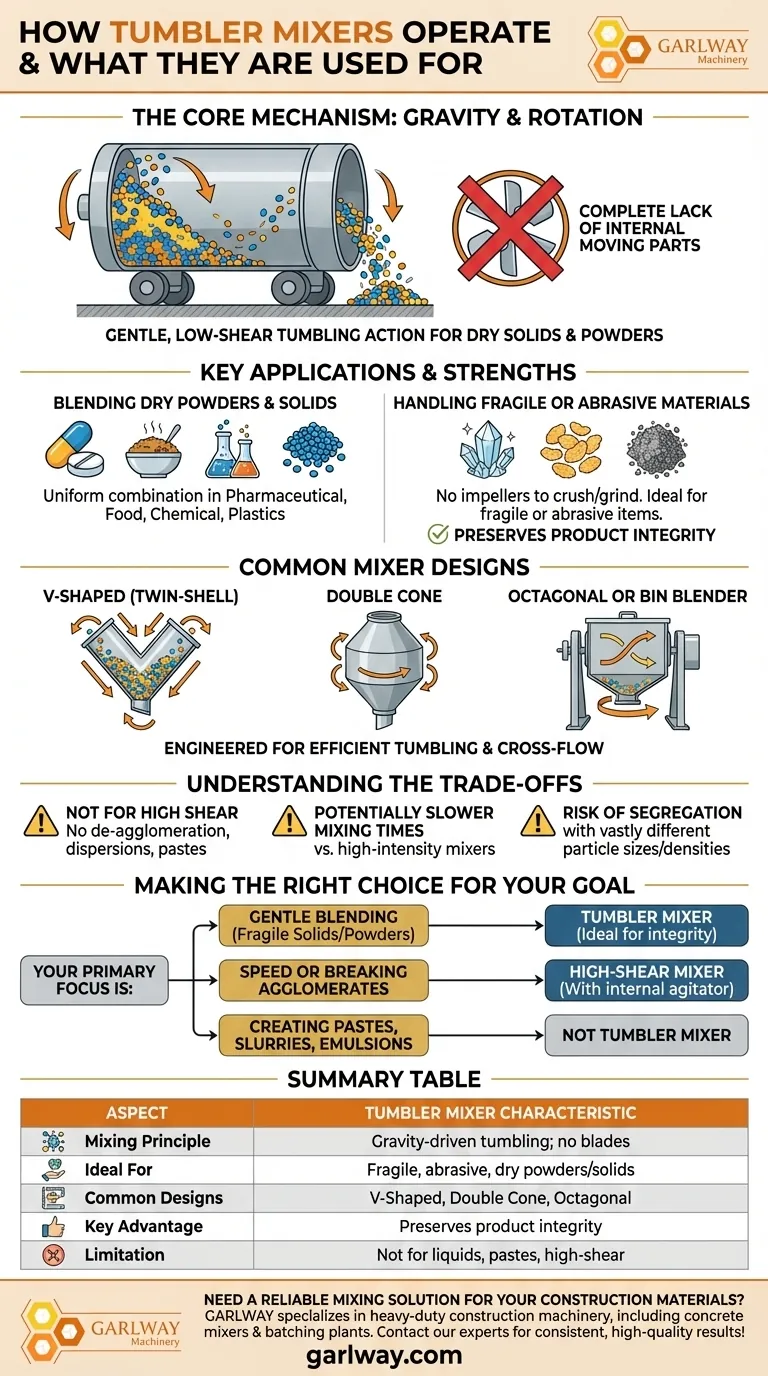
At its core, a tumbler mixer operates by rotating a vessel to make the materials inside tumble over one another. This process uses gravity and the container's geometry—not internal blades or impellers—to gently blend dry solids and powders.
The fundamental principle of a tumbler mixer is its use of a gentle, low-shear tumbling action. This makes it exceptionally well-suited for blending materials that could be damaged, altered, or heated by more aggressive mixing methods.
The Core Mechanism: Gravity and Rotation
A tumbler mixer's operation is elegant in its simplicity. It focuses on macro-mixing, moving large groups of particles around to achieve a uniform distribution.
The Tumbling Action
As the sealed container rotates, the material inside is lifted up the side of the vessel. Once it reaches a certain angle, gravity causes the material to cascade or tumble back down to the bottom of the drum. This continuous cycle of lifting and tumbling is what creates the blending effect.
Absence of Impellers
The most defining characteristic of a tumbler mixer is the complete lack of internal moving parts like blades, paddles, or agitators. The mixing energy is imparted solely by the rotation of the vessel itself. This design is critical for its primary applications.
Key Applications and Strengths
The gentle nature of tumbler mixers makes them the preferred choice in several industries, particularly where product integrity is paramount.
Blending Dry Powders and Solids
This is the primary use case. Tumbler mixers excel at uniformly combining multiple dry ingredients, such as in the pharmaceutical, food, chemical, and plastics industries.
Handling Fragile or Abrasive Materials
Because there are no impellers to crush or grind the particles, these mixers are ideal for fragile materials like breakfast cereals, pharmaceutical granulations, or delicate crystals. The same principle applies to abrasive materials, as there are no internal parts to wear down.
Common Mixer Designs
The shape of the vessel is engineered to enhance the tumbling and cross-flow of materials.
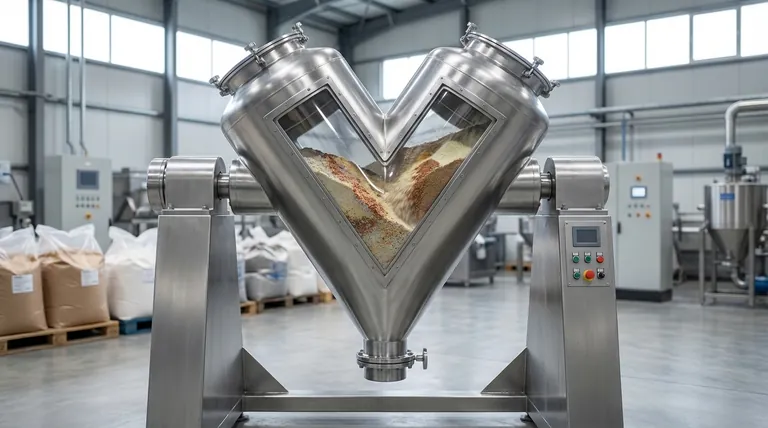
- V-Shaped (Twin-Shell): This design repeatedly splits the batch of material into two streams as it rotates and then merges them. This splitting and recombining action provides a very efficient and predictable mixing pattern.
- Double Cone: Similar to the V-blender, the double cone design provides a gentle, low-impact tumbling motion suitable for powders and granules.
- Octagonal or Bin Blender: These are often used when the container itself is a removable bin. This allows for contained transport of materials before and after mixing, minimizing dust and contamination.
Understanding the Trade-offs
While highly effective for their intended purpose, tumbler mixers are not a universal solution. Their unique design comes with specific limitations.
Not Suitable for High Shear
These mixers are fundamentally low-shear devices. They cannot be used for applications that require breaking down clumps (de-agglomeration), creating fine dispersions, or blending liquids into a paste.
Potentially Slower Mixing Times
The gentle action may result in longer mixing times compared to high-intensity ribbon or paddle mixers, which use aggressive force to blend materials quickly.
Risk of Segregation
For materials with vastly different particle sizes, shapes, or densities, the tumbling action can sometimes cause the particles to separate rather than mix. Careful control of rotation speed is needed to mitigate this risk.
Making the Right Choice for Your Goal
Selecting the correct mixer depends entirely on the characteristics of your materials and your desired end-state.
- If your primary focus is gentle blending of fragile solids or powders: A tumbler mixer is the ideal choice to ensure product integrity without particle damage.
- If your primary focus is speed or breaking down tough agglomerates: You should investigate a high-shear mixer with an internal agitator.
- If your primary focus is creating pastes, slurries, or liquid emulsions: A tumbler mixer is not the correct tool for your application.
By understanding the simple yet effective principle of gravity-driven tumbling, you can confidently determine when this technology is the right solution for your process.
Summary Table:
| Aspect | Tumbler Mixer Characteristic |
|---|---|
| Mixing Principle | Gravity-driven tumbling action; no internal blades |
| Ideal For | Fragile, abrasive, or dry powders and solids |
| Common Designs | V-Shaped, Double Cone, Octagonal/Bin |
| Key Advantage | Preserves product integrity; gentle on materials |
| Limitation | Not suitable for liquids, pastes, or high-shear tasks |
Need a reliable mixing solution for your construction materials? GARLWAY specializes in heavy-duty construction machinery, including concrete mixers and batching plants designed for the rigorous demands of construction companies and contractors. Our equipment ensures consistent, high-quality results on your projects. Contact our experts today to discuss how we can support your operational goals!
Visual Guide
Related Products
- Portable Concrete Mixer Machine Equipment for Mixing Concrete
- Portable Electric Small Cement Mixer Concrete Machine
- Portable Ready Mix Concrete Mixer Equipment
- Portable Electric Concrete Mixer Machine for Cement Mixing
- Portable Cement Mixer with Lift Concrete Machine
People Also Ask
- Why is it necessary to use a portable concrete mixer? Gain Total Control & Efficiency
- How much concrete can you pour with a portable mixer? Find the Perfect Fit for Your Project
- What types of projects are portable concrete mixers suitable for? Ideal for DIY & Small-Scale Construction
- How much does a portable concrete mixer hold? A Guide to Choosing the Right Capacity
- What types of portable concrete mixers exist? Find the Perfect Mixer for Your Project