
At its core, a rotary drum mixer functions by gently tumbling materials inside a slowly rotating horizontal vessel. Ingredients are introduced through a top inlet, and specially designed internal flights lift, fold, and turn the material, creating a highly uniform blend without high impact or shear. The final mixture is then discharged through a controlled outlet at the bottom.
The essential principle behind a rotary drum mixer is achieving a homogenous blend through a low-energy, low-shear folding action. This makes it the ideal choice for fragile materials where preserving particle integrity is just as important as the final mix quality.
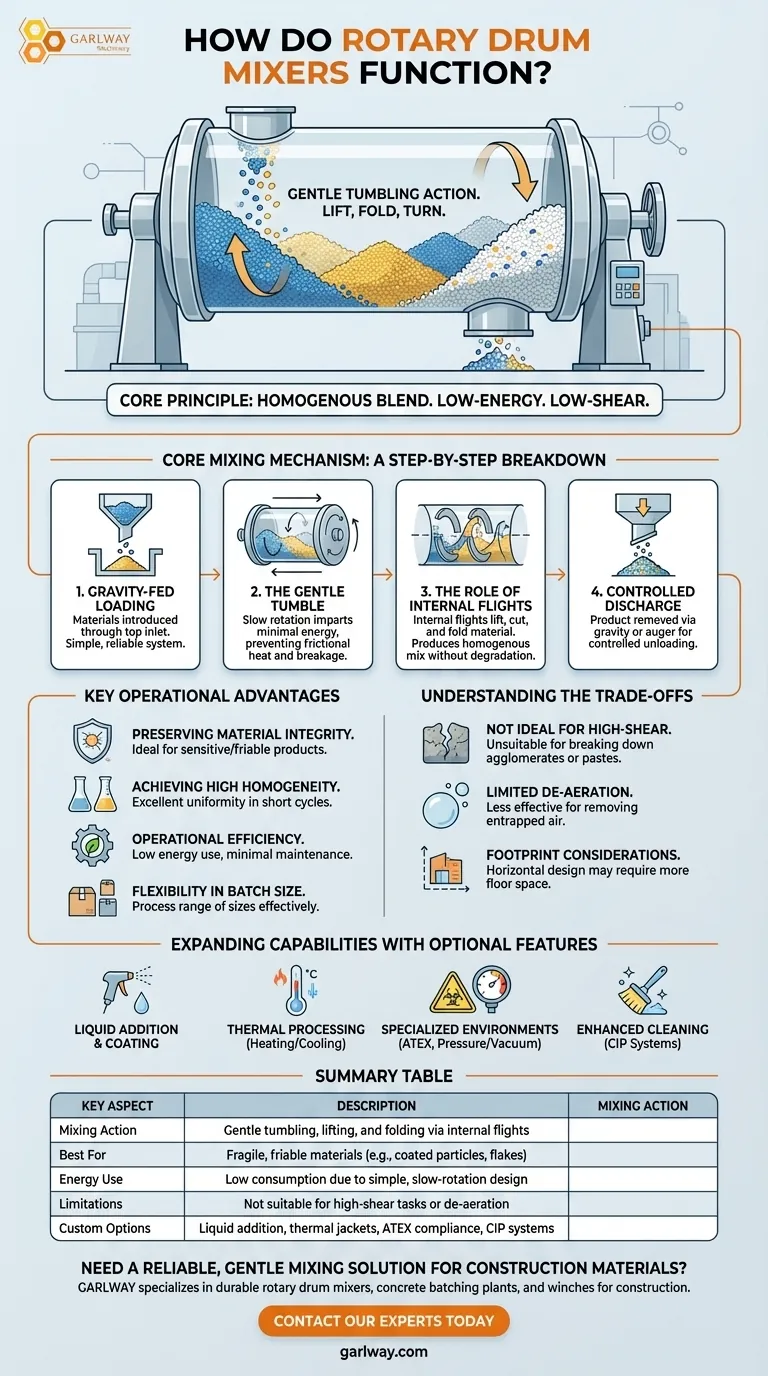
The Core Mixing Mechanism: A Step-by-Step Breakdown
To understand why this mixer is chosen for specific applications, we must look at each stage of its simple yet highly effective process.
Gravity-Fed Loading
Materials are loaded into the drum through an inlet at the top. This gravity-based system is mechanically simple, reliable, and reduces the complexity of the overall equipment design.
The Gentle Tumble
The drum rotates at a relatively slow speed. This action imparts minimal energy into the product, preventing the generation of frictional heat and avoiding the high-impact forces that could break down sensitive particles.
The Role of Internal Flights
This is the most critical element of the design. The internal flights—which can be shaped as chutes or baffles—are not aggressive paddles. Their purpose is to gently lift, cut, and fold the material back into itself as the drum rotates.
This continuous folding action is what produces a statistically homogenous mixture without causing degradation.
Controlled Discharge
Once the blending cycle is complete, the product is removed. This is typically accomplished either by opening a simple discharge gate and letting gravity empty the drum or by using a discharge auger for more controlled or automated unloading.
Key Operational Advantages
The gentle mixing mechanism directly translates into several significant operational benefits that define where this technology excels.
Preserving Material Integrity
The low-shear, low-impact action is perfect for sensitive or friable products. This includes coated particles, lightweight flakes, extruded pellets, and any material where breakage would be detrimental to the final product quality.
Achieving High Homogeneity
Despite its gentle nature, the folding action is remarkably efficient. It can achieve excellent product uniformity in surprisingly short mixing cycles, minimizing segregation of particles with different sizes or densities.
Operational Efficiency
Rotary drum mixers are known for their very low energy consumption and minimal maintenance requirements due to their simple design and low number of moving parts. They are also often quick and easy to clean between batches.
Flexibility in Batch Size
Many designs can effectively process a wide range of batch sizes within the same machine without a significant loss in mixing quality, offering valuable operational flexibility.
Understanding the Trade-offs
No single technology is perfect for every task. To make an informed decision, it's crucial to understand the limitations of the rotary drum design.
Not Ideal for High-Shear Applications
If your process requires breaking down agglomerates, dispersing thick pastes, or creating an emulsion, this is the wrong tool. The low-energy action is insufficient for tasks that require intense particle-to-particle friction or shear force.
Limited De-aeration Capability
The gentle tumbling action does not actively force air out of a mixture. For products that tend to entrap a lot of air, this design may be less effective than more intensive mixing systems.
Footprint Considerations
The horizontal construction, while allowing for easy access and loading, can require a larger operational footprint compared to some vertical mixer designs with a similar capacity.
Expanding Capabilities with Optional Features
Modern rotary drum mixers can be customized to function as multi-purpose processors, going far beyond simple blending.
Liquid Addition and Coating
Liquid injection systems can be integrated to allow for precise coating, impregnation, or enrobing of solid particles in a controlled, gentle environment.
Thermal Processing
The mixer can be fitted with heating or cooling jackets to control product temperature. For more extreme applications, cryogenic mixing using liquid nitrogen is also possible for cooling and embrittling materials.
Specialized Environments
For processing in hazardous locations, mixers can be built to ATEX-compliant standards. They can also be designed for operation under pressure or vacuum for specific chemical reactions or de-aeration processes.
Enhanced Cleaning and Access
Features like Clean-in-Place (CIP) systems and extra-large, quick-opening doors significantly reduce downtime between batches, particularly in food and pharmaceutical applications.
Making the Right Choice for Your Process
Selecting the correct mixer comes down to matching the technology's core strengths to your primary process goal.
- If your primary focus is preserving fragile materials: This is the ideal technology for mixing delicate granules, flakes, or coated products without causing degradation.
- If your primary focus is low-energy coating: The gentle folding action combined with liquid injection provides an excellent method for evenly distributing liquids onto solids.
- If your primary focus is breaking down lumps or creating a paste: You should investigate higher-shear technologies like ribbon, plow, or paddle mixers.
By understanding that its strength lies in gentle efficiency, you can effectively leverage the rotary drum mixer for superior results in the right application.
Summary Table:
| Key Aspect | Description |
|---|---|
| Mixing Action | Gentle tumbling, lifting, and folding via internal flights |
| Best For | Fragile, friable materials (e.g., coated particles, flakes) |
| Energy Use | Low consumption due to simple, slow-rotation design |
| Limitations | Not suitable for high-shear tasks or de-aeration |
| Custom Options | Liquid addition, thermal jackets, ATEX compliance, CIP systems |
Need a reliable, gentle mixing solution for your construction materials? GARLWAY specializes in construction machinery, offering durable and efficient rotary drum mixers, concrete batching plants, and winches tailored for construction companies and contractors worldwide. Let us help you achieve uniform blends while preserving material integrity—contact our experts today to discuss your project requirements!
Visual Guide
Related Products
- Belle Mixer Drum Self Loading Mortar Mixers JS3000
- Concrete Cement Mixer Machine Drum Mixer for Construction
- Harbor Freight JS1500 On Site Concrete Mixing Volumetric Cement Mixer
- JS1000 Volumetric Concrete Mortar Mixer for Sale Skid Steer Cement Mixer
- Shaft Mixer Machine for Cement and Regular Concrete Mixing
People Also Ask
- What are the features of mobile transporting in a self loading mixer? Boost On-Site Efficiency
- Why is timely cleaning important for a self loading mixer? Prevent Costly Downtime and Mix Failure
- How is discharging accomplished in a self loading mixer? Master Precise Concrete Placement
- What is the purpose of keeping the drum rotating during transportation in a self loading concrete mixer? Ensure Quality & Consistency
- What components are involved in the loading process of a self loading concrete mixer? A Guide to the Key Systems


