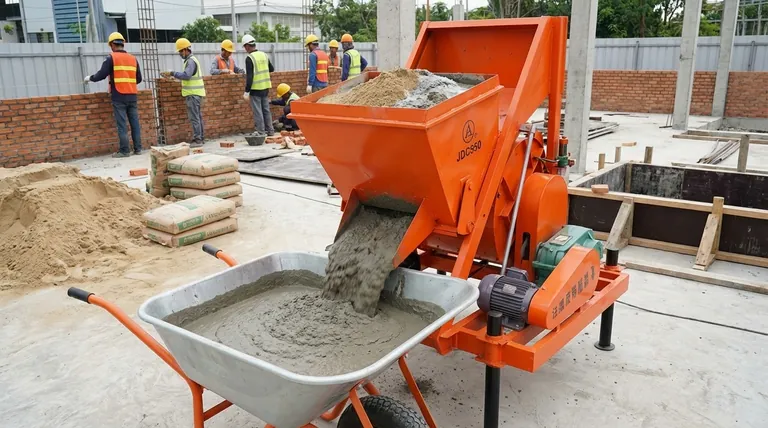
In short, a mortar mixer improves the quality of construction mixtures by using mechanical force to create a perfectly uniform and homogeneous blend. This process ensures that every grain of sand and cement is consistently coated with water, which directly enhances the final strength, durability, and longevity of the material.
The core advantage of a mortar mixer is not speed, but precision. It eliminates the inconsistencies inherent in manual mixing, transforming the potential for weak spots and future failures into a reliable, high-performance material from batch to batch.
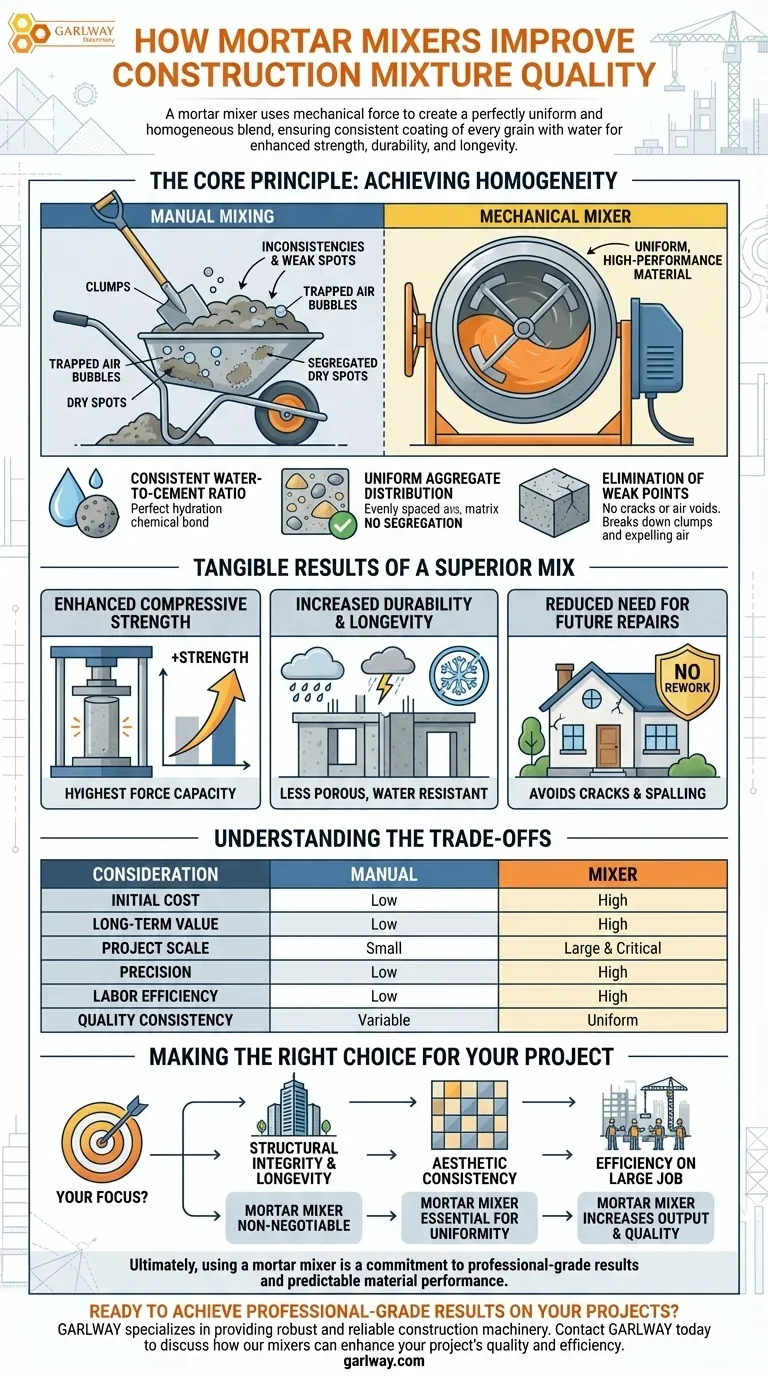
The Core Principle: Achieving Homogeneity
The term homogeneity is central to understanding a mixer's value. It means the mixture has the same composition and properties at every point. This is practically impossible to achieve by hand but is the primary function of a machine.
Consistent Water-to-Cement Ratio
Proper hydration of cement is the chemical reaction that gives mortar its strength. A mixer ensures every particle of cement gets the right amount of water, maximizing the reaction and preventing dry, unactivated pockets that compromise integrity.
Uniform Aggregate Distribution
A mixer's paddle action thoroughly distributes sand and other aggregates. This prevents segregation, where heavier particles settle, creating weak zones that are prone to cracking and failure under load.
Elimination of Weak Points
Manual mixing often leaves clumps of material or air voids. A mechanical mixer's consistent, powerful action breaks down these clumps and expels trapped air, resulting in a denser and more robust final product.
The Tangible Results of a Superior Mix
Achieving a homogeneous mixture isn't just an abstract goal; it produces measurable improvements in the finished construction work.
Enhanced Compressive Strength
Because the cement is fully hydrated and aggregates are evenly distributed, the cured mortar can withstand significantly more force. This is critical for any structural or load-bearing application.
Increased Durability and Longevity
A uniform mixture is less porous and more resistant to water penetration and the freeze-thaw cycles that cause materials to crumble over time. This leads to a longer service life for the entire structure.
Reduced Need for Future Repairs
By eliminating the hidden weak spots that cause most failures, a properly mixed mortar significantly reduces the likelihood of future cracks, spalling, or bond failure. This saves immense cost and labor down the line.
Understanding the Trade-offs
While the quality benefits are clear, a professional evaluation includes practical considerations. A mortar mixer is a tool, and its use must be appropriate for the task.
Initial Cost vs. Long-Term Value
The upfront investment in a mixer is easily offset by the reduced labor costs on larger jobs and, more importantly, by avoiding the high cost of rework and warranty repairs caused by material failure.
Scale of the Project
For a very small, non-critical patch, careful hand-mixing may be adequate. However, for any project involving structural integrity, significant volume, or high-quality finishes, a mixer becomes essential.
Precision for Fine Materials
Projects requiring fine material blending, such as specialized grouts or plasters, demand the high degree of consistency that only a machine can provide. Manual mixing cannot guarantee the precision needed for these applications.
Making the Right Choice for Your Project
The decision to use a mixer should be based on the demands of the job and the desired quality of the outcome.
- If your primary focus is structural integrity and longevity: A mortar mixer is non-negotiable to ensure the material meets its specified strength and durability.
- If your primary focus is aesthetic consistency: For projects like tiling, stucco, or masonry, a mixer guarantees uniform color and texture across all batches.
- If your primary focus is efficiency on a large job: A mixer dramatically increases output and reduces worker fatigue compared to manual methods, while simultaneously improving quality.
Ultimately, using a mortar mixer is a commitment to professional-grade results and predictable material performance.
Summary Table:
| Benefit | Key Outcome |
|---|---|
| Homogeneous Mixture | Eliminates weak spots and ensures consistent material properties. |
| Enhanced Compressive Strength | Creates a final product that can withstand significantly more force. |
| Increased Durability | Produces a less porous material, resistant to water and freeze-thaw cycles. |
| Cost Efficiency | Reduces labor on large jobs and prevents expensive future repairs. |
Ready to achieve professional-grade results on your projects?
GARLWAY specializes in providing robust and reliable construction machinery, including mortar mixers, for construction companies and contractors globally. Our equipment is engineered to deliver the uniform, high-strength mixtures essential for structural integrity and long-term durability, saving you time and money.
Contact GARLWAY today to discuss how our mixers can enhance your project's quality and efficiency.
Visual Guide
Related Products
- JDY350 Electric Hydraulic Mortar Mud Concrete Mixer
- JDC350 Small Cement Concrete Mortar Mixer
- Mini Cement Mortar Mixer Truck for Construction
- Belle Mixer Drum Self Loading Mortar Mixers JS3000
- JS1000 Volumetric Concrete Mortar Mixer for Sale Skid Steer Cement Mixer
People Also Ask
- When are electric mortar mixers typically used? Find the Perfect Tool for Small to Medium-Sized Jobs
- What are hydraulic concrete mixers used for? Powering Large-Scale Construction Projects
- How are mortar mixers utilized in concrete and grout projects? Maximize Your Mixing Efficiency
- What are the benefits of electric concrete mixers? Quiet, Clean, and Low-Maintenance Mixing
- What is a mortar mixer and what is its primary use? Master Masonry with the Right Equipment