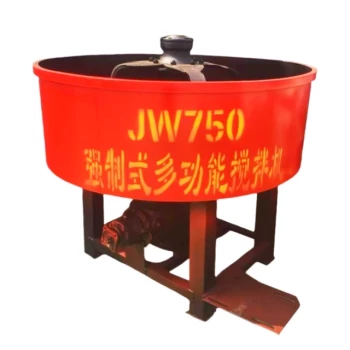
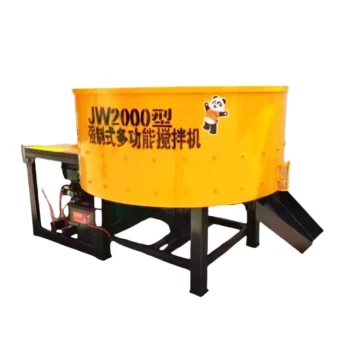
Drum mixers achieve efficient and consistent mixing by combining the simple action of rotation with the precise, engineered use of gravity and internal geometry. The tumbling motion created by the rotating drum, guided by its angle of inclination and internal blades, ensures that materials are continuously folded, lifted, and distributed throughout the batch.
A drum mixer is not just a passive tumbling container; it is an engineered system where the drum's angle, rotational speed, and internal components work in concert with gravity to produce a predictable, uniform, and energy-efficient blend.
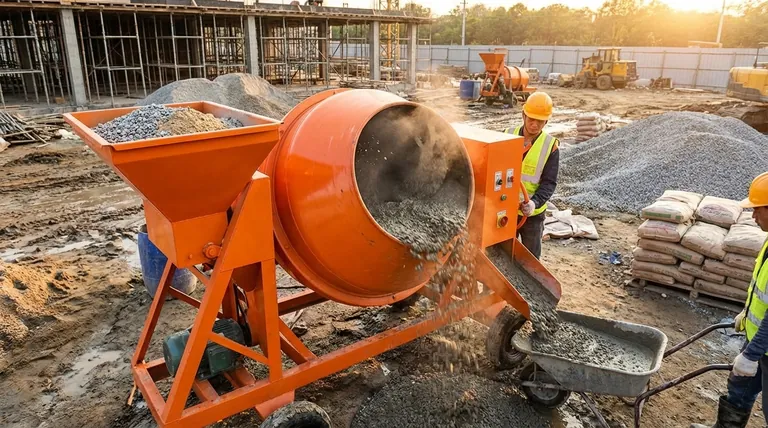
The Core Mechanics of a Drum Mixer
To understand how a drum mixer achieves its results, it's essential to look at the three physical principles it leverages. Each plays a distinct role in turning a collection of separate ingredients into a homogeneous product.
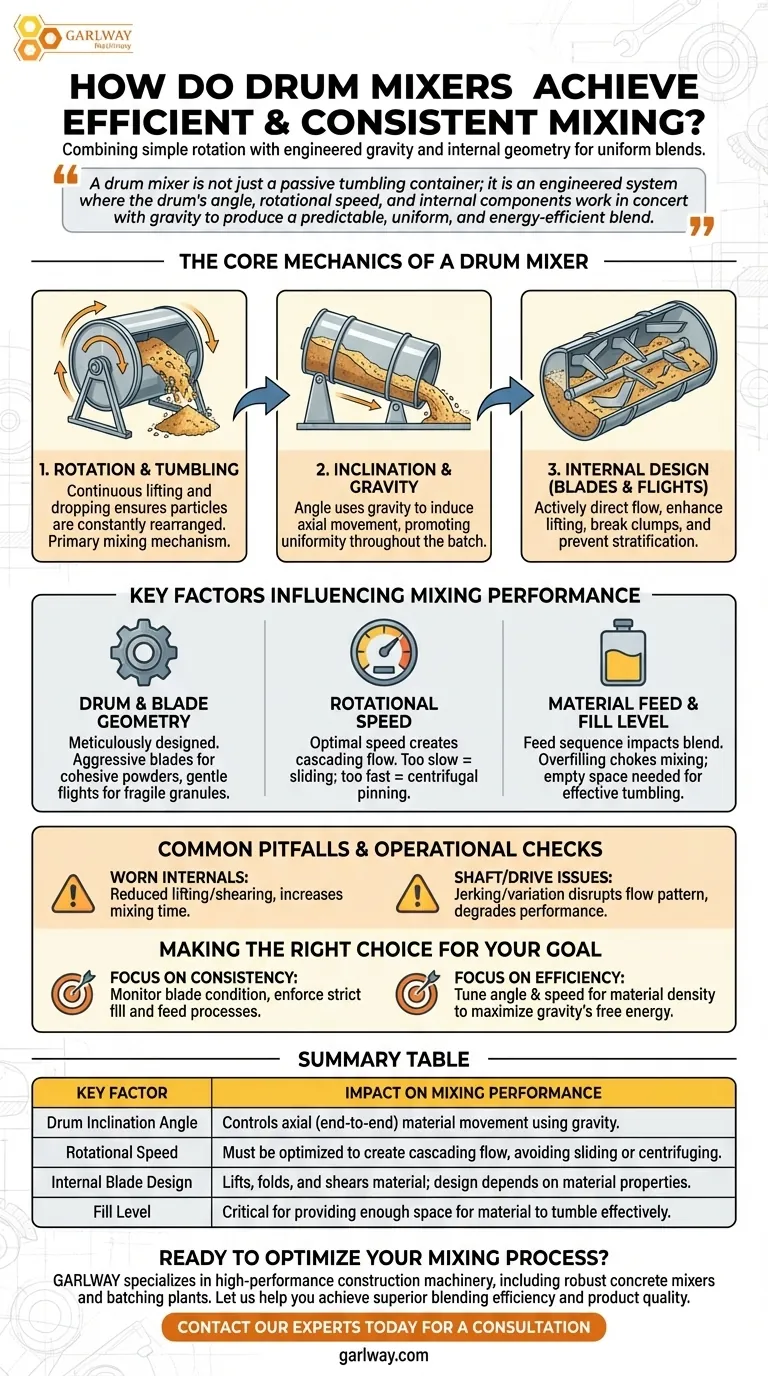
The Principle of Rotation and Tumbling
The most obvious action is the rotation of the drum itself. As the drum turns, it carries material up its side until the angle of repose is exceeded.
The material then tumbles back down, creating a cascading flow that is the primary mechanism for mixing. This continuous lifting and dropping ensures particles are constantly being rearranged.
The Critical Role of Inclination and Gravity
Most industrial drum mixers are set at a specific angle of inclination. This is not an arbitrary choice; it is a critical design feature.
The angle uses gravity to induce an axial (end-to-end) movement in the material. As particles tumble, they also gently slide toward the lower end of the drum, then get carried back up and toward the higher end, creating a gentle, continuous cycle that promotes uniformity throughout the entire batch length.
Internal Design: Blades, Flights, and Liners
The inside of the drum is rarely a simple smooth cylinder. It is typically fitted with blades, flights, or baffles.
These internal components actively direct the flow of material. They enhance the lifting action, break up clumps, and ensure that material in the center of the batch is folded into the material at the edges, preventing stratification and creating a more vigorous mixing action than tumbling alone could achieve.
Key Factors Influencing Mixing Performance
While the principles are straightforward, the final mixing quality depends on several interconnected variables. Optimizing these factors is the key to achieving peak efficiency and consistency.
Drum and Blade Geometry
The shape of the drum, the size of the blades, and the angle of the blades are all meticulously designed.
Aggressive blades are necessary for cohesive powders that tend to clump, while more gentle, curved flights are used for fragile granules to prevent breakage. The wrong internal geometry for your material will lead to poor results.
Rotational Speed
Rotational speed must be carefully controlled. If the speed is too slow, the material will simply slide instead of tumbling, resulting in poor mixing.
If the speed is too fast, centrifugal force will pin the material against the drum wall, preventing any mixing action from occurring at all. The optimal speed creates a rolling, cascading curtain of material.
Material Feed and Fill Level
The sequence and timing of how raw materials are fed into the mixer can significantly impact the final blend. Adding a small amount of a critical additive last, for example, might require a longer mixing time to ensure it is evenly dispersed.
Furthermore, the fill level is crucial. Overfilling the drum will choke the mixing action, as there won't be enough empty space for the material to tumble effectively.
Common Pitfalls and Operational Checks
Even a well-designed mixer will perform poorly if not operated and maintained correctly. Consistency is a product of both design and process discipline.
Worn Internals
Over time, the internal blades and liners will wear down from abrasion. Worn components are less effective at lifting and shearing material, which can dramatically increase the required mixing time and lead to an inconsistent product. Regular inspection is essential.
Shaft or Drive Issues
Any mechanical issue, such as shaft binding or inconsistent drive speed, will directly impact the mixing action. A smooth, steady rotation is fundamental to the process, and any jerking or variation will disrupt the material's flow pattern and degrade performance.
Making the Right Choice for Your Goal
To optimize your drum mixing process, you must align your operational parameters with your primary objective.
- If your primary focus is consistency: Pay close attention to the condition of your internal blades and liners, and enforce a strict, repeatable process for fill level and ingredient feed sequencing.
- If your primary focus is efficiency (speed and energy): Ensure the drum's angle and rotational speed are perfectly tuned for your material's density and flow characteristics to maximize the free energy provided by gravity.
- If you are troubleshooting a poor mix: Always start by inspecting for internal wear and verifying your operational parameters (fill level, speed, feed order) before investigating more complex mechanical issues.
By understanding these core principles, you can transform your drum mixer from a simple container into a precision blending tool.
Summary Table:
| Key Factor | Impact on Mixing Performance |
|---|---|
| Drum Inclination Angle | Controls axial (end-to-end) material movement using gravity. |
| Rotational Speed | Must be optimized to create a cascading flow, avoiding sliding or centrifuging. |
| Internal Blade Design | Lifts, folds, and shears material; design depends on material properties. |
| Fill Level | Critical for providing enough space for the material to tumble effectively. |
Ready to Optimize Your Mixing Process?
GARLWAY specializes in high-performance construction machinery, including robust concrete mixers and batching plants designed for contractors and construction companies worldwide. Our expertise in drum mixer design ensures efficient, consistent results for your projects.
Let us help you achieve superior blending efficiency and product quality.
Contact our experts today for a consultation to discuss your specific needs and discover the right GARLWAY solution for you.
Visual Guide
Related Products
- Belle Mixer Drum Self Loading Mortar Mixers JS3000
- Concrete Cement Mixer Machine Drum Mixer for Construction
- JDY350 Electric Hydraulic Mortar Mud Concrete Mixer
- Construction Products Concrete Plant Machine Mixing Concrete Mixer
- Harbor Freight JS1500 On Site Concrete Mixing Volumetric Cement Mixer
People Also Ask
- What are the features of mobile transporting in a self loading mixer? Boost On-Site Efficiency
- Why is timely cleaning important for a self loading mixer? Prevent Costly Downtime and Mix Failure
- How is discharging accomplished in a self loading mixer? Master Precise Concrete Placement
- What is the purpose of keeping the drum rotating during transportation in a self loading concrete mixer? Ensure Quality & Consistency
- What components are involved in the loading process of a self loading concrete mixer? A Guide to the Key Systems