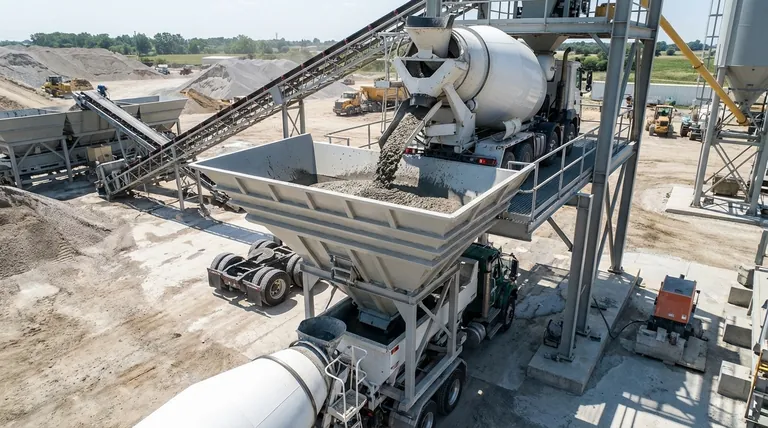
To reduce the discharging time of a mixing station, you must increase the capacity of the concrete discharge hopper or redesign it to function as a dedicated storage container. This strategy effectively decouples the mixer's operational cycle from the truck's loading cycle, allowing the mixer to discharge a full batch immediately, regardless of whether a truck is perfectly positioned.
The fundamental challenge isn't the speed of the discharge gate itself, but the waiting time created by the dependency between the mixer and the transport truck. The most effective solution is to create a buffer—a holding hopper—that allows each piece of equipment to operate on its own efficient schedule.
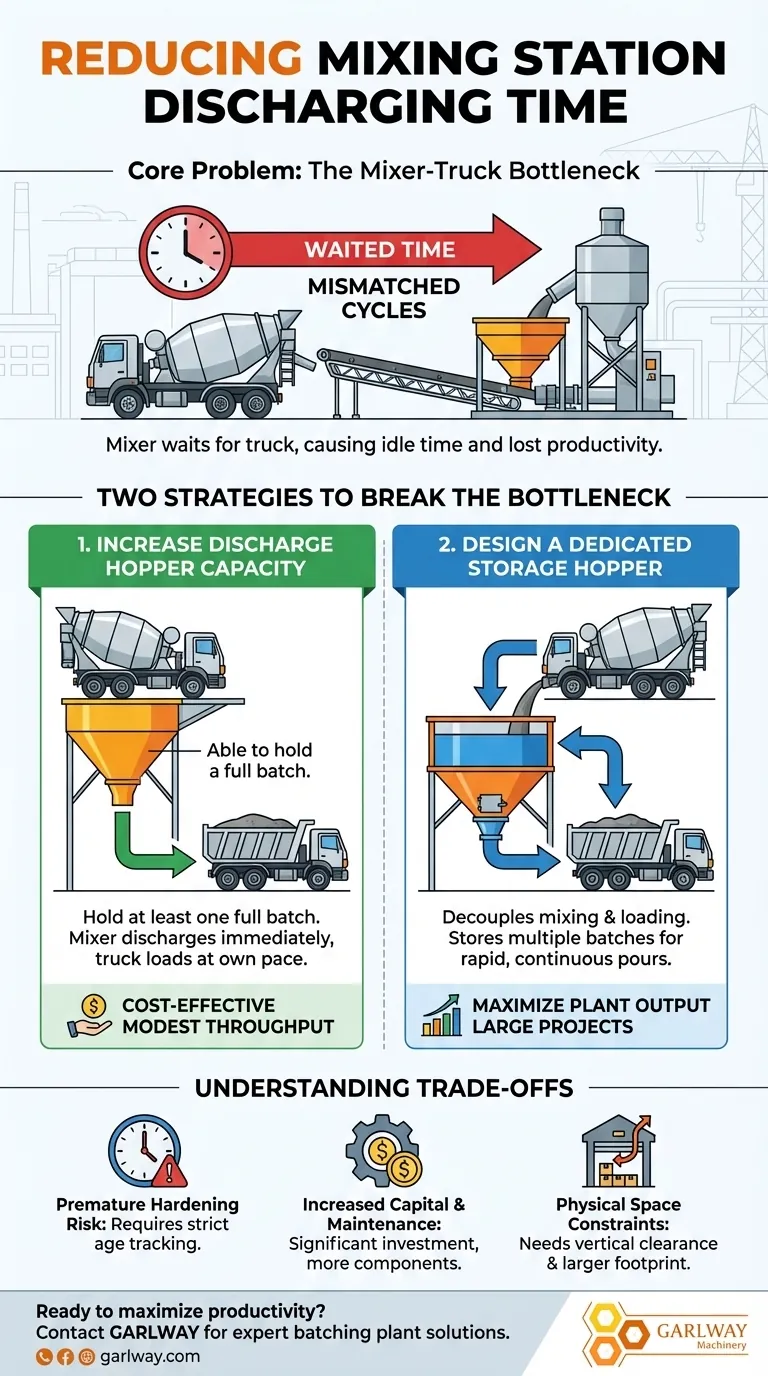
The Core Problem: The Mixer-Truck Bottleneck
To truly improve efficiency, you must first understand the bottleneck. The total time it takes to get concrete into a truck is limited by the slowest, most rigid part of the process.
Mismatched Cycle Times
A mixer can complete a batch in a fixed amount of time. However, it often has to wait for a truck to get into position before it can discharge. This idle time is a direct loss of plant productivity.
The Cost of Idle Equipment
Every minute the mixer waits is a minute it could have been starting the next batch. This delay cascades, reducing the total cubic meters of concrete your plant can produce in a day and increasing the cycle time for your entire truck fleet.
Two Strategies to Break the Bottleneck
The goal is to allow the mixer to discharge the moment a batch is ready. This can only be achieved by creating a holding area for the finished concrete.
Strategy 1: Increase Discharge Hopper Capacity
The most direct approach is to ensure your standard discharge hopper is large enough to hold at least one full batch of concrete from the mixer.
This simple upsizing allows the mixer to dump its contents and immediately begin the next charging and mixing cycle. The truck can then pull underneath the hopper and load at its own pace without holding up the primary mixer.
Strategy 2: Design the Hopper as a Storage Container
A more advanced solution is to implement a dedicated storage or "gob" hopper. This is more than just a funnel; it's a separate piece of equipment designed to hold concrete for short periods.
This system completely decouples the mixer from the loading area. The mixer can produce several batches back-to-back, storing them in the hopper. This creates a ready supply that can rapidly fill multiple trucks, which is ideal for high-volume projects requiring continuous pouring.
Understanding the Trade-offs
While effective, implementing larger hopper systems introduces new operational considerations that must be managed carefully.
The Risk of Premature Hardening
Concrete is perishable. If a batch sits in a storage hopper for too long, it can begin to set (hydrate), affecting its workability and quality. Plants using this method must have strict procedures for tracking the age of concrete in the hopper.
Increased Capital and Maintenance Costs
A larger, more complex hopper system represents a significant capital investment. It also adds another mechanical system with gates, sensors, and structural supports that require regular inspection and maintenance.
Physical Space Constraints
Installing a larger or separate storage hopper requires significant vertical clearance and a larger overall plant footprint. This may not be feasible in an existing facility without substantial structural modifications.
Making the Right Choice for Your Goal
Your decision should be based on your specific operational needs and production targets.
- If your primary focus is a modest throughput increase: Simply upsizing your existing discharge hopper to hold one full batch is the most cost-effective solution.
- If your primary focus is maximizing plant output for large projects: Investing in a dedicated storage hopper system will provide the greatest return by fully decoupling production from truck loading.
Ultimately, breaking the discharging bottleneck is about creating a buffer that allows your most critical equipment to operate without interruption.
Summary Table:
| Strategy | Key Action | Primary Benefit |
|---|---|---|
| Increase Hopper Capacity | Upsize the discharge hopper to hold one full batch. | Cost-effective solution for a modest throughput increase. |
| Add a Storage Hopper | Install a dedicated storage container to decouple mixing and loading. | Maximizes plant output for large, continuous-pour projects. |
Ready to eliminate discharge delays and maximize your concrete plant's productivity?
At GARLWAY, we specialize in high-performance construction machinery for contractors and construction companies worldwide. Our expert team can help you select or customize the ideal concrete batching plant solution—whether it's a high-capacity discharge hopper or a full storage hopper system—to match your project's demands and dramatically increase your daily output.
Contact GARLWAY today for a free consultation and let us engineer a more efficient solution for you.
Visual Guide
Related Products
- HZS90 Large Multiquip Concrete Mixers for Construction
- HZS75 Concrete Batching Plant Cement Mixer Price Concrete Mixer Bunnings Mixing Plant
- Portable Concrete Mixer Machine Equipment for Mixing Concrete
- Commercial Electric Concrete Mixer Machine HZS 50 Small Batch Plant for Sale
- HZS35 Small Cement Concrete Mixing Batch Plant
People Also Ask
- What are the types of concrete mixers used in batching plants? Choose the Right Mixer for Your Project
- What is the core component of a concrete batching plant? The Mixer Unit Defines Your Concrete Quality
- What are the different power sources for concrete mixers? Choose the Right Power for Your Project
- What are the main types of concrete mixers? A Guide to Batch, Continuous & More
- What are the main types of concrete mixers mentioned? Find the Perfect Mixer for Your Project