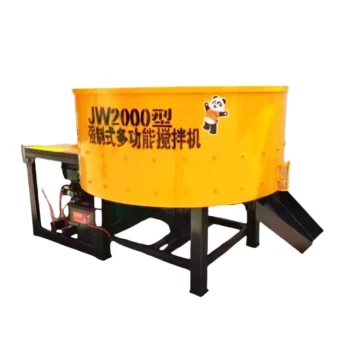
Beyond concrete, a cement mixer is a powerful force multiplier for large-scale gardening and farming tasks. This single piece of equipment can be repurposed to uniformly blend custom potting soils, mix bulk fertilizers, evenly coat seeds with inoculants, and accelerate the composting process, saving immense amounts of time and manual labor.
The core value of a cement mixer in agriculture is its ability to rapidly and consistently blend large volumes of materials. This mechanization saves labor while ensuring a uniform distribution of nutrients, amendments, and treatments that is difficult to achieve by hand.
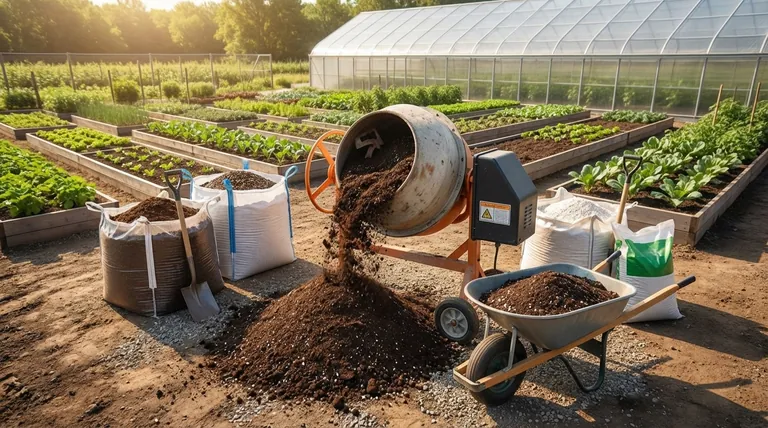
Core Applications for Farming and Gardening
A cement mixer’s tumbling action is ideal for any task requiring the thorough mixing of granular or loose materials. It transforms jobs that would take hours with a shovel and wheelbarrow into tasks that take mere minutes.
Preparing Custom Soil and Potting Mixes
For nurseries, market gardeners, or serious home gardeners, creating custom soil blends is common practice. A mixer effortlessly combines components like peat moss, compost, perlite, vermiculite, and topsoil into a homogenous, perfectly textured final product for seed starting or container planting.
Blending Bulk Fertilizers
Purchasing individual nutrient components like nitrogen, phosphorus, and potassium in bulk is far more cost-effective than buying pre-mixed blends. A cement mixer allows you to create custom fertilizer ratios tailored specifically to your soil test results and crop needs, ensuring precise and efficient nutrient application.
Activating and Mixing Compost
While not a primary composter, a mixer is excellent for aerating, moistening, and homogenizing finished or nearly-finished compost. This action ensures consistent moisture levels and even distribution of microbial life throughout the batch before it's applied to fields or gardens.
Treating Seeds with Inoculants
For legumes like peas, beans, and clover, applying a powdered inoculant is critical for nitrogen fixation. Achieving an even coating on every seed by hand is nearly impossible. A cement mixer gently tumbles the seeds with the inoculant, ensuring a perfect, uniform application for maximum effectiveness.
A Practical Guide to Using Your Mixer
Transitioning a mixer from concrete to soil requires a slightly different approach. Following a few key principles ensures you get the best results and protect your materials.
The Correct Loading Sequence
Unlike concrete where water goes in first, for soil mixes you should start with the driest, lightest materials. This prevents heavy, wet ingredients from clumping at the bottom. A good sequence is to add peat or coco coir, then perlite, then compost and topsoil, adding water slowly as it tumbles.
Finding the Right Volume
Do not overfill the mixer. For the best tumbling action, the drum should be filled to no more than half or two-thirds of its capacity. This leaves enough room for the materials to fall and fold over on themselves, which is essential for proper mixing.
Monitor for Consistency
Mixing time is not fixed; it depends on the ingredients and desired outcome. Visually check the mix every few minutes. Once you can no longer see distinct clumps or layers of individual ingredients, the job is done. Over-mixing can break down soil structure.
The Critical Cleanup Step
Thoroughly clean the mixer drum with a hose and stiff brush immediately after every use. This is non-negotiable. Dried soil is difficult to remove, and residue from fertilizers or other amendments can contaminate your next batch, potentially harming sensitive seedlings.
Understanding the Trade-offs and Limitations
While incredibly useful, a cement mixer is a brute-force tool. Understanding its limitations is key to using it effectively and safely.
Risk of Cross-Contamination
If you don't practice strict hygiene, you risk contaminating sensitive materials. Fertilizer residue could harm a seed-starting mix, or soil pathogens from one batch could be introduced to a sterilized medium. Meticulous cleaning between different tasks is essential.
Potential Damage to Materials
The abrasive tumbling action can be too aggressive for certain materials. It can damage fragile seed coats or pulverize beneficial soil structures like mycorrhizal fungi aggregates if left to mix for too long. Always use the shortest mixing time necessary to achieve uniformity.
Not a Precision Instrument
A cement mixer is designed for bulk, not for small, precise measurements. While excellent for blending hundreds of pounds of soil, it is not the right tool for mixing a few ounces of a specific amendment where exact ratios are critical on a micro-scale.
Making the Right Choice for Your Goal
Integrating a cement mixer into your workflow is about identifying the highest-value, labor-intensive tasks it can solve for your specific operation.
- If your primary focus is large-scale soil production: A mixer is an essential tool for creating consistent, high-volume batches for market gardens or nurseries.
- If your primary focus is cost-effective fertilization: This allows you to leverage the savings of bulk ingredients and tailor nutrient ratios to your specific soil needs.
- If your primary focus is legume crop success: It is the most reliable method for ensuring uniform coating of seed inoculants, directly impacting nitrogen fixation and yield.
Ultimately, treating a cement mixer as a versatile agricultural tool unlocks new levels of efficiency and consistency for your operation.
Summary Table:
| Application | Key Benefit |
|---|---|
| Custom Soil & Potting Mixes | Creates uniform, homogenous blends for containers and seed starting. |
| Bulk Fertilizer Blending | Enables cost-effective, custom nutrient ratios based on soil tests. |
| Seed Inoculant Treatment | Ensures even coating on legume seeds for maximum nitrogen fixation. |
| Compost Activation | Aerates and homogenizes compost for consistent quality before application. |
Ready to transform your agricultural workflow with a durable, multi-purpose mixer? GARLWAY specializes in construction and agricultural machinery, offering robust cement mixers, winches, and concrete batching plants designed for the demanding needs of construction companies, farmers, and contractors globally. Our equipment is engineered to handle tough jobs, saving you time and labor while ensuring consistent, high-quality results. Contact GARLWAY today to find the perfect mixer for your farming or gardening operation and unlock new levels of efficiency!
Visual Guide

Related Products
- HZS25 Best Cement Mixer for Quick Mix Concrete at Bunnings
- JDC350 Small Cement Concrete Mortar Mixer
- Concrete Cement Mixer Machine Drum Mixer for Construction
- JW1000 Mobile Cement Mixer Concrete Mixer Truck and Batching Plant
- JZC500 Large Cement Mixer Machine Price for Concrete Mix
People Also Ask
- How do cement mixers enhance safety on construction sites? Reduce Strain, Hazards, and Accidents
- What are the main components of a cement mixer? A Guide to Core Parts & Functions
- What are some tips for using a cement mixer effectively? Maximize Your Mixer's Performance & Concrete Quality
- How does cleaning a cement mixer after use benefit its performance? Maximize Lifespan and Mix Quality
- Why is it important to clean the cement mixer after use? Prevent Costly Damage and Ensure Quality Concrete