Our Psychological Blind Spot
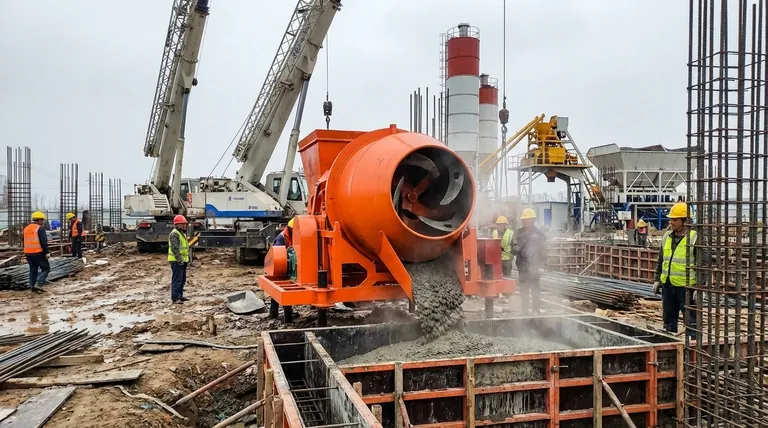
Think of a modern construction site. We see the towering cranes, the sprawling foundations, the architectural ambition. We are drawn to the scale of the final product.
In this picture, the humble concrete truck mixer is often relegated to the background—a mere delivery vehicle, mentally filed alongside dump trucks and flatbeds.
This is a profound misunderstanding.
A truck mixer is not a passive container. It is a time-sensitive, mobile processing plant. Its entire design is a sophisticated solution to one of construction's most fundamental challenges: how to transport a heavy, perishable material that begins a chemical reaction the moment it's mixed, and ensure it arrives in a perfect, usable state.
Anatomy of the Solution
The familiar rotating drum is a marvel of purpose-built engineering. It’s an environment designed to counteract time and physics.
The Drum: A Compromise with Gravity and Law
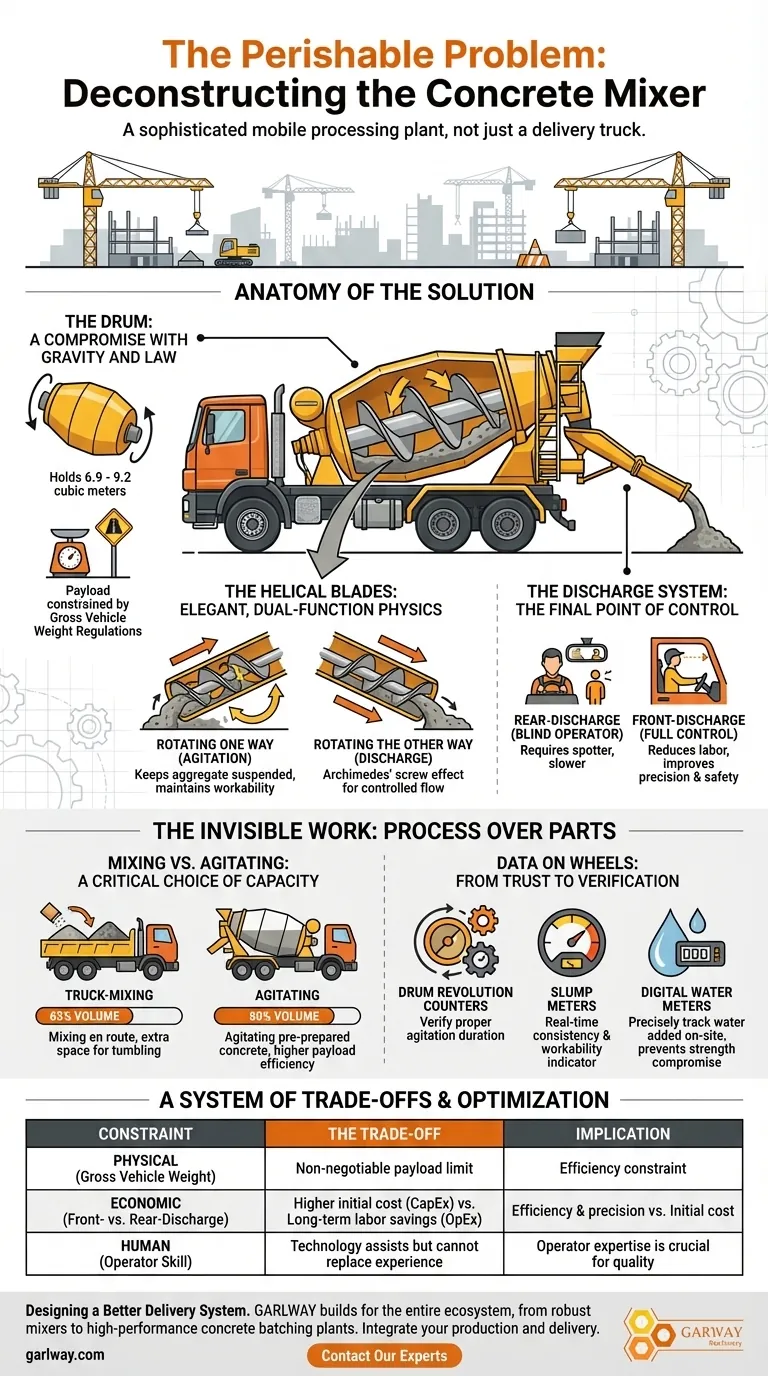
The drum itself, typically holding between 6.9 to 9.2 cubic meters (9-12 cubic yards), represents a critical balance. Its size isn't determined by manufacturing limits, but by something far more mundane: gross vehicle weight regulations. The laws of the road are the first and final constraint on its payload.
The Helical Blades: Elegant, Dual-Function Physics
Welded to the interior of the drum are helical blades. This is where the machine's genius lies. It’s a beautifully simple mechanical solution to a dual-function problem.
- When rotating one way: The blades gently lift and fold the concrete, pushing it deeper into the drum. This constant agitation prevents segregation and keeps the aggregate suspended, maintaining the mixture's workability.
- When rotating the other way: The same blades transform into an Archimedes' screw, guiding the heavy, viscous material out of the drum and into the discharge chute in a controlled flow.
One mechanical part, two essential and opposing functions.
The Discharge System: The Final Point of Control
The chute system, extending 3 to 6 meters, is the final touchpoint. The distinction between rear- and front-discharge models is more than a design choice; it's a fundamental shift in on-site workflow.
A traditional rear-discharge truck requires a spotter to guide the driver, who is effectively operating blind. A front-discharge mixer puts the driver in full control, with a clear line of sight to the pour. This reduces labor needs, improves precision, and increases safety on congested sites.
The Invisible Work: Process Over Parts
The mixer's true function is defined not just by its hardware, but by how it's used within the larger construction system. This is a game of capacity and quality.
Mixing vs. Agitating: A Critical Choice of Capacity
How the truck is used dictates its efficiency. The rules are dictated by physics:
- Truck-Mixing: If raw materials are loaded into the drum for mixing en route, it can only be filled to 63% of its volume. The extra space is essential for the materials to tumble and combine properly.
- Agitating: If the truck is loaded with already-prepared concrete from a central plant, its role is simply to agitate. It can be filled to 80% of its volume.
This single decision, made back at the batching plant, changes the payload by nearly 27%. It's a logistical choice with significant financial consequences.
Data on Wheels: From Trust to Verification
Modern mixers are becoming data hubs. Onboard sensors provide a layer of quality assurance that was previously impossible.
- Drum Revolution Counters: Verify the mixture has been properly agitated for the required duration.
- Slump Meters: Measure hydraulic pressure to estimate the concrete's consistency, giving a real-time indicator of its workability.
- Digital Water Meters: Precisely track any water added on-site, preventing unauthorized additions that could compromise the concrete's strength.
This technology transforms a process once based on the operator's feel and experience into one that is data-driven and verifiable.
A System of Trade-offs
For all its engineering elegance, the concrete mixer operates within a world of constraints. Recognizing these trade-offs is key to using it effectively.
| Constraint | The Trade-Off | Implication |
|---|---|---|
| Physical | Gross Vehicle Weight | The ultimate, non-negotiable limit on payload and efficiency. |
| Economic | Front- vs. Rear-Discharge | Higher initial cost (CapEx) for a front-discharge model versus long-term labor savings and on-site efficiency (OpEx). |
| Human | Operator Skill | Technology assists, but it cannot replace an experienced operator's judgment in managing the pour and maintaining the equipment. |
The quality of a multi-million dollar concrete pour still relies on the driver's expertise. They are the final link in the quality control chain.
Designing a Better Delivery System
Choosing the right equipment isn't about the machine in isolation; it's about optimizing the entire delivery system. A concrete mixer is a critical component, but it works in concert with the batching plant that produces the mix.
At GARLWAY, we understand this ecosystem because we build for it. Our expertise covers not just robust concrete mixers but also the high-performance concrete batching plants that feed them. We help contractors build integrated, efficient, and reliable systems for concrete production and delivery.
Understanding this system is the first step; implementing it is the next. Contact Our Experts to build a more reliable concrete delivery process.
Visual Guide
Related Products
- Portable Concrete Mixer Machine Equipment for Mixing Concrete
- Construction Products Concrete Plant Machine Mixing Concrete Mixer
- Portable Electric Concrete Mixer Machine for Cement Mixing
- JZC400 Mobile Small Concrete Mixer Cement Mixer Machine
- Hydraulic Concrete Mixer Machine Cement Mixing Equipment for Mixture Concrete
Related Articles
- How to Diagnose and Prevent Sensor Resistance Failures in Concrete Mixing Equipment
- How to Build an OSHA-Compliant Safety System for Concrete Mixer Workspaces
- The Downtime Equation: How a Manufacturer's Support System Defines Your Concrete Mixer's True Cost
- How to Choose Concrete Mixers for Long-Term Reliability and Cost Savings
- How Concrete Composition Works: The Science Behind Stronger Structures