The Illusion of Simplicity
Mixing concrete looks deceptively simple. Take some grey powder, add sand, gravel, and water. Stir until it looks right. For a small garden post, this might suffice.
But when you build a foundation, a support column, or a structural slab, you're not just mixing mud. You are manufacturing a high-performance material. The human eye is a poor judge of the molecular bonds forming within that slurry. Our tendency to trust what "looks right" is a cognitive shortcut that can lead to catastrophic failure.
The true enemy of strong concrete is not the physical labor of mixing; it is the invisible force of material segregation.
The Unseen Battle Inside the Drum
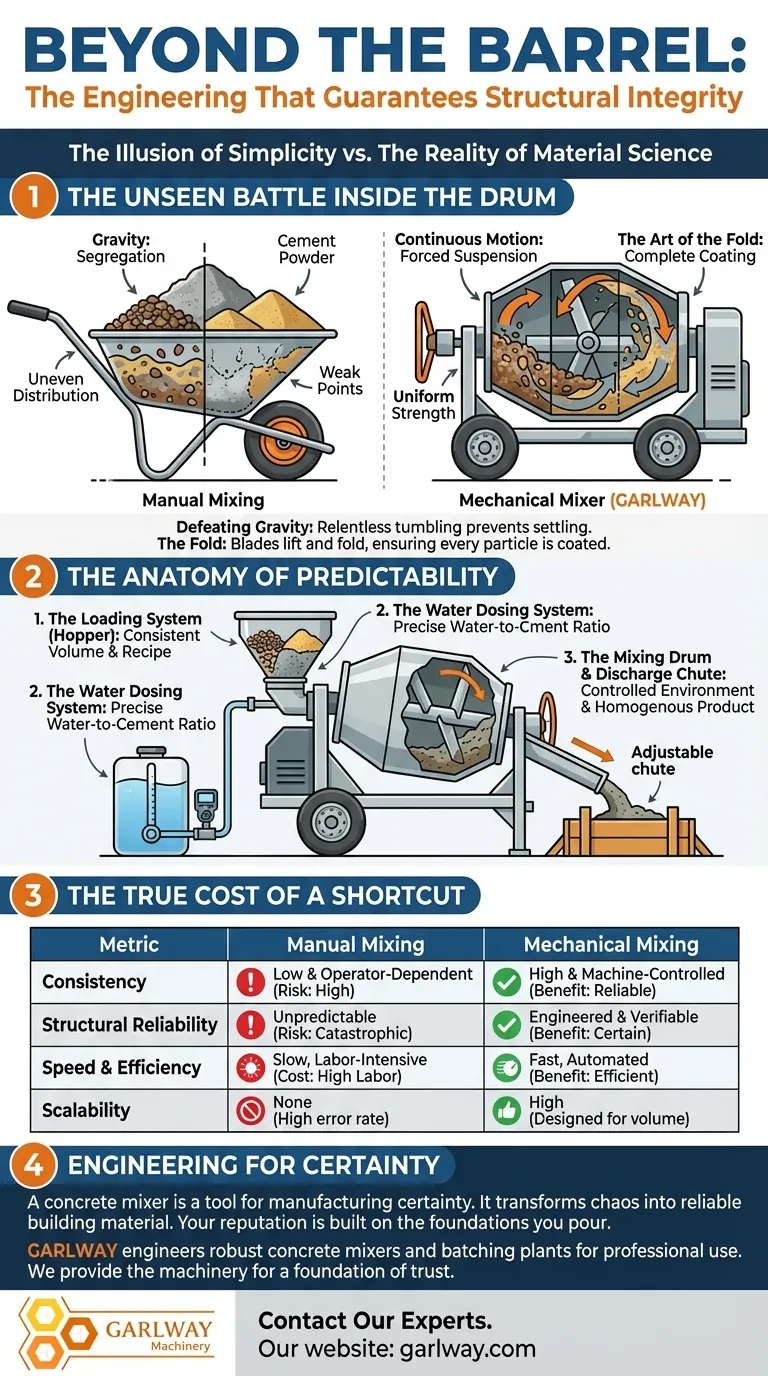
Imagine a pile of raw materials. Heavy gravel, finer sand, and the lightest cement particles. Add water. Gravity immediately goes to work, pulling the heaviest aggregates to the bottom. Water pools in pockets. The cement paste, which is the glue holding everything together, is distributed unevenly.
Mixing by hand in a wheelbarrow is a futile fight against this physical tendency. You create a mixture riddled with inconsistencies—some parts too wet, others too dry, some rich with cement, others starved of it. These are not just imperfections; they are latent weak points, waiting for stress and time to expose them as cracks.
A mechanical mixer is engineered to win this battle decisively.
Defeating Gravity with Continuous Motion
The heart of a mixer is its constantly rotating drum. This is not mere stirring. It is a state of forced suspension.
The relentless tumbling keeps the heavy aggregates from settling, ensuring they are evenly distributed throughout the entire batch. Every cubic inch of the final product has the same carefully designed ratio of materials. This is the foundation of uniform strength.
The Art of the Fold: How Blades Create Bonds
Inside that drum, strategically angled blades or fins perform a task that is impossible by hand. They lift the material, carry it to the top, and fold it back into itself.
This folding action is critical. It forces every single particle of sand and gravel to be coated in the cement-water paste. This complete coating is what facilitates the chemical reaction (hydration) that gives concrete its immense compressive strength. It’s the difference between a simple mixture and a true composite material.
The Anatomy of Predictability
Professional construction is an exercise in managing variables to produce a predictable outcome. A modern concrete mixer is an instrument of control, designed to make the process of creating concrete repeatable and reliable.
Its key components are not just parts of a machine; they are stages in a quality control process.
- The Loading System: A hydraulic hopper doesn't just save effort; it ensures that a consistent volume of aggregates and cement is added every single time, forming the basis of a repeatable recipe.
- The Water Dosing System: This is arguably the most critical component. The water-to-cement ratio is the primary determinant of concrete's final strength. A precise dosing system removes the guesswork, delivering the exact amount of water needed for optimal hydration.
- The Mixing Drum & Discharge Chute: The drum provides the controlled environment for the chemical reaction to begin, and the adjustable chute ensures the final, homogenous product is placed exactly where it's needed without re-introducing segregation.
The True Cost of a Shortcut
The decision between manual and mechanical mixing is not about budget; it is about risk tolerance. While the initial cost of a mixer is higher, the potential cost of inconsistent, low-strength concrete is astronomical.
| Metric | Manual Mixing (Wheelbarrow) | Mechanical Mixing (Professional Mixer) |
|---|---|---|
| Consistency | Low & Operator-Dependent | High & Machine-Controlled |
| Structural Reliability | Unpredictable | Engineered & Verifiable |
| Speed & Efficiency | Slow, Labor-Intensive | Fast, Automated |
| Scalability | None (High error rate) | High (Designed for volume) |
For any project where structural integrity is a factor—from a patio slab to a multi-story building—the shortcut of manual mixing introduces a level of unpredictability that is professionally unacceptable.
Engineering for Certainty
Ultimately, a concrete mixer is a tool for manufacturing certainty. It takes a chaotic blend of raw materials and transforms them into a predictable, uniform, and reliable building material. It's a testament to how simple mechanical principles can solve complex material science challenges.
For construction companies and contractors, whose reputations are built quite literally on the foundations they pour, this certainty is not a luxury—it is the core of their business. That is why GARLWAY engineers robust concrete mixers and batching plants designed for the rigors of professional use. We provide the machinery that transforms your raw materials into a foundation of trust.
For projects where failure is not an option, the right equipment is the only answer. Contact Our Experts
Visual Guide
Related Products
- Portable Concrete Mixer Machine Equipment for Mixing Concrete
- Construction Products Concrete Plant Machine Mixing Concrete Mixer
- Portable Electric Concrete Mixer Machine for Cement Mixing
- JZC400 Mobile Small Concrete Mixer Cement Mixer Machine
- Hydraulic Concrete Mixer Machine Cement Mixing Equipment for Mixture Concrete
Related Articles
- How to Diagnose and Prevent Sensor Resistance Failures in Concrete Mixing Equipment
- How to Build an OSHA-Compliant Safety System for Concrete Mixer Workspaces
- The Downtime Equation: How a Manufacturer's Support System Defines Your Concrete Mixer's True Cost
- How to Choose Concrete Mixers for Long-Term Reliability and Cost Savings
- How Concrete Composition Works: The Science Behind Stronger Structures