
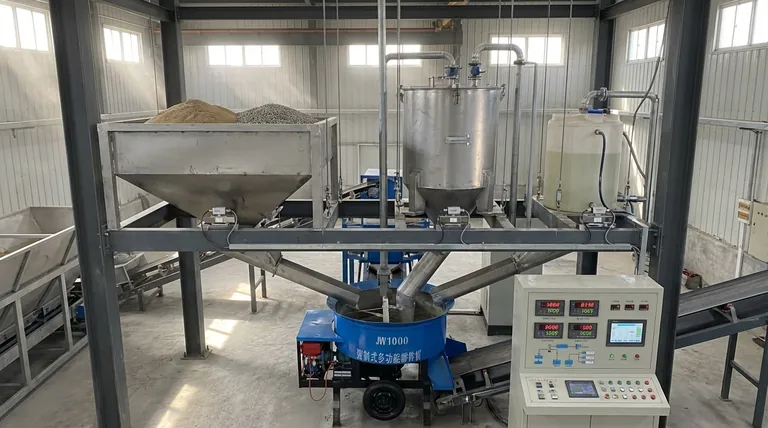
At its core, a concrete mixing plant's weighing system consists of weighing hoppers and sensors. These components are organized into three primary sub-systems designed to precisely measure aggregates, powders, and liquids, ensuring the correct proportions for every batch of concrete.
The accuracy of your final concrete product—both in quality and cost—is determined entirely by the weighing system. It is not a single scale, but rather a set of specialized, computer-controlled systems working in concert to guarantee the integrity of the mix.
The Role of the Weighing System
The weighing system is one of the five foundational pillars of a modern concrete plant, alongside the mixing, conveying, storage, and control systems. Its sole purpose is to ensure every ingredient is measured with precision.
Why Weight is the Standard
While materials can be measured by volume, nearly all large-scale engineering projects mandate measurement by weight. Weight is a far more accurate and consistent metric, unaffected by material compaction or density variations.
The Direct Impact on Quality and Cost
Even small deviations in the proportions of cement, water, or aggregates can compromise the strength and durability of the finished concrete. An accurate weighing system prevents this, while also eliminating material waste and reducing overall production costs.
A Breakdown of the Three Weighing Sub-Systems
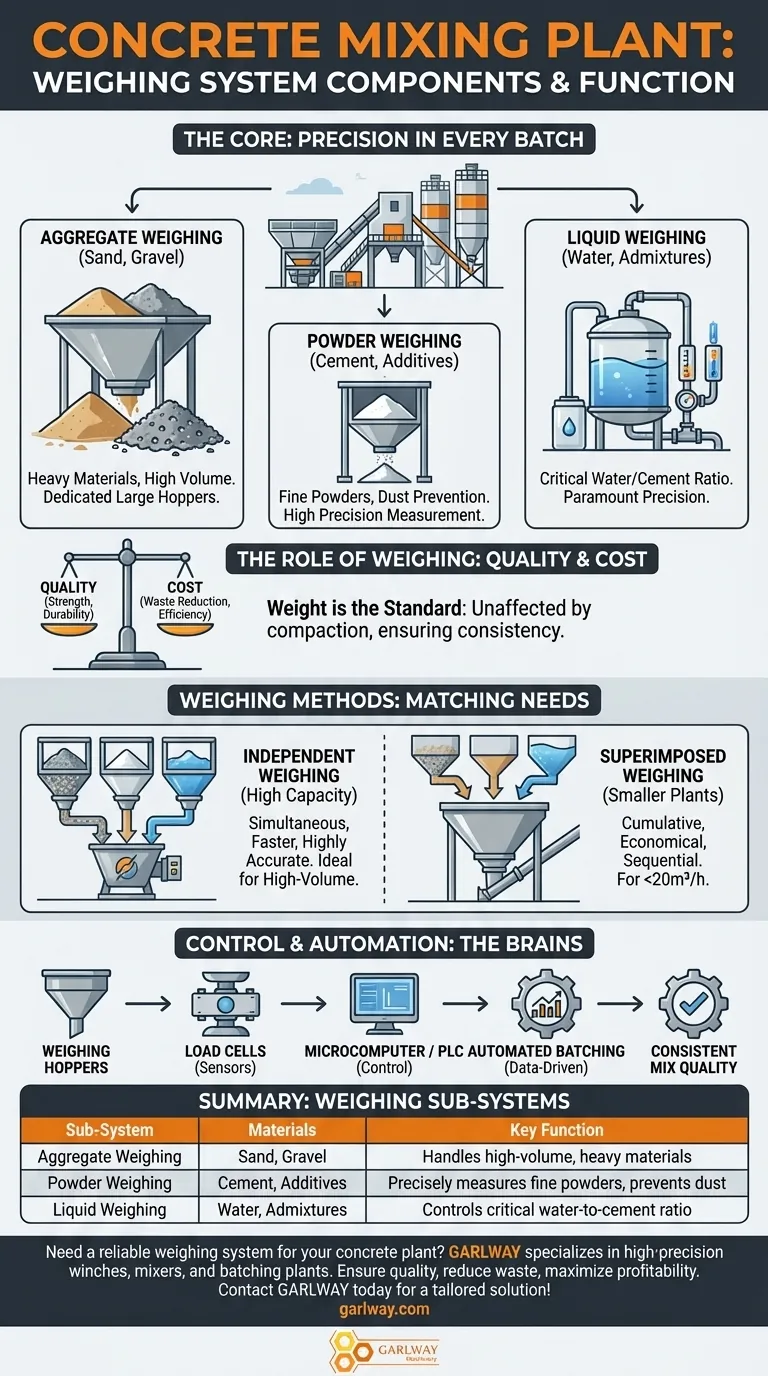
To handle the diverse physical properties of concrete ingredients, the weighing system is divided into three specialized parts. For plants producing over 50 cubic meters per hour, each of these systems typically operates independently for maximum accuracy.
1. Aggregate Weighing
This system is responsible for measuring the heaviest components: sand and gravel. It uses large weighing hoppers to handle the high volume of these materials before they are transported to the mixer.
2. Powder Weighing
This system precisely measures fine powders like cement and other supplementary cementitious materials. It is designed to handle these materials carefully to prevent dust and ensure accuracy.
3. Liquid Weighing
The liquid weighing system measures water and any chemical admixtures. Given the critical role of the water-to-cement ratio, this system's precision is paramount to the concrete's final performance.
Understanding the Trade-offs in Weighing Methods
The specific method used for weighing often depends on the plant's production capacity and budget.
Independent Weighing
In this method, each material (or class of material) is weighed in its own separate hopper simultaneously. This is the standard for high-capacity plants because it is faster and extremely accurate.
Superimposed (Cumulative) Weighing
Common in smaller plants (under 20 cubic meters per hour), this method uses a single weighing hopper for all aggregates. Materials are added and weighed one after another. This approach is more economical but can be slower.
The Brains of the Operation: Control and Automation
The physical hoppers are only one part of the equation. The modern weighing system relies on a seamless connection between hardware and software.
Sensors and Load Cells
Electronic sensors, or load cells, are installed on the weighing hoppers. These devices convert the physical force (weight) of the material into an electrical signal.
Microcomputer Control
This electrical signal is sent to a microcomputer or PLC (Programmable Logic Controller). The control system reads the data, closes the gates when the target weight is reached, and manages the entire automated batching process.
Matching the System to Your Production Needs
Choosing the right configuration is critical for aligning the plant's capabilities with its operational goals.
- If your primary focus is high-volume, high-precision production: An independent weighing system with dedicated electronic scales for each material class is the necessary standard.
- If your primary focus is a smaller-scale or budget-conscious operation: A superimposed (cumulative) weighing system provides a reliable and cost-effective solution.
Ultimately, the weighing system serves as the heart of the plant's quality control, directly dictating the integrity and profitability of every batch produced.
Summary Table:
| Weighing Sub-System | Materials Measured | Key Function |
|---|---|---|
| Aggregate Weighing | Sand, Gravel | Handles high-volume, heavy materials |
| Powder Weighing | Cement, Additives | Precisely measures fine powders, prevents dust |
| Liquid Weighing | Water, Chemical Admixtures | Controls critical water-to-cement ratio |
Need a reliable weighing system for your concrete plant? GARLWAY specializes in construction machinery, providing high-precision winches, concrete mixers, and batching plants for construction companies and contractors globally. Our robust weighing systems ensure consistent mix quality, reduce material waste, and maximize your profitability. Contact GARLWAY today to discuss your project requirements and get a tailored solution!
Visual Guide
Related Products
- HZS90 Large Multiquip Concrete Mixers for Construction
- HZS180 Ready Mix Concrete Plant for Foundations with Sand and Cement
- Construction Products Concrete Plant Machine Mixing Concrete Mixer
- HZS120 Ready Mix Concrete Batching Plant Commercial Mud Cement Mixer
- HZS35 Small Cement Concrete Mixing Batch Plant
People Also Ask
- What are the types of concrete mixers used in batching plants? Choose the Right Mixer for Your Project
- What is the core component of a concrete batching plant? The Mixer Unit Defines Your Concrete Quality
- What are the different power sources for concrete mixers? Choose the Right Power for Your Project
- What are the main types of concrete mixers? A Guide to Batch, Continuous & More
- What are the main types of concrete mixers mentioned? Find the Perfect Mixer for Your Project





