
At its core, essential off-road gear is a system designed to address the most common points of failure: loss of traction, tire damage, and mechanical issues. A basic, effective kit includes traction boards, a full-size spare tire with a plug kit, a proper recovery strap with shackles, an air compressor and deflator, and a shovel.
The goal isn't just to accumulate gear; it's to build a reliable system for self-sufficiency. Your equipment should empower you to safely get yourself unstuck, manage your tires for varied terrain, and handle unforeseen challenges far from assistance.
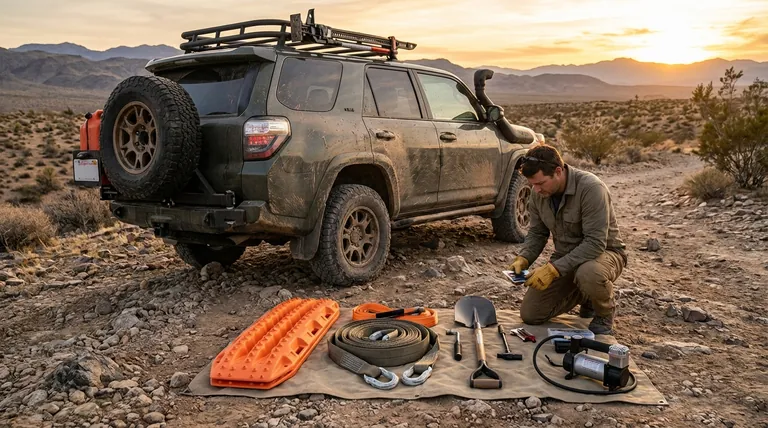
Foundational Gear: The Non-Negotiables
Before investing in complex recovery systems, every off-road vehicle must be equipped with the absolute basics. These items address the most frequent and predictable issues you will encounter on the trail.
A Full-Size, Functional Spare Tire
Your vehicle's temporary "donut" spare is not suitable for off-road use. You need a full-size spare tire that matches the other four in size and type, ensuring you can continue your journey safely after a flat.
A Reliable Jack and Lug Wrench
Ensure the factory jack is in good working order and that you know how to use it on uneven ground. Consider upgrading to a sturdy bottle jack or a dedicated off-road jack for better stability and lift height. Always have the correct lug wrench for your wheels.
Tire Repair and Plug Kit
A simple tire plug kit is an inexpensive, indispensable tool. It allows you to repair common punctures from nails or sharp rocks without having to mount your spare, saving it for a more serious sidewall tear.
A Sturdy Shovel
Never underestimate the power of a good shovel. It's a versatile tool for digging out a buried tire, clearing mud or snow from your path, leveling ground for a jack, or managing a campfire. A collapsible or short-handled shovel is a great, space-saving option.
Vehicle Recovery Equipment
When you are truly stuck, this is the gear designed to get your vehicle moving again. It requires a clear understanding of the forces involved and a commitment to safe practices.
Traction Aids
Traction boards are one of the most significant safety innovations in modern off-roading. These durable boards can be wedged under your tires to provide immediate grip in mud, sand, or snow, often preventing the need for a more complex pull or winch recovery.
Straps and Shackles
It is critical to understand the difference between recovery straps and tow straps. A kinetic recovery strap (or snatch strap) is designed to stretch, building up energy to "snatch" a stuck vehicle free. A static tow strap has no stretch and is only for pulling a rolling vehicle on a flat surface.
You will also need shackles (D-rings or soft shackles) to safely connect the strap to your vehicle's recovery points.
Recovery Points
None of your pulling gear is useful without solid, frame-mounted recovery points. Factory tie-down loops are not rated for the shock loads of a recovery and can break, becoming dangerous projectiles. Ensure your vehicle has rated hooks or shackle mounts bolted directly to the frame.
The High-Lift Jack
A Hi-Lift jack is a powerful and versatile tool for lifting, light winching, and clamping. However, it is inherently unstable and can be extremely dangerous if used improperly. It should only be considered after you have mastered the basics and received proper training.
Tire Management and Air Systems
Proper tire pressure is arguably the most important factor for off-road performance and safety. Your gear should allow you to adapt your tire pressure to the terrain at will.
Airing Down for Traction
Lowering your tire pressure (airing down) increases the tire's footprint, dramatically improving traction on sand, rocks, and mud. A simple tire deflator tool makes this process fast and accurate.
Airing Up for the Road
You must reinflate your tires to a safe highway pressure before returning to pavement. A portable 12V air compressor is the most common and reliable solution. For faster fills, some users opt for a CO2 tank, though it has a finite supply.
Understanding the Dangers: Common Gear Misuses
Having the gear is not enough; using it incorrectly can cause catastrophic equipment failure, severe injury, or worse. Understanding the limits and risks is non-negotiable.
Never Use a Tow Strap for Kinetic Recovery
Using a static tow strap to "snatch" a vehicle creates a massive shock load that can break recovery points, shackles, or the strap itself. Only a strap specifically rated as a kinetic recovery strap should be used for this purpose.
Chains are for Towing, Not Recovery
The references mention tow chains, but they should almost never be used in a dynamic recovery. A chain has zero stretch and will transfer the full shock load instantly. If it breaks, it becomes a lethal whip.
Respect the Hi-Lift Jack
The Hi-Lift jack is responsible for countless off-road injuries. Its handle can fly up with incredible force, and the vehicle can easily slip off its small lifting point. Never get any part of your body under a vehicle supported only by a Hi-Lift jack.
Building Your Kit: A Phased Approach
Your gear should match your ambition. Start with the essentials and add more specialized equipment as you tackle more challenging terrain.
- If your primary focus is occasional trail riding: Start with a shovel, a tire plug kit, a quality air compressor/deflator, traction boards, and one proper kinetic recovery strap with two shackles.
- If your primary focus is multi-day overlanding: Add a Hi-Lift jack (with training), a comprehensive tool kit, extra fuel and water storage, and a reliable communication device like a satellite messenger.
- If your primary focus is extreme rock crawling or remote exploration: A vehicle-mounted winch becomes essential, along with a full winch recovery kit (snatch block, tree saver), spare axle shafts, and advanced first-aid supplies.
Ultimately, the best off-road gear is the knowledge of how and when to use it safely to keep your adventure going.
Summary Table:
| Gear Category | Essential Items | Key Purpose |
|---|---|---|
| Foundational Gear | Full-size spare tire, jack, tire plug kit, shovel | Handle basic tire issues and digging out |
| Recovery Equipment | Traction boards, kinetic recovery strap, shackles, frame-mounted recovery points | Safely extract a stuck vehicle |
| Tire Management | 12V air compressor, tire deflator | Adjust tire pressure for optimal traction and safety |
| Safety & Knowledge | Understanding gear limits, avoiding misuse of chains/tow straps | Prevent equipment failure and injury |
Ready to equip your vehicle for any adventure? At GARLWAY, we specialize in durable machinery and tools built for tough conditions. While our core expertise is in construction equipment like winches, concrete mixers, and batching plants, we understand the importance of reliability and safety in demanding environments. If you're a contractor or construction professional looking for robust solutions, contact our team today to learn how GARLWAY can support your projects with dependable, high-performance equipment.
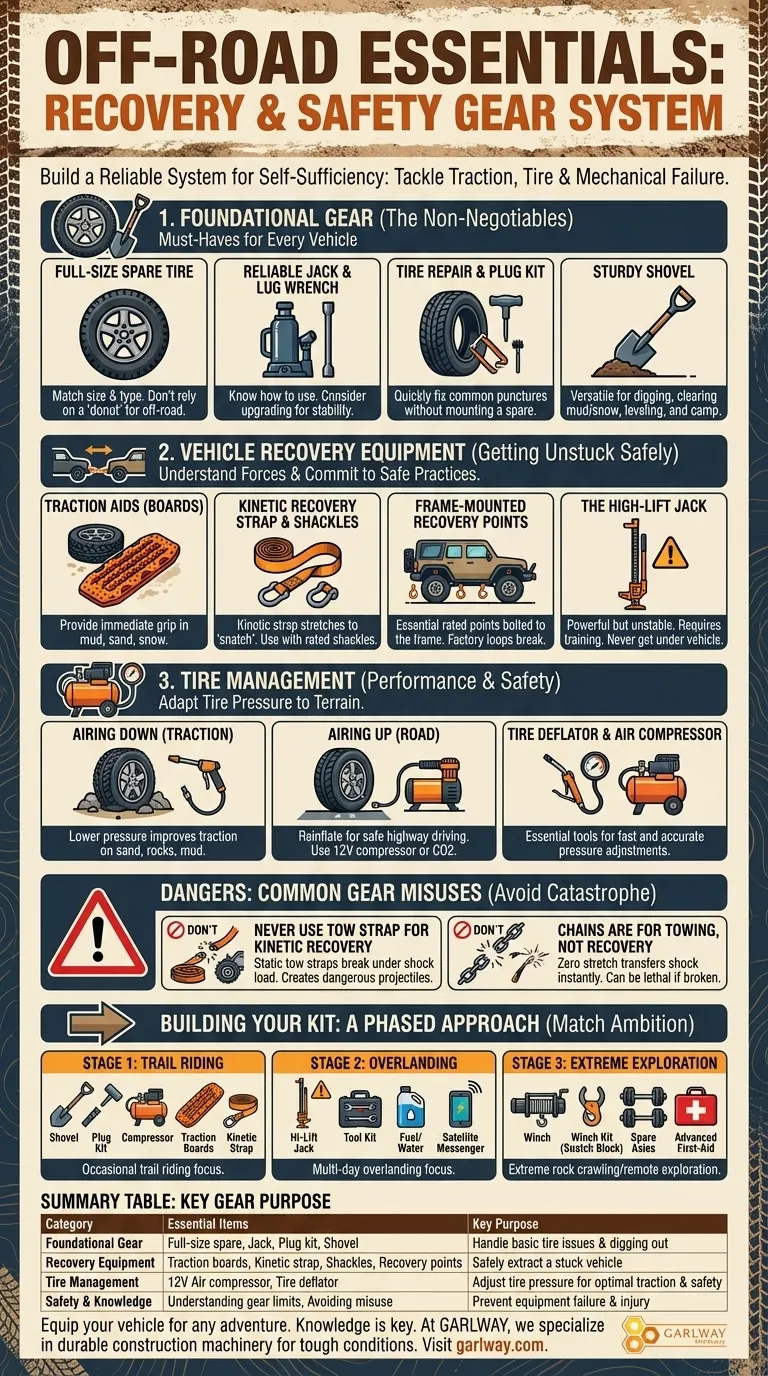
Visual Guide
Related Products
- Quick Windlass Portable Winch for Truck and Boat Best Boat Winch
- Portable Small Trailer Winch
- 12000 lb Electric Boat Trailer Winch with Windlass Anchor Warn
- Warn Winch Windlass Boat Trailer Winch
- Heavy Duty Electric Boat Winch Windlass Anchor
People Also Ask
- What features were incorporated into the upgraded portable winch system? Boost Your Recovery Power & Safety
- What are some uses mentioned for portable winches beyond vehicle recovery? Essential Versatility for Property & Work
- How could the twisting issue with a portable winch be mitigated? Achieve Safe, Centered Pulls with Proper Rigging
- What are the primary uses of a portable winch for a truck? Boost Your Truck's Capability and Self-Reliance
- What is the single rope traction force of the quick winch without a pulley block? 0.5 to 40 Tons Explained


