
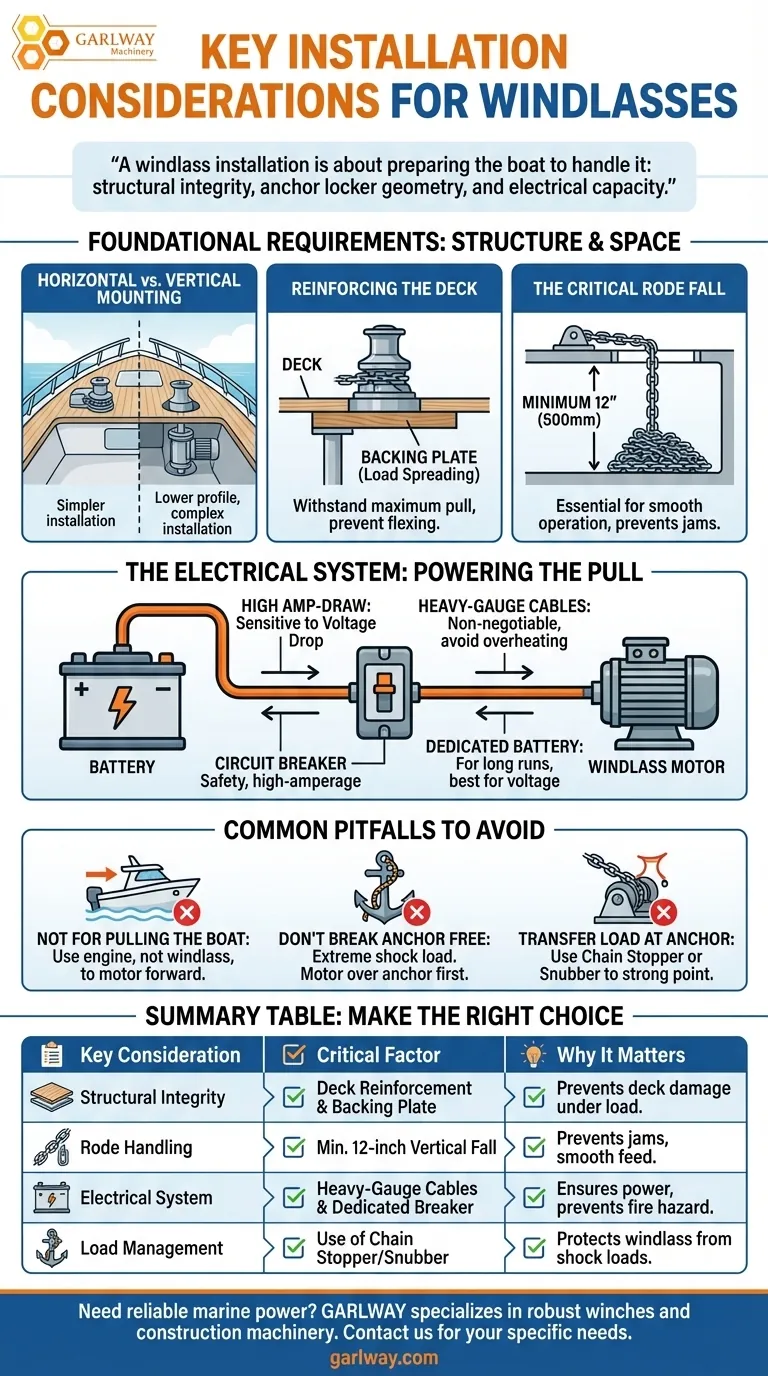
When installing a windlass, your primary considerations are the structural integrity of your deck, the geometry of your anchor locker, and the capacity of your electrical system. These three areas must be properly addressed to handle the immense loads a windlass places on the vessel.
A windlass installation is less about the device itself and more about preparing the boat to handle it. Success depends on reinforcing the mounting location to withstand high stress and providing a robust, dedicated electrical circuit to meet its significant power demand.

Foundational Requirements: Structure and Space
A windlass transfers the entire weight of your ground tackle—and often significant environmental loads—to a small section of your deck. Ensuring this area is prepared is the most critical step.
Horizontal vs. Vertical Mounting
Horizontal windlasses mount entirely on the deck, making the mechanical installation simpler. However, they have a larger footprint on deck.
Vertical windlasses have the motor and gearbox located below deck, requiring a significant hole to be cut. This results in a lower on-deck profile and a better 180-degree wrap of the rode around the gypsy, but demands more complex installation and sufficient space below.
Reinforcing the Deck
The deck under the windlass must be strong enough to withstand the maximum pulling power of the unit without flexing or cracking. Many production boat decks require reinforcement with a backing plate made of marine plywood, metal, or composite material to spread the load effectively.
The Critical Role of Rode Fall
For a windlass to feed the anchor rode properly, there must be a clear, unobstructed drop into the anchor locker. A minimum of 12 inches (or about 500mm) of vertical fall from the underside of the deck to the top of the rode pile is essential.
Without sufficient fall, the chain or rope will pile up, jam the hawsepipe, and prevent the windlass from operating correctly. This is a primary cause of windlass failure.
The Electrical System: Powering the Pull
Windlasses are one of the highest-demand electrical components on a boat, drawing anywhere from 35 to over 200 amps. An inadequate electrical system will starve the motor, leading to poor performance and creating a potential fire hazard.
Understanding High Amp-Draw
The high amperage draw means the windlass motor is highly sensitive to voltage drop. The entire electrical circuit, from the batteries to the windlass, must be designed to minimize this drop.
Correct Cable Sizing
Using heavy-gauge electrical cables is non-negotiable. The correct size depends on the windlass's amp draw and the total length of the wire run (positive and negative wires combined). Undersized cables will overheat and cause a significant voltage drop, reducing the windlass's pulling power.
The Necessity of a Circuit Breaker
A dedicated, high-amperage circuit breaker or fuse must be installed in the positive cable as close to the battery as possible. This is a critical safety device that protects the expensive motor and the boat's wiring from over-current damage.
Dedicated Battery Considerations
For long cable runs, such as from a stern battery bank to a bow-mounted windlass, installing a dedicated battery or battery bank in the bow is often the best solution. This dramatically shortens the high-amperage cables, ensuring the windlass receives adequate voltage.
Common Pitfalls to Avoid
A proper installation is only effective if the equipment is operated correctly. Understanding what a windlass is—and is not—designed to do is crucial for its longevity.
The Windlass is Not for Pulling the Boat
A windlass is designed to lift a dead weight (the anchor and rode), not to pull the boat forward against wind and current. Use your engine to motor forward, taking the strain off the windlass as you retrieve the rode.
Don't Break the Anchor Free
Never use the windlass to break a deeply set anchor out of the seabed. This places an extreme shock load on the gearbox and motor. Instead, motor the boat forward and over the anchor until the rode is nearly vertical, allowing the boat's momentum to gently break it free.
Transfer the Load at Anchor
The windlass shaft and gears are not designed to endure the constant, high shock loads of a boat swinging at anchor. Once anchored, the load must be transferred from the windlass to a chain stopper or a snubber tied to a strong point like a deck cleat.
Making the Right Choice for Your Installation
Your installation strategy should be guided by your boat's design and your primary goals for the system.
- If your primary focus is ease of installation: A horizontal windlass is often simpler as it avoids major below-deck work, but it requires adequate deck space.
- If your primary focus is a clean deck and optimal chain handling: A vertical windlass provides a lower profile and a better wrap around the gypsy, but it requires careful deck penetration and sufficient under-deck space.
- If your primary focus is safety and reliability: Prioritize a robust electrical system with correctly sized cables, a dedicated breaker, and a structural reinforcement plan for the mounting location, regardless of the windlass type.
A well-planned and executed installation transforms your anchoring process from a chore into a safe and reliable operation.
Summary Table:
| Key Consideration | Critical Factor | Why It Matters |
|---|---|---|
| Structural Integrity | Deck Reinforcement & Backing Plate | Prevents deck flexing/cracking under high load. |
| Rode Handling | Minimum 12-inch (500mm) Vertical Fall | Prevents jams and ensures smooth operation. |
| Electrical System | Heavy-Gauge Cables & Dedicated Breaker | Prevents voltage drop, ensures power, and protects against fire. |
| Load Management | Use of Chain Stopper/Snubber | Protects windlass from shock loads while at anchor. |
Need a reliable power source for your marine equipment? GARLWAY specializes in construction machinery, offering winches, concrete mixers, and concrete batching plants for construction companies and contractors globally. Our expertise in robust, high-demand systems ensures your projects run smoothly and efficiently. Contact GARLWAY today to discuss your specific needs and discover how our solutions can power your success.
Visual Guide
Related Products
- Quick Windlass Portable Winch for Truck and Boat Best Boat Winch
- Warn Winch Windlass Boat Trailer Winch
- Electric Hoist Winch Boat Anchor Windlass for Marine Applications
- Heavy Duty Electric Boat Winch Windlass Anchor
- 12000 lb Electric Boat Trailer Winch with Windlass Anchor Warn
People Also Ask
- What features were incorporated into the upgraded portable winch system? Boost Your Recovery Power & Safety
- What are some uses mentioned for portable winches beyond vehicle recovery? Essential Versatility for Property & Work
- How could the twisting issue with a portable winch be mitigated? Achieve Safe, Centered Pulls with Proper Rigging
- What are the primary uses of a portable winch for a truck? Boost Your Truck's Capability and Self-Reliance
- What is the single rope traction force of the quick winch without a pulley block? 0.5 to 40 Tons Explained


