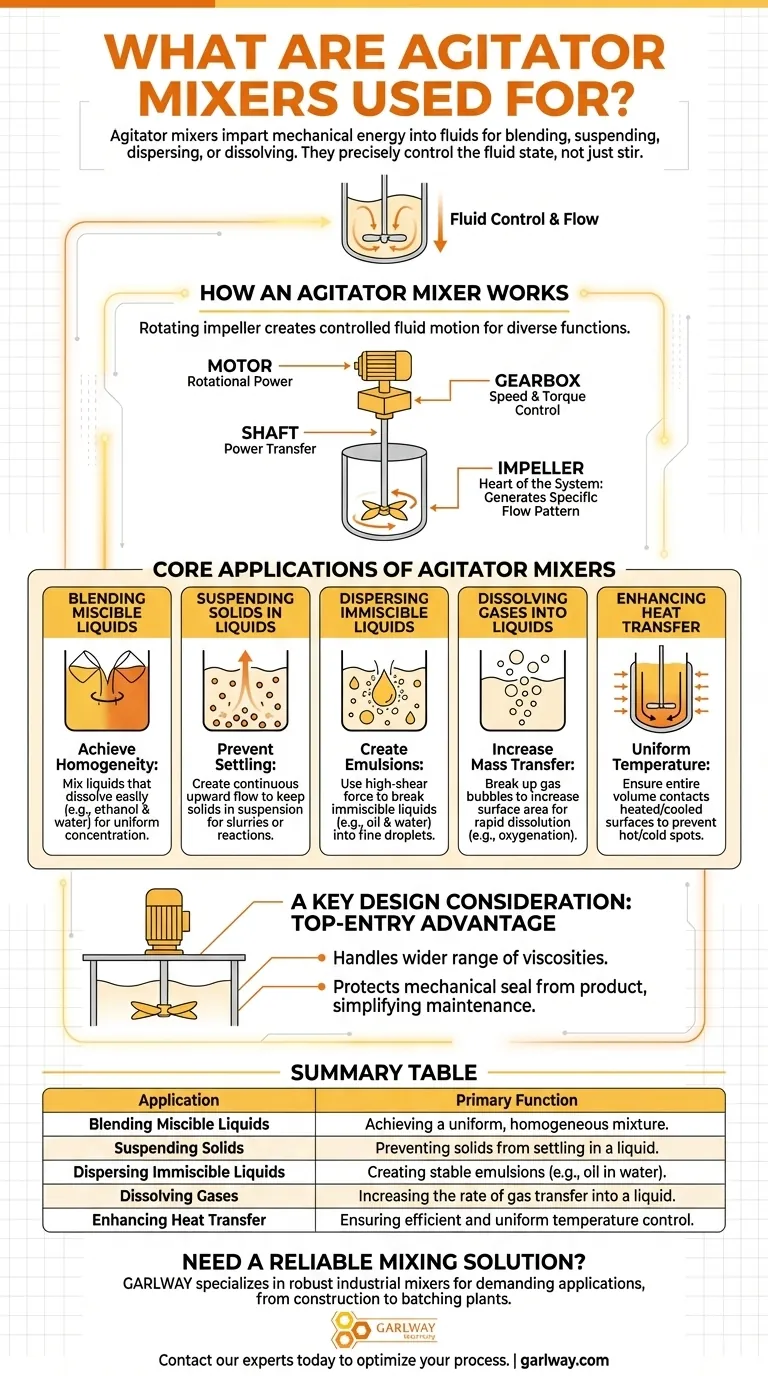
In short, agitator mixers are used for a wide range of industrial applications that require blending, suspending, dispersing, or dissolving substances within a liquid. Their primary function is to impart mechanical energy into a fluid to achieve a specific process goal, from creating a uniform mixture to enhancing chemical reactions.
The core purpose of an agitator mixer is not just to "stir" but to precisely control the physical state of a fluid system. It uses a rotating impeller to create the specific type of flow needed to blend liquids, keep solids from settling, or facilitate heat transfer.
How an Agitator Mixer Works
An agitator mixer's design is straightforward, consisting of a few key parts working in unison. Understanding these components clarifies its function.
The Core Components
A motor provides the rotational power, which is typically managed by a gearbox to control the speed and torque. This power is transferred down a shaft and into the liquid by a specially designed impeller.
The impeller is the heart of the system. Its shape and rotation speed are what generate the specific flow pattern required for the application.
The Principle of Operation
The rotating impeller creates fluid motion, which can be tailored for high flow (moving large volumes of liquid) or high shear (creating intense, localized mixing). This controlled motion is what enables the mixer to perform its diverse functions effectively.
Core Applications of Agitator Mixers
Agitator mixers are versatile tools used across many industries. Each application leverages a specific type of fluid motion generated by the impeller.
Blending Miscible Liquids
This is the most fundamental application, involving the mixing of two or more liquids that can easily dissolve into one another, like ethanol and water. The goal is to achieve homogeneity, ensuring the final product has a uniform concentration.
Suspending Solids in Liquids
When solids need to be kept from settling at the bottom of a tank, an agitator creates a continuous upward flow. This application is critical for creating slurries or ensuring that solid reactants remain available for a chemical reaction.
Dispersing Immiscible Liquids
For liquids that do not naturally mix, like oil and water, an agitator provides the high-shear force needed to break one liquid into fine droplets and disperse them throughout the other. This process is essential for creating emulsions.
Dissolving Gases into Liquids
Many processes require dissolving a gas into a liquid, such as oxygenation in a bioreactor. The agitator creates a large surface area by breaking up gas bubbles, dramatically increasing the rate of mass transfer from the gas to the liquid.
Enhancing Heat Transfer
In jacketed vessels, an agitator ensures that the entire volume of liquid comes into contact with the heated or cooled surface. This forced convection prevents hot or cold spots and makes temperature control far more efficient and uniform.
A Key Design Consideration
While agitators serve many purposes, their physical configuration has significant practical implications for maintenance and performance.
The Advantage of Top-Entry Design
Most industrial agitators are top-entry mixers, where the motor, gearbox, and shaft are mounted on top of the vessel. This configuration offers two major advantages.
First, it can handle a much wider range of fluid viscosities (thickness). Second, and more critically, it keeps the mechanical seal—a critical component that prevents leaks—out of the product being mixed. This protects the seal from abrasive or corrosive materials, simplifying maintenance and increasing reliability.
Making the Right Choice for Your Process
Selecting the right application for an agitator mixer depends entirely on the physical outcome you need to achieve in your fluid system.
- If your primary focus is a uniform solution: You are using the agitator for liquid-liquid blending.
- If your primary focus is to prevent solids from settling: Your application is solid suspension.
- If your primary focus is to create an emulsion like a lotion: You need the high shear required for liquid dispersion.
- If your primary focus is process efficiency: You are likely using the agitator to accelerate heat transfer or gas dissolution.
Ultimately, an agitator is a tool for precisely controlling the dynamics of a fluid to achieve a desired industrial result.
Summary Table:
| Application | Primary Function |
|---|---|
| Blending Miscible Liquids | Achieving a uniform, homogeneous mixture. |
| Suspending Solids | Preventing solids from settling in a liquid. |
| Dispersing Immiscible Liquids | Creating stable emulsions (e.g., oil in water). |
| Dissolving Gases | Increasing the rate of gas transfer into a liquid. |
| Enhancing Heat Transfer | Ensuring efficient and uniform temperature control. |
Need a reliable mixing solution for your construction or industrial project?
GARLWAY specializes in providing robust construction machinery, including industrial mixers for demanding applications. Whether you're a contractor needing a durable concrete mixer or an industrial company requiring a custom batching plant solution, our equipment is engineered for performance and longevity.
Contact our experts today to discuss how we can optimize your mixing processes and deliver the right machinery for your specific needs.
Visual Guide
Related Products
- Portable Electric Small Cement Mixer Concrete Machine
- Portable Concrete Mixer Machine Equipment for Mixing Concrete
- Portable Cement Mixer with Lift Concrete Machine
- Portable Electric Concrete Mixer Machine for Cement Mixing
- Portable Ready Mix Concrete Mixer Equipment
People Also Ask
- What is a portable cement mixer? Achieve Consistent, On-Demand Concrete Mixing
- What are the power sources for portable cement mixers? Choose the Right Power for Your Job Site
- What are the size and portability options for portable cement mixers? Find Your Perfect Match for Any Job
- What was the first recorded version of the portable concrete mixer and who invented it? Discover the 1904 Horse-Drawn Innovation
- How does a portable concrete mixer benefit construction projects? Boost Efficiency & Cut Costs On-Site