
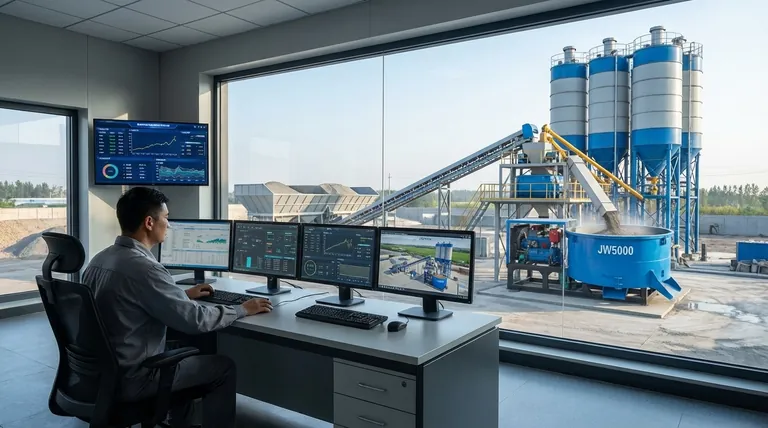
At its core, the control room and its main software are the brain and central nervous system of a concrete batching plant. They provide the centralized automation and intelligence needed to transform raw materials into a consistent, high-quality product by managing recipes, automating measurements, and monitoring the entire production cycle.
The fundamental role of the control system is to shift concrete production from a variable, manual-labor-intensive task to a highly precise, repeatable, and efficient industrial process. It is the key to guaranteeing quality while minimizing waste.
The Core Functions of the Control System
A modern control system is responsible for orchestrating every critical step of the batching process with digital precision. It replaces manual guesswork with automated, data-driven commands.
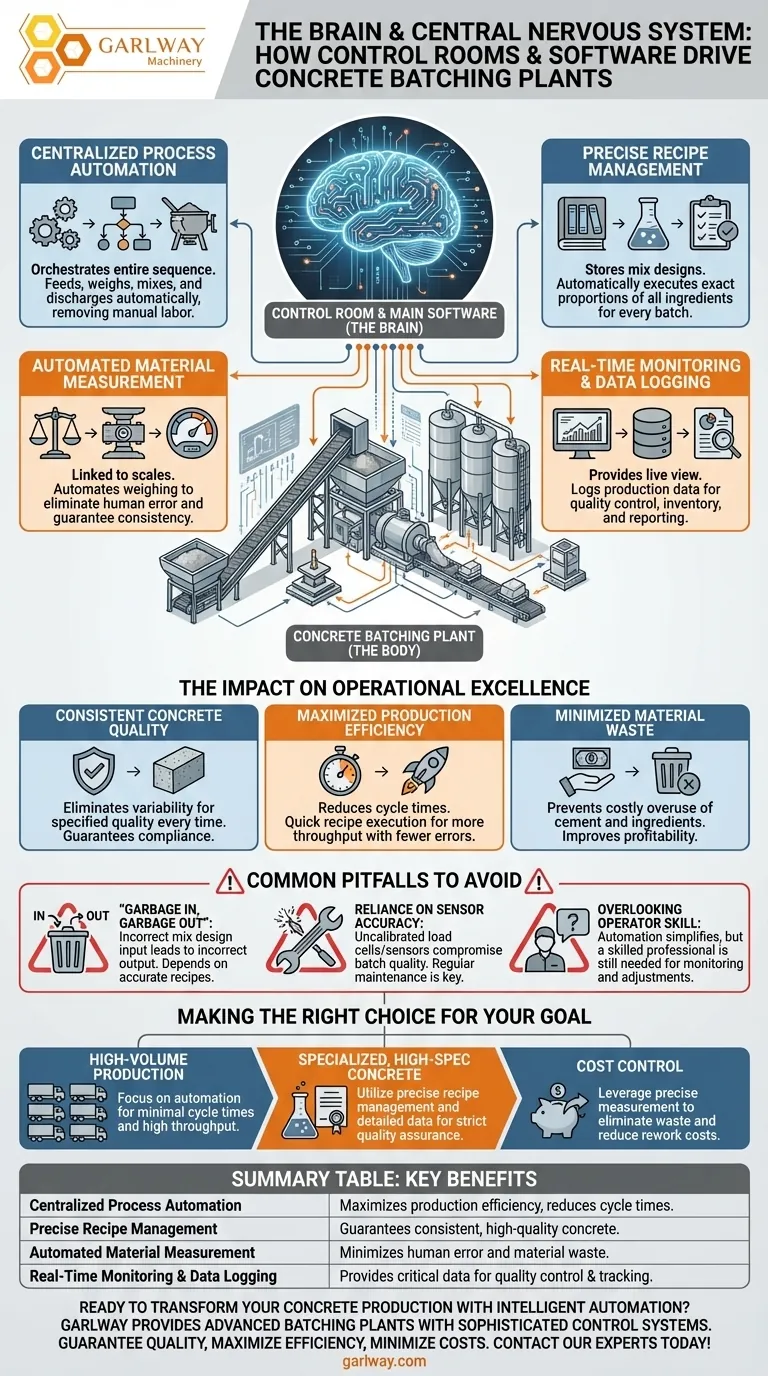
Centralized Process Automation
The software directs the entire operational sequence. This includes feeding aggregates and powders from storage bins, weighing each component, transferring them to the mixer, adding water and additives, and managing the mixing time before discharge.
Precise Recipe Management
The system stores predetermined mix designs, or "recipes," in its memory. Operators can select a specific recipe, and the software automatically executes it, ensuring the exact proportions of sand, aggregate, cement, water, and admixtures are used for every single batch.
Automated Material Measurement
To ensure accuracy, the control system is linked to scales and meters. It automates the weighing and measurement of all ingredients, a critical function that eliminates the potential for human error and guarantees batch-to-batch consistency.
Real-Time Monitoring and Data Logging
The control room provides operators with a live view of the entire plant's operation. The software also logs production data, which is invaluable for quality control, inventory tracking, and generating reports.
The Impact on Operational Excellence
By automating and centralizing control, the system delivers tangible benefits that are crucial for any modern construction project. The impact goes far beyond simple convenience.
Guaranteeing Consistent Concrete Quality
The system’s primary benefit is its ability to produce concrete of a consistent, specified quality every time. By precisely controlling mix parameters, it eliminates the variability that leads to weak or non-compliant concrete.
Maximizing Production Efficiency
Automation dramatically reduces the time required to complete a batch cycle. The ability to quickly call up recipes and execute them without manual intervention means more concrete can be produced in less time, with fewer errors.
Minimizing Material Waste
Precision is the enemy of waste. By ensuring the exact amount of each material is used, the control system prevents the costly overuse of cement and other expensive ingredients, directly improving the plant's profitability.
Common Pitfalls to Avoid
While powerful, the control system is a tool that depends on correct inputs and maintenance. Understanding its limitations is key to leveraging its full potential.
The "Garbage In, Garbage Out" Principle
The system's output is only as good as the recipes programmed into it. An incorrect mix design entered into the software will be executed perfectly, resulting in a perfectly produced batch of incorrect concrete.
Reliance on Sensor Accuracy
The entire system depends on accurately calibrated sensors, especially the load cells for weighing materials. If these sensors are not maintained and calibrated regularly, the software will operate on false data, compromising batch quality.
Overlooking Operator Skill
Automation simplifies tasks, but it does not eliminate the need for a skilled operator. A trained professional is required to monitor the system, perform quality checks, troubleshoot mechanical issues, and make informed adjustments when necessary.
Making the Right Choice for Your Goal
Leverage the control system by aligning its capabilities with your specific operational priorities.
- If your primary focus is high-volume production: Rely on the system's automation to minimize batch cycle times and use its production tracking features to monitor throughput.
- If your primary focus is specialized, high-spec concrete: Utilize the precise recipe management and detailed data logging to ensure every batch meets strict quality assurance standards.
- If your primary focus is cost control: Leverage the system's precise material measurement to eliminate waste and reduce the cost of rework by ensuring consistent quality.
Ultimately, the control system is what elevates a batching plant from a simple collection of machinery into a sophisticated and reliable production facility.
Summary Table:
| Function | Key Benefit |
|---|---|
| Centralized Process Automation | Maximizes production efficiency and reduces cycle times. |
| Precise Recipe Management | Guarantees consistent, high-quality concrete for every batch. |
| Automated Material Measurement | Minimizes human error and material waste. |
| Real-Time Monitoring & Data Logging | Provides critical data for quality control and inventory tracking. |
Ready to transform your concrete production with intelligent automation? As GARLWAY, a specialist in construction machinery, we provide advanced concrete batching plants with sophisticated control systems for construction companies and contractors globally. Our solutions are designed to guarantee your concrete quality, maximize your operational efficiency, and minimize material costs. Contact our experts today to discuss how our batching plants can meet your specific production goals!
Visual Guide
Related Products
- HZS120 Ready Mix Concrete Batching Plant Commercial Mud Cement Mixer
- HZS35 Small Cement Concrete Mixing Batch Plant
- HZS75 Concrete Batching Plant Cement Mixer Price Concrete Mixer Bunnings Mixing Plant
- HZS180 Ready Mix Concrete Plant for Foundations with Sand and Cement
- Commercial Electric Concrete Mixer Machine HZS 50 Small Batch Plant for Sale
People Also Ask
- What is a ready mix concrete batching plant? The Engine of Modern Construction
- What is the name of the machine used in ready mix? Unpacking the Complete Concrete System
- What is the core component of a concrete batching plant? The Mixer Unit Defines Your Concrete Quality
- What are the types of concrete mixers used in batching plants? Choose the Right Mixer for Your Project
- What are the advantages and disadvantages of concrete batching plants? Maximize Quality & Efficiency





