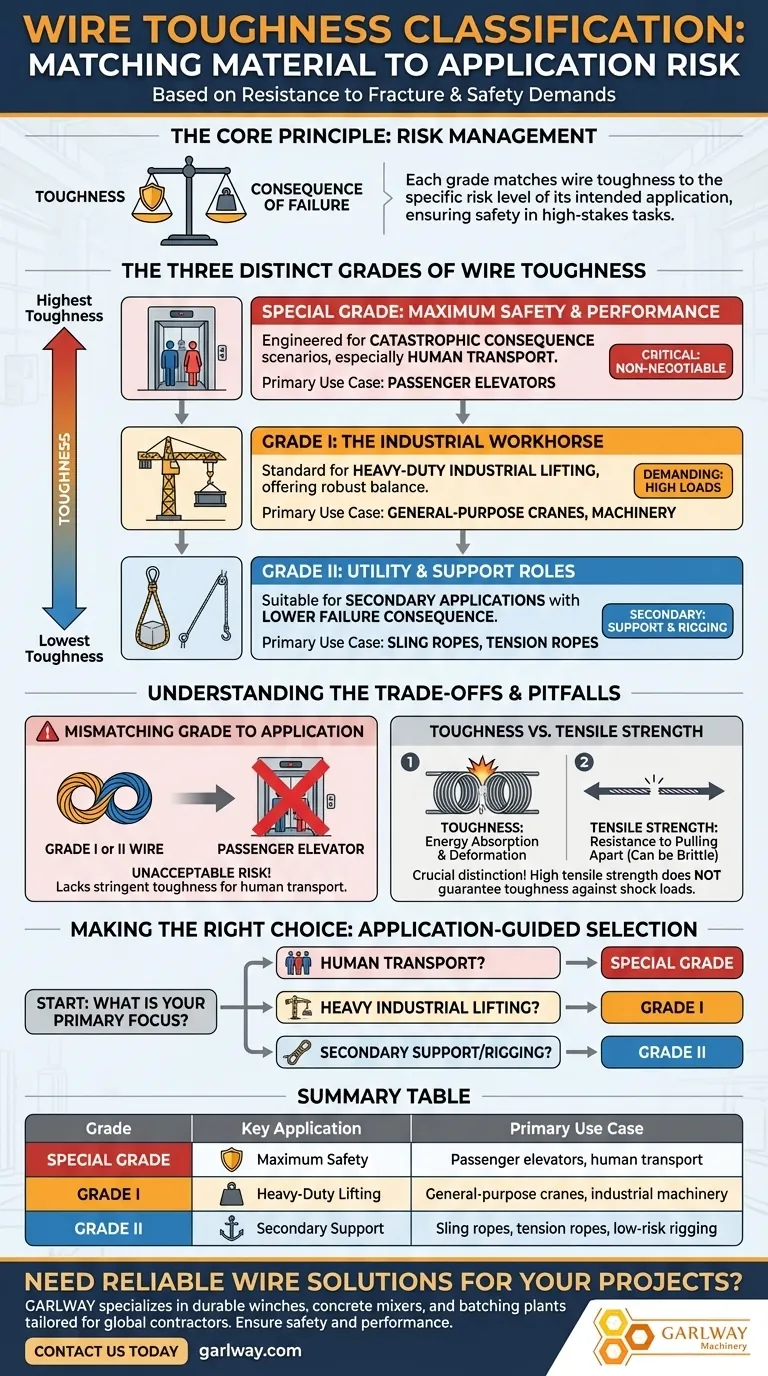
In industrial applications, wires are classified into three distinct grades based on their toughness, a measure of their ability to resist fracture. This system directly correlates the wire's material integrity with the safety and operational demands of its intended use, ranging from Special grade for the most critical tasks down to Grade II for secondary support roles.
The core principle behind wire classification is risk management. Each grade represents a specific level of toughness engineered to match the consequence of failure in an application, ensuring that the highest-risk tasks are supported by the most resilient materials.
The Three Grades of Wire Toughness Explained
Understanding these grades is fundamental to ensuring both safety and performance in any engineering or industrial project. Each classification corresponds to a specific set of applications where its properties are best suited.
Special Grade: Maximum Safety and Performance
This is the highest classification for wire toughness.
Special grade wires are engineered for applications where failure could have catastrophic consequences, particularly those involving human transport. The primary example is their mandated use in passenger elevators.
Grade I: The Industrial Workhorse
This grade represents the standard for most heavy-duty industrial lifting.
Grade I wires are designed for general-purpose cranes and other machinery where high loads are common. They offer a robust balance of toughness and durability for demanding, yet less critical, applications than human transport.
Grade II: Utility and Support Roles
This is the classification for wires used in less demanding scenarios.
Grade II wires are suitable for secondary applications. Their use is common for sling ropes and tension ropes, where the direct consequence of failure is significantly lower than in primary lifting systems.
Understanding the Trade-offs
Choosing the wrong wire grade is not a matter of simple inefficiency; it is a critical safety issue. The classification system exists to prevent the misuse of materials in applications they are not designed to handle.
Mismatching Grade to Application
The most significant pitfall is using a lower-grade wire for a high-risk task. For example, substituting a Grade I or Grade II wire in a passenger elevator system would introduce an unacceptable level of risk, as it lacks the stringent toughness properties of a Special grade wire.
Toughness vs. Tensile Strength
It is crucial to understand that toughness is not the same as tensile strength. While tensile strength measures a wire's ability to resist being pulled apart, toughness measures its ability to absorb energy and deform without fracturing. A wire can have high tensile strength but be brittle (not tough), making it unsuitable for applications with shock loads or repeated stress cycles.
Making the Right Choice for Your Application
Selecting the correct wire grade is a straightforward process when guided by the intended application and its associated risk.
- If your primary focus is human transport: Special Grade is the only acceptable choice due to its non-negotiable safety requirements.
- If your primary focus is heavy industrial lifting: Grade I provides the necessary toughness and reliability for general-purpose cranes and machinery.
- If your primary focus is secondary support or rigging: Grade II offers a functional and cost-effective solution where operational demands and risks are lower.
Properly matching the wire grade to the task is the foundation of a safe and reliable mechanical system.
Summary Table:
| Grade | Key Application | Primary Use Case |
|---|---|---|
| Special Grade | Maximum Safety | Passenger elevators, human transport |
| Grade I | Heavy-Duty Lifting | General-purpose cranes, industrial machinery |
| Grade II | Secondary Support | Sling ropes, tension ropes, low-risk rigging |
Need reliable wire solutions for your construction or industrial projects? GARLWAY specializes in construction machinery, offering durable winches, concrete mixers, and batching plants tailored for contractors and construction companies globally. Ensure safety and performance with the right equipment—contact us today to discuss your needs!
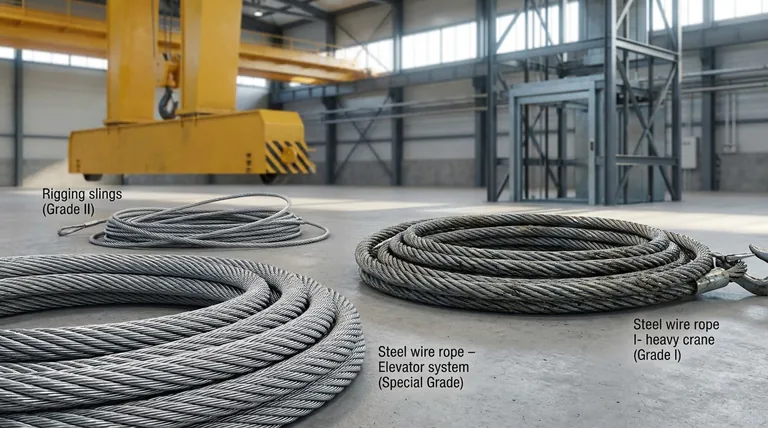
Visual Guide