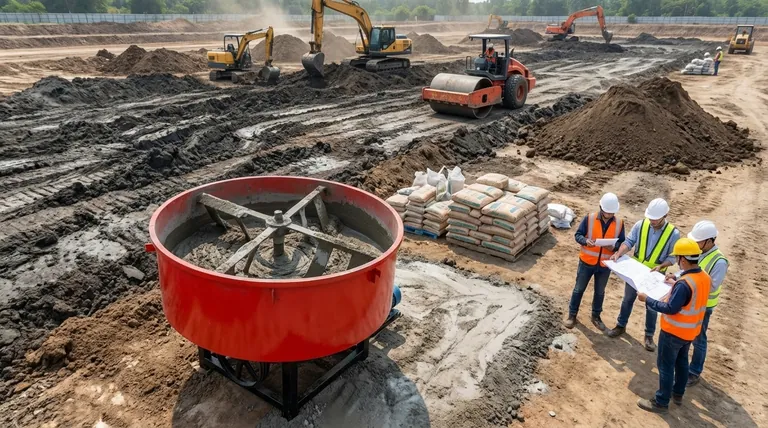
Building on weak or unstable soil can jeopardize structural integrity and increase long-term maintenance costs. Selecting the optimal soil improvement technique requires balancing soil type, project scale, budget constraints, and environmental factors. This guide provides a systematic approach to evaluating your site conditions and matching them with proven stabilization strategies—ensuring durable foundations while optimizing resource allocation.
Foundations on Low-Strength Soil: Challenges and Solutions
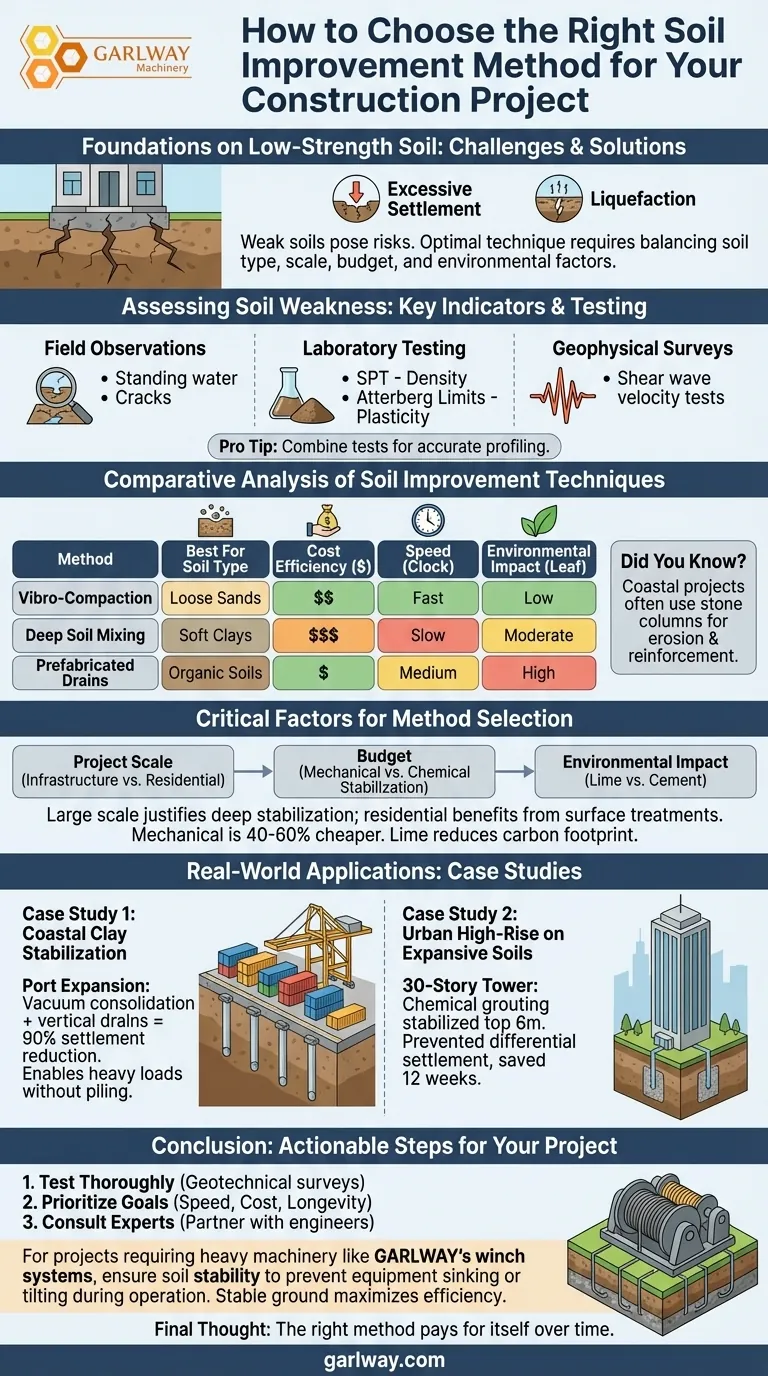
Weak soils—including loose sands, soft clays, and organic deposits—pose significant risks like excessive settlement or liquefaction during seismic events. Ever wondered why some structures remain stable while others develop cracks within years? The answer often lies beneath the surface.
Assessing Soil Weakness: Key Indicators and Testing Methods
- Field Observations: Look for standing water, surface cracks, or uneven vegetation growth.
-
Laboratory Testing:
- Standard Penetration Test (SPT) measures soil density.
- Atterberg Limits determine clay plasticity.
- Geophysical Surveys: Shear wave velocity tests identify subsurface anomalies.
Pro Tip: Combine multiple tests for accurate soil profiling.
Comparative Analysis of Soil Improvement Techniques
| Method | Best for Soil Type | Cost Efficiency | Speed | Environmental Impact |
|---|---|---|---|---|
| Vibro-Compaction | Loose Sands | $$ | Fast | Low |
| Deep Soil Mixing | Soft Clays | $$$ | Slow | Moderate |
| Prefabricated Drains | Organic Soils | $ | Medium | High |
Did You Know? Coastal projects often use stone columns to prevent saltwater erosion while reinforcing soil.
Critical Factors for Method Selection
- Project Scale: Large-scale infrastructure (e.g., highways) may justify expensive deep stabilization, while residential projects benefit from cost-effective surface treatments.
- Budget: Mechanical compaction is 40–60% cheaper than chemical stabilization but less effective for expansive clays.
- Environmental Impact: Lime stabilization reduces carbon footprint compared to cement-based methods.
Real-World Applications of Soil Improvement Strategies
Case Study 1: Coastal Clay Stabilization for Port Infrastructure
A port expansion in Southeast Asia faced soft marine clay with high water content. Engineers deployed vacuum consolidation combined with vertical drains, achieving 90% settlement reduction in 8 months. The solution enabled heavy container loads without costly piling.
Key Takeaway: For waterlogged soils, drainage accelerates consolidation.
Case Study 2: Urban High-Rise on Expansive Soils
In Texas, a 30-story tower on shrink-swell clay required chemical grouting to stabilize the top 6 meters. The method prevented differential settlement while allowing concurrent foundation work—saving 12 weeks in scheduling.
Conclusion: Actionable Steps for Your Project
- Test Thoroughly: Invest in geotechnical surveys to identify soil weaknesses.
- Prioritize Goals: Rank needs (speed, cost, longevity) to narrow technique options.
- Consult Experts: Partner with engineers experienced in your soil type.
For projects requiring heavy machinery like Garlway’s winch systems, ensure soil stability to prevent equipment sinking or tilting during operation. Stable ground isn’t just about safety—it’s about maximizing efficiency.
Final Thought: Would you risk a foundation failure to save 15% on soil prep? The right method pays for itself over time.
Visual Guide